





How Politics Helps Drive The Future Of Light-Duty Electric Power
Highway Funding and the New Political Calculus on Capitol Hill
The inauguration of Joe Biden as the 46th president, coupled with the Senate majority returning to Democratic control upon the swearing in of Vice President Kamala Harris, not only notched many historic “firsts,” but also instantly rewrote the calculus of policymaking and power-brokering on Capitol Hill.
January 27, 2021
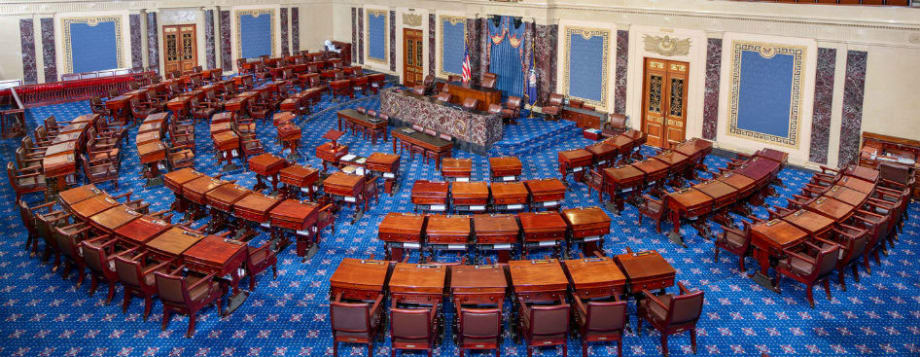
Rarely has the U.S. Senate been so evenly divided.
Photo: U.S. Senate
6 min to read
The inauguration of Joe Biden as the 46th president, coupled with the Senate majority returning to Democratic control upon the swearing in of Vice President Kamala Harris, not only notched many historic “firsts,” but also instantly rewrote the calculus of policymaking and power-brokering on Capitol Hill.
A momentous power shift in Washington happens after many elections. But this time around, the transfer of power was complex. It will force lobbyists, including the national associations that speak for trucking, to rewrite their game plans. While the House of Representatives retains its Democratic Party majority, instead of working to influence a government where Republicans control the White House and the Senate, lobbyists have to work with a Democrat in the Oval Office and Democrats in control of the Senate – albeit by the slimmest of margins.
Only three times before has the Senate been evenly split between the parties. When this happens, the vice president of the United States, in his or her role as president of the Senate, votes whenever a tie occurs. While Harris will formally serve as a tiebreaker, by tradition the Senate’s majority and minority leaders are left to work out how power will be shared in a 50-50 body.
The last time this happened was 20 years ago, after the 2000 election. At that time, Sens. Tom Daschle (D-S.D.) and Trent Lott (R-Miss.), who were known for enjoying a good working relationship, forged a deal that’s expected to be the model for Sens. Chuck Schumer (D-N.Y.) and Mitch McConnell (R-Ky.) to negotiate their own power-sharing agreement, formally known as an organizing resolution.
That resolution will take care of how the Senate will run day to day. For example, the 2001 agreement put an equal number of Democrats and Republicans on each committee and the parties received equal office space and budgets.
What no power-sharing deal can do, however, is make up for the lack of a clear majority that could help push legislation through quickly.
Playing from the Center
That already reads like a recipe for legislative log-jamming, and that’s without factoring in the power that six centrist, for lack of a better term, senators from both parties will wield in the 50-50 chamber: Democrats Joe Manchin from West Virginia, Jon Tester from Montana, and Krysten Sinema from Arizona, and Republicans Lisa Murkowski from Alaska, Susan Collins from Maine, and Utah’s Mitt Romney.
Although their ideologies do not neatly match up, all these politicians can be described as pragmatists who refuse to be boxed in by the hard-left or hard-right wings of their parties. In a sharply divided Senate, their clout as deal-makers who are comfortable meeting in the middle is expected to corral enough votes to wrangle contentious bills across the finish line.
That is not to say that senators in the minority won’t be tempted to filibuster to prevent a measure from being brought to a vote. A filibuster requires most bills to meet a 60-vote threshold to pass. On the other hand, the majority party is in a strong position to approve any motion that only requires a simple majority, such as confirming executive-branch appointments. However, should now-Minority Leader McConnell obstruct passage of President Biden’s agenda bill-by-bill, Democrats currently not in favor of killing the filibuster may rethink their position.
Also helping drive the president’s agenda will be Biden himself. The 46th president does have a popular-vote mandate, which affords him political capital to spend on pushing his policies. He also has the know-how to horse-trade and buttonhole votes in Congress, having served in various Senate leadership posts in his 36 years there. And through two terms as vice president for Barack Obama, he was charged with reaching compromises with another ace of the political game, Mitch McConnell. Then there’s Harris, who also knows her way around Capitol Hill having served as a senator for several years.
Action on Infrastructure
Given all that, the outlook this year for passing a significant infrastructure bill, which likely will incorporate changes in how highways are federally funded and provide incentives for greener cars and trucks, appears brighter than it has in a long time.
For one thing, Biden’s policy agenda calls for “a transformational investment in our country’s infrastructure and future” of $1.3 trillion over 10 years, which covers all sorts of infrastructure projects. More immediately, that plan will seek to spend, in just his first year in office, $50 billion “to kickstart the process” of repairing existing roads, highways, and bridges while boosting the economy.
Specific items in the plan include creating a national electric-vehicle charging network, modernizing the nation’s electric grid, and pushing to build a national high-speed rail network.
On the road side, Biden wants to increase federal funding for safety initiatives such as the Department of Transportation’s existing Highway Safety Improvement Program and encourage state and local governments to explore new technologies that can reduce accidents, including ‘smart’ pavement, vehicle-to-infrastructure communication, connected intersections, and other such innovations.
Also of direct interest to trucking is Biden’s call to invest $400 billion over 10 years in clean energy research and innovation. His plan seeks to develop a federal research program focused on reducing the cost of biofuels and increasing their energy density, while “developing more efficient engines that can power long-haul trucks, planes, and ships, to keep global commerce moving while reaching net-zero emissions by 2050.”
Paying for Infrastructure
The new administration is also keyed in on a policy change regarded throughout trucking as a must-have: addressing the “grossly underfunded” Highway Trust Fund. Biden wants to see it stabilized with new revenues – but has not outlined specifically how to do that. Raising the federal fuel tax would be one option, but other proposals include a vehicle-mile tax or a carbon tax on the use of oil, gas, and coal as fuel.
In practical terms, the trucking-related elements in the Biden policy plan may become law by way of the Senate adopting and/or modifying the $500 billion five-year “green” infrastructure bill passed by the House last year.
Dubbed the “Invest in America” Act, this bill would have funded highways and advance clean transportation efforts. But it also had other measures woven into it that trucking interests would aim to modify or eliminate if the Senate takes up the bill, such as:
Implement revised methodology for the Compliance, Safety, Accountability program
Return CSA scores to public view before federal regulators have finished their ongoing reform of the system
Delay implementing the more flexible hours-of-service rule (which went into effect after the bill was passed) until a comprehensive review is completed within 18 months (suggesting that HOS is not yet out of the legislative crosshairs)
Adjust the ELD personal conveyance guidance to require setting up specific mileage or time limits, or both.
To be sure, none of those proposed changes are set in stone. As American Trucking Associations President and CEO Chris Spear said in a statement last year when the bill was rolled out, while it boasts “significant investment in our country’s roads and bridges…. [and while] we may not agree on every provision therein, this is a real and commendable step… to advance the process in the House and ultimately arrive at a negotiable solution with the Senate.”
In short, there’s still a lot of negotiating and compromising to be done. But the House-passed bill, coupled with the Biden policy initiative, adds up to a solid starting point from which to mount a bipartisan campaign to drive desperately needed highway funding legislation across Capitol Hill and onto the White House for the president’s signature.
Jan. 29, 2021: Corrected to indicate Trent Lott was from Mississippi.
More Fleet Management

Sponsored•September 16, 2026
Color Match Smarter: Tools That Restore & Perform
For fleet managers and collision repair professionals keeping heavy-duty trucks on the road, getting the color right the first time isn't just about appearance — it's about efficiency, turnaround time, and bottom-line results. Discover how today's digital color tools are transforming the repair process from guesswork to precision.
Read More →
FMCSA Pauses Biennial-Update Enforcement Amid Motus Transition
Carriers whose updates were due on or after June 1 have more time, while FMCSA works to stabilize its new registration system and warns of phishing sites impersonating its new carrier registration system, Motus.
Read More →
Sponsored•September 14, 2026
2026 Blueprint for Countering Smarter Supply Chain Theft
Cargo theft is no longer just the cost of doing business. It's a multi-billion-dollar criminal enterprise exploiting vulnerabilities across your fleet, drivers, and supply chain.
Read More →


Sponsored•September 1, 2026
How Telematics Improves Visibility, Control, and Performance in Refrigerated Fleets
Explore how telematics help refrigerated fleets improve visibility, uptime, efficiency, compliance, and cargo protection across connected cold chain operations.
Read More →
What the U.S.-Canada Trade War Means for Trucking
Escalating U.S.-Canada tariffs could disrupt cross-border freight, reduce truck volumes, raise costs, and create new uncertainty for carriers on both sides of the border.
Read More →
What Are Trucking’s Top Concerns for 2026?
The American Transportation Research Institute wants to know what's worrying trucking fleet managers, drivers, and other stakeholders in its annual Industry Issues survey.
Read More →
American Trucking Associations Looks for a New Leader
ATA President and CEO Chris Spear abruptly left his job at the association on August 21, at a pivotal time for the trucking industry.
Read More →
Public Wi-Fi Cybersecurity Risks: How Truck Drivers and Fleets Can Protect Their Data
Public Wi-Fi can expose truck drivers and fleets to credential theft, malware, and other cyber threats. Here’s how to reduce the risk on the road.
Read More →
For Nicky Cupp, Fleet Innovation Starts With Frustration
HDT Truck Fleet Innovator Nicky Cupp turns everyday pain points at Fraley & Schilling into opportunities for better technology and smarter processes.
Read More →
Adam Buttgenbach’s Approach to Electric Trucks: Start With Where They Fit
HDT Truck Fleet Innovator Adam Buttgenbach helped PepsiCo build one of North America’s largest EV fleets by focusing on where electric trucks make operational sense.
Read More →