




Highway Conditions, Congestion Key Factors in Supply Chain Reliability
Improving the performance of the nation’s supply chain will require improvement to the conditions of U.S.’s network of roads and bridges, and a solution to highway congestion, according to a TRIP report.

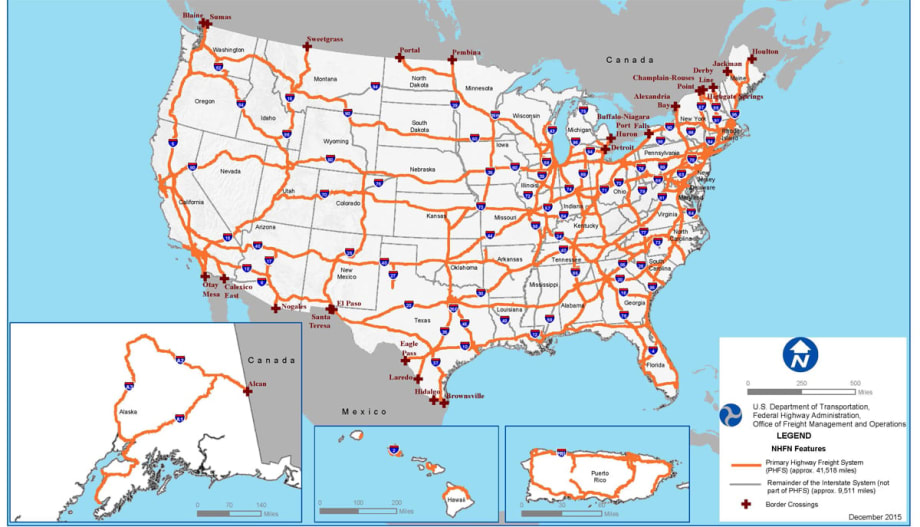
The National Highway Freight Network includes 47,279 miles of Interstate highways represent.
Map: USDOT Federal Highway Administration
Improving the performance of the nation’s supply chain will require improvement to the conditions of U.S.’s network of roads and bridges, and a solution to highway congestion, according to a TRIP report.
TRIP’s report — The U.S. Freight Network’s Critical Role in the Supply Chain — examines the latest information on the condition and reliability of the nation’s supply chain and the critical role of the U.S. freight transportation network in keeping the economy moving.
According to the report, which cited Texas Transportation Institute data, increasing traffic congestion resulted in a 77% increase in traffic delays for commercial trucks from 2000 to 2019, increasing from 219 million hours to 387 million hours.
Congestion on this network can cause unpredictable reliability, impact delivery times and costs, and hinder the delivery of goods, supplies and raw materials. This could in turn disrupt manufacturing supply chains and prolong the time it takes for customers to receive orders.
Decreased reliability also requires drivers to budget extra time, track routes in real time and make route adjustments to account for inconsistent travel times and delays. The inability to predict travel times may lead to delayed deliveries or schedule changes, which can increase the cost of freight operations or deliveries and result in lost pay to truck, TRIP officials said in the report.
The National Highway Freight Network, established by Congress in 2015, includes 47,279 miles of Interstate highways represent — the largest portion of the 57,994-mile network.
Improvement to this network will require an increase in investment since the condition of the network can greatly impact the delivery of goods, according to the report. TRIP cited a 2021 report from the U.S. Department of Transportation, which calls for a 55% increase over current levels of annual investment in roads, highways and bridges.
According to the report, 4% of bridges and pavement on the National Highway Freight Network are rated in poor condition.
Annually, 19.7 billion tons of freight are shipped to and from sites in the U.S. The majority of freight shipped in the U.S. are transported by trucks, which carry 72% of freight by value and 64% by weight annually. An additional 7% by value and 3% by weight are shipped annually by multiple modes, which includes trucks, according to the report.
TRIP is a nonprofit organization that researches, evaluates and distributes economic and technical data on surface transportation issues. TRIP is sponsored by insurance companies, equipment manufacturers, distributors and suppliers; businesses involved in highway and transit engineering and construction; labor unions; and organizations concerned with efficient and safe surface transportation.
More Fleet Management

Color Match Smarter: Tools That Restore & Perform
For fleet managers and collision repair professionals keeping heavy-duty trucks on the road, getting the color right the first time isn't just about appearance — it's about efficiency, turnaround time, and bottom-line results. Discover how today's digital color tools are transforming the repair process from guesswork to precision.
Read More →
FMCSA Pauses Biennial-Update Enforcement Amid Motus Transition
Carriers whose updates were due on or after June 1 have more time, while FMCSA works to stabilize its new registration system and warns of phishing sites impersonating its new carrier registration system, Motus.
Read More →
2026 Blueprint for Countering Smarter Supply Chain Theft
Cargo theft is no longer just the cost of doing business. It's a multi-billion-dollar criminal enterprise exploiting vulnerabilities across your fleet, drivers, and supply chain.
Read More →


How Telematics Improves Visibility, Control, and Performance in Refrigerated Fleets
Explore how telematics help refrigerated fleets improve visibility, uptime, efficiency, compliance, and cargo protection across connected cold chain operations.
Read More →
What the U.S.-Canada Trade War Means for Trucking
Escalating U.S.-Canada tariffs could disrupt cross-border freight, reduce truck volumes, raise costs, and create new uncertainty for carriers on both sides of the border.
Read More →
What Are Trucking’s Top Concerns for 2026?
The American Transportation Research Institute wants to know what's worrying trucking fleet managers, drivers, and other stakeholders in its annual Industry Issues survey.
Read More →
American Trucking Associations Looks for a New Leader
ATA President and CEO Chris Spear abruptly left his job at the association on August 21, at a pivotal time for the trucking industry.
Read More →
Public Wi-Fi Cybersecurity Risks: How Truck Drivers and Fleets Can Protect Their Data
Public Wi-Fi can expose truck drivers and fleets to credential theft, malware, and other cyber threats. Here’s how to reduce the risk on the road.
Read More →
For Nicky Cupp, Fleet Innovation Starts With Frustration
HDT Truck Fleet Innovator Nicky Cupp turns everyday pain points at Fraley & Schilling into opportunities for better technology and smarter processes.
Read More →
Adam Buttgenbach’s Approach to Electric Trucks: Start With Where They Fit
HDT Truck Fleet Innovator Adam Buttgenbach helped PepsiCo build one of North America’s largest EV fleets by focusing on where electric trucks make operational sense.
Read More →