




HDT Truck Fleet Innovators Talk Specs, Engines at Mid-America Fleet Forum
MATS, LOUISVILLE, KY -- A panel discussion of innovative fleet leaders Wednesday illustrated why one size does not fit all is not an approach that works well in the trucking industry.

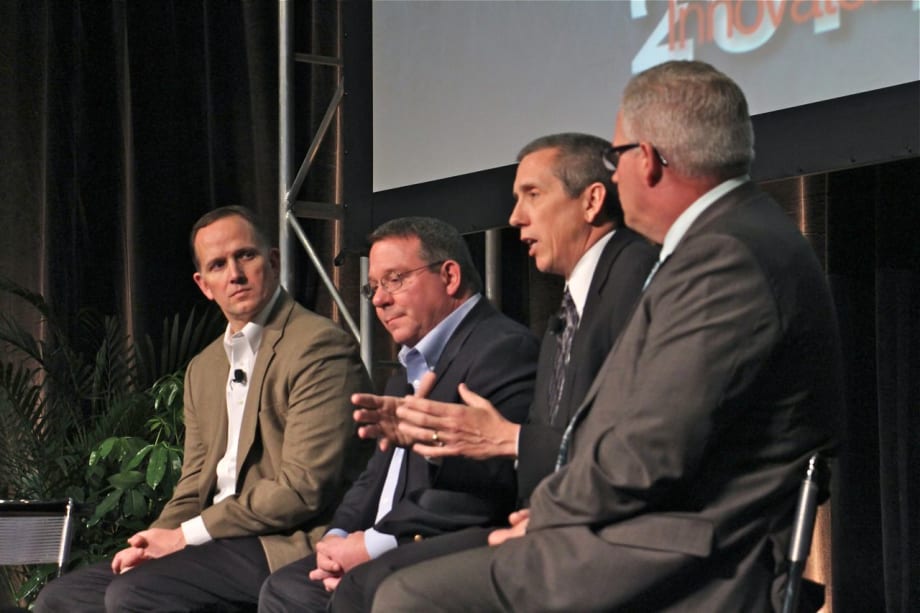
PepsiCo's Shelby Green (gesturing) talks about how his company is changing its beverage delivery using a 48-foot trailer with an automatic lift axle and robust liftgate specs. Photo: Evan Lockridge
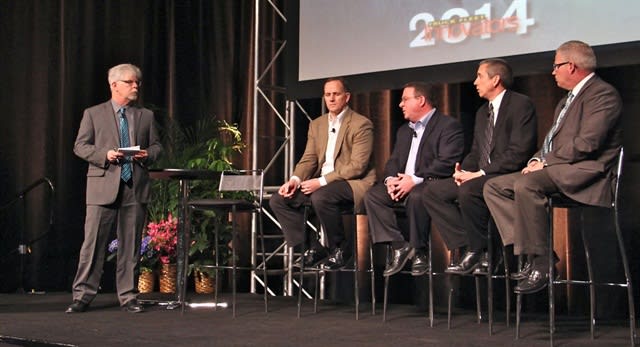
HDT Equipment Editor Jim Park, far left, hosts a panel of HDT's Truck Fleet Innovators, from left, Mike O'Connell, David Hoover, Shelby Green and Bill Bliem. Photo: Evan Lockridge
MATS, LOUISVILLE, KY -- A panel discussion of innovative fleet leaders Wednesday illustrated why one size does not fit all is not an approach that works well in the trucking industry.
HDT's 2014 Truck Fleet Innovators were honored during the Mid America Trucking Show Fleet Forum event, participating in a panel discussion on their perspectives on equipment.
The panel was moderated by Heavy Duty Trucking Equipment Editor Jim Park. When he asked the panel what drives the spec'ing procedure at their companies, operating costs were a the biggest concern.
"At the end of the day, while acquisition costs are important, I pay for that once," said Mike O'Connell, Senior Director, Supply Chain Fleet for Frito-Lay. With some route trucks that are 15 years old, he said, "operation cost becomes very important for total cost of ownership."
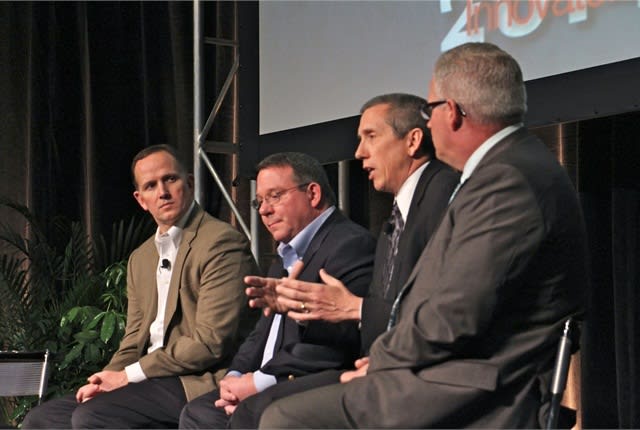
PepsiCo's Shelby Green (gesturing) talks about how his company is changing its beverage delivery using a 48-foot trailer with an automatic lift axle and robust liftgate specs. Photo: Evan Lockridge
For Shelby Green, Senior Fleet Director for PepsiCo North America Beverages, spec'ing is a very deliberate, team process.
"You only get the chance once to spec something you want to call standard, so we take a very deliberate approach to it," he said, looking at things such as total life costs and serviceability. "Most of all in today's world … we really have to look at how to we spec something so it become more productive, more ergonomic, more driver friendly."
Bill Bliem, Senior Vice President, Fleet Services for New Jersey-based NFI, was asked about whether as a for-hire fleet, purchase cost was more important than it was for the private fleets that made up the rest of the panel.
"I have some suppliers that will disagree with me," he said to an audience chuckle, "but it's not all about price. Really for us there's four things that drive the decision: Driver comfort, fuel efficiency, weight, and durability. We try to standardize across our fleet the same axles, the same transmissions, but we're constantly improving on what we call our standard spec. As technology evolves we're changing our standard spec once or twice a year."
For David Hoover, Director, Outbound Logistics for Michigan-based supercenter chain Meijer, the higher weights allowed in the state make a big difference in many specs. For instance, he said, the fleet tested tractors powered by 12-liter natural gas engines, but found the higher weights created too much of a fuel economy penalty.
Some of the other Innovators, however, are expanding their natural gas fleets. NFI, for instance, currently has about 25 units and is adding another 30 this summer. They have found that to get the desired return on investment, the trucks need to run at least 140,000 miles a year, which they are doing in their Texas LNG fleet with a slip seat operation.
Frito-Lay has more than 200 natural gas units in its over the road fleet, mostly using the 9-liter Cummins but implementing the new 12-liters now.
"We're an out-and-back fleet so I really only need one fuel station near my facility," he said. "30% of fleet on the tractor side will be natural gas this year after we finish deployment."
Diesel engines, of course, are still the mainstay.
At NFI, about 75% of the fleet is EPA 2010 engines. "We went both routes with both technologies," Bliem said. "They both have good fuel improvement, one had much better maintenance costs. The first real issues we're having with SCR was this winter in the subfreezing temperatures. We started seeing a lot of derates, we had DEF freezing up on us, especially up in Chicago, Wisconsin, Canada."
Bliem and O'Connell both mentioned that the EPA 2010 engines are now getting to the point where the emissions systems need maintenance.
Meijer was one of the first fleets in the country to go with EPA 2010-emissions engines, and did a lot of pre-production testing and validation in partnership with Detroit. Now Hoover is upgrading to the GHG 2014 fuel-efficient engines; about 30% of the fleet currently has them, and Hoover reported "a drastic fuel economy jump."
More Fuel Smarts

How Volvo Updated Its D13 for EPA 2027 [Watch]
Volvo’s updated D13 promises lower emissions without sacrificing performance or fuel economy. Take a closer look at what changed inside the engine in this HDT Spotlight video.
Read More →
Diesel Price Spike Shortens Payback for Natural Gas Trucks, Report Says
Energy Vision estimates fleets could recover the higher purchase price of an RNG-fueled Class 8 tractor in 1.3 to 2.8 years under current fuel-price scenarios.
Read More →
Calstart Becomes Catalyst Mobility, Reflecting Broader Focus
Calstart is now Catalyst Mobility, reflecting the nonprofit’s growing national role in clean transportation, including zero-emission trucks, infrastructure and incentive programs.
Read More →

Record Diesel Prices Squeeze Trucking Fleets
Average U.S. diesel prices have climbed to nearly $6 a gallon, surpassing the 2022 record as tight refinery capacity and Middle East disruptions keep fuel costs elevated.
Read More →
How Fuel Delivery Shapes Engine Performance
Fuel delivery depends on more than what happens at the injector. For fleet, maintenance and technical professionals, looking at the full path from pump to injector can provide useful context for understanding engine performance.
Read More →
East Coast Port Launches $45M Electric Truck Push
The Port Authority of New York and New Jersey announced millions in incentives for zero-emission drayage trucks, yard tractors, and new charging hubs near the port.
Read More →
California Bill Could Shed Light on Electric Truck Prices
Why do battery-electric Class 8 trucks remain so expensive? A California bill headed to Gov. Gavin Newsom would give fleets and state agencies more visibility into what manufacturers charge.
Read More →
Detroit Opens Orders for EPA 2027 Engines
Detroit isn’t starting from scratch to meet EPA 2027 diesel emissions standards. Its Gen 6 DD13 and DD15 engines keep much of today’s platform while updating the fuel and aftertreatment systems.
Read More →
Zero-Emission Truck Corridor Planned for West Coast
California, Oregon, Washington, British Columbia and Baja California are coordinating plans for truck charging and hydrogen fueling from Canada to Mexico.
Read More →
A Closer Look at Kenworth’s Electric T880E Vocational Truck [Video]
Learn more about Kenworth's T880E battery-electric vocational truck at the Paccar Technical Center, including its range, applications, upfitting considerations, and PTO options, in this HDT Spotlight video.
Read More →