





More from Run on Less Electric — Electric Terminal Tractors: Stepping-Stone to a New Era?
Half of all Regional-Haul Trucks Could Go Electric Now
Nearly 470,000 Class 8 regional-haul trucks could convert to battery-electric technology today with no loss in productivity or efficiency, according to a report from the North American Council for Freight Efficiency.
May 5, 2022
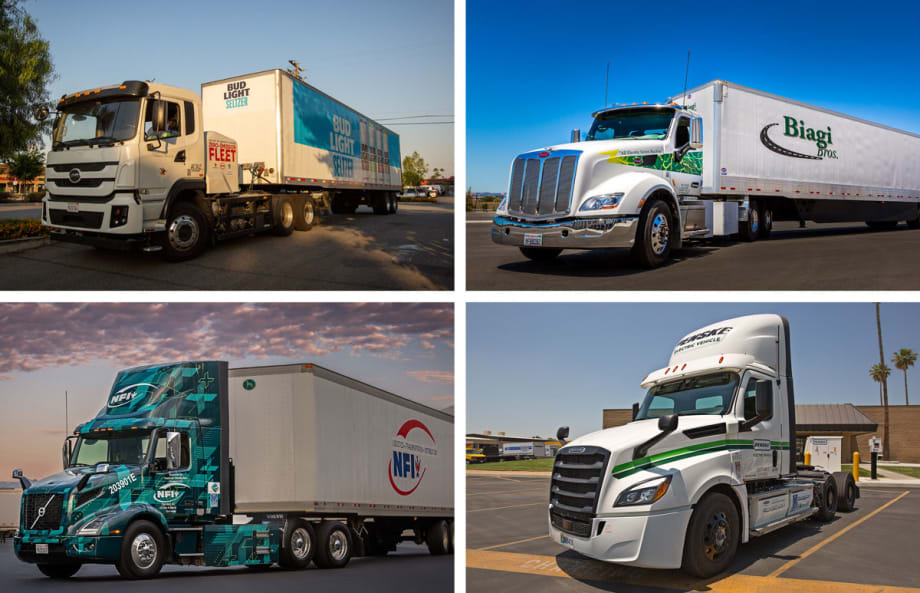
NACFE's Run on Less Electric evaluated many kinds of battery-electric vehicles, including regional-haul.
Photo: NACFE
4 min to read
Roughly half of all U.S. and Canadian Class 8 tractors engaged in regional-haul applications could switch to battery-electric technology today with minimal or no impact on operations, productivity, or efficiency, according to a new report.
The North American Council for Freight Efficiency’s new report, “Electric Trucks Have Arrived: The Case for Heavy Duty Regional Haul Tractors,” is based on findings from NACFE’s Run on Less Electric vehicle evaluation trials completed last year.
Run on Less Electric evaluated the performance of various light-, medium-, and heavy-duty electric trucks in real-world operations around the country to gain insights into how well the trucks performed compared to conventional diesel-powered units.
Based on that study, NACFE considers short and medium regional heavy-duty tractors electrifiable today, explained NACFE Executive Director Mike Roeth during an online press briefing on May 5. These trucks have a range of about 200 miles and improving total cost of ownership when monetizing all benefits, despite about 3,000 to 4,000 pounds of freight capacity penalty compared to diesels. Regional haul tractors perform in various duty cycles, including out-and-back, hub-and-spoke and diminishing return.
Battery-electric tractor models currently available could meet the needs of about 50% of this market segment, or an estimated 468,782 power units.
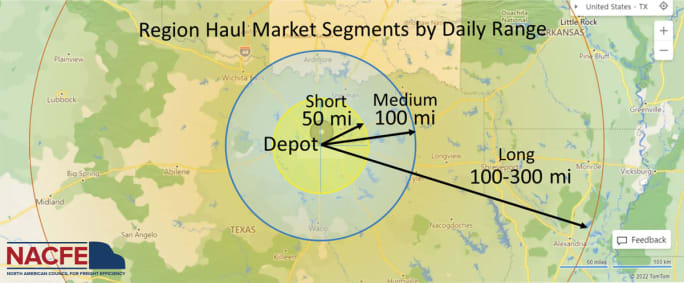
NACFE considers short and medium regional applications electrifiable today, with BEV versions having a range of about 200 miles.
Source: NACFE
“Regional haul is really interesting when it comes to electric trucks,” Roeth added. “In 2019, NACFE concluded that the regional-haul operational model is really good for trucking. That’s because the trucks return to base every night — which is what drivers want. So, we’re seeing a lot of technology converge around regional haul today to make freight more predictable. And we’re seeing a lot of dedicated, regional-haul businesses grow rapidly with well-known national carriers like J.B. Hunt, Schneider and others moving into this market segment.”
Because many regional-haul tractors return to base daily, fleets can have more confidence about making investments in charging infrastructure, he said. Just as important, these trucks often have at least 10 hours of overnight dwell time for charging.
“Many people mistakenly assume Class 8 heavy-duty tractors are used in mostly long-haul disparate routes,” Roeth said. “But, in fact, only 40% are used in long-haul, and 30% are vocational trucks and regional haul tractors respectively. These regional-haul tractors are good candidates for electrification due to their shorter daily distances and return to base operation.”
Regional EV Operational Challenges and Considerations
NACFE found that operational changes, such as the choices of the truck for each daily route, en route opportunity charging, driver incentives and managed charging, are all examples of actions to improve the total cost of ownership of heavy-duty regional-haul BEVs. As a result, many actions and technologies are emerging to improve the TCO of operating electric vehicles in this market segment, many having to do with increasing range. Roeth noted that batteries are expensive and heavy, so fleets can reduce the up-front cost by taking actions to extend the range. Others include lowering costs with tactics such as charging during off-peak hours.
“We also found a critical relationship between freight and weight that fleets considering electric, regional-haul trucks must consider,” Roeth added. NACFE previously found that for every 10,000 lbs. of payload added to a diesel truck, it loses 0.5 mpg. “And one of the biggest insights for us in this study is that there is a similar weight tradeoff for battery-electric trucks as well. That’s because each additional 10,000 lbs. in payload on those vehicles results in a corresponding loss of overall daily range.” However, Roeth noted that many shorter, 50-to-100-mile, regional haul routes typically carry heavier payloads than trucks working on 200- to 300-mile daily routes. “And these are issues that can be controlled by fleets to ensure maximum performance from the trucks.”
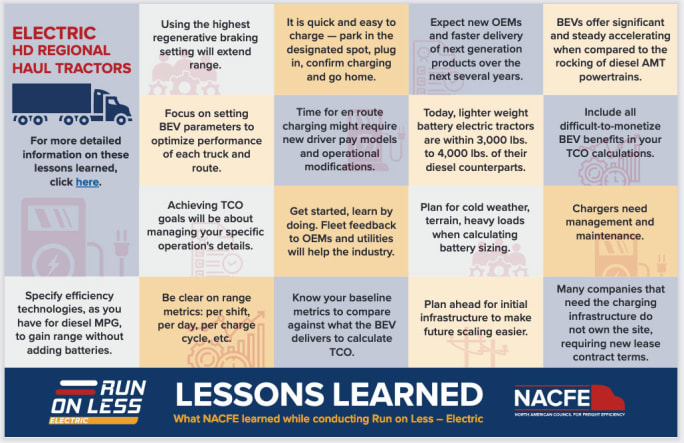
NACFE found that operational changes, such as the choices of the truck for each daily route, en route opportunity charging, driver incentives and managed charging, are all examples of actions to improve the total cost of ownership of heavy-duty regional-haul BEVs.
Source: NACFE
Roeth also called out the drivability (particularly in getting up to speed), quietness, and other aspects that make electric trucks attractive to drivers. Drivers of all sizes of electric vehicles shared how much they like the driving experience compared to internal combustion engines. For regional-haul driving much time is spent accelerating to highway speeds, and this specific aspect of day cab electric tractors definitely will help attract and retain drivers in this segment, he said.
“For me, this a lot like when automated transmissions came into trucking,” Roeth said. “The drivers liked them immediately, and they very quickly became the dominant transmission in the industry. I think we’re just at the beginning of this movement with electric trucks — and more, dramatic improvements are coming. In fact, I believe electric trucks are going to be the biggest positive/attraction for drivers — more than anything else I’ve seen in my career.”
As Run on Less – Electric concluded in September 2021, NACFE predicted that 70% of this market segment was electrifiable. “But now, given the more detailed analysis, interviews with industry experts and further research for this report, we now consider this market segment to be 50% electrifiable with lower average daily miles,” Roeth said. “And if that were to happen, we would see a reduction in nearly 29.4 million metric tons of CO2e annually (e equals carbon dioxide equivalent). NACFE estimates the entire CO2e to be eliminated by this segment at an average of 250 miles per day to be 97.8 million metric tons.”
Download the NAFCE Executive Summary: “Electric Trucks Have Arrived: The Case for Heavy Duty Regional Haul Tractors.”
More Fuel Smarts

How Volvo Updated Its D13 for EPA 2027 [Watch]
Volvo’s updated D13 promises lower emissions without sacrificing performance or fuel economy. Take a closer look at what changed inside the engine in this HDT Spotlight video.
Read More →
Diesel Price Spike Shortens Payback for Natural Gas Trucks, Report Says
Energy Vision estimates fleets could recover the higher purchase price of an RNG-fueled Class 8 tractor in 1.3 to 2.8 years under current fuel-price scenarios.
Read More →
Calstart Becomes Catalyst Mobility, Reflecting Broader Focus
Calstart is now Catalyst Mobility, reflecting the nonprofit’s growing national role in clean transportation, including zero-emission trucks, infrastructure and incentive programs.
Read More →

Record Diesel Prices Squeeze Trucking Fleets
Average U.S. diesel prices have climbed to nearly $6 a gallon, surpassing the 2022 record as tight refinery capacity and Middle East disruptions keep fuel costs elevated.
Read More →
Sponsored•September 9, 2026
How Fuel Delivery Shapes Engine Performance
Fuel delivery depends on more than what happens at the injector. For fleet, maintenance and technical professionals, looking at the full path from pump to injector can provide useful context for understanding engine performance.
Read More →
East Coast Port Launches $45M Electric Truck Push
The Port Authority of New York and New Jersey announced millions in incentives for zero-emission drayage trucks, yard tractors, and new charging hubs near the port.
Read More →
California Bill Could Shed Light on Electric Truck Prices
Why do battery-electric Class 8 trucks remain so expensive? A California bill headed to Gov. Gavin Newsom would give fleets and state agencies more visibility into what manufacturers charge.
Read More →
Detroit Opens Orders for EPA 2027 Engines
Detroit isn’t starting from scratch to meet EPA 2027 diesel emissions standards. Its Gen 6 DD13 and DD15 engines keep much of today’s platform while updating the fuel and aftertreatment systems.
Read More →
Zero-Emission Truck Corridor Planned for West Coast
California, Oregon, Washington, British Columbia and Baja California are coordinating plans for truck charging and hydrogen fueling from Canada to Mexico.
Read More →
A Closer Look at Kenworth’s Electric T880E Vocational Truck [Video]
Learn more about Kenworth's T880E battery-electric vocational truck at the Paccar Technical Center, including its range, applications, upfitting considerations, and PTO options, in this HDT Spotlight video.
Read More →