




Going Up: What’s Driving Trucking Forward
At the FTR Transportation Conference, speaker after speaker attempted to capture just how hard-galloping the economy is and the positive if head-spinning impact that is having on the market for moving freight.

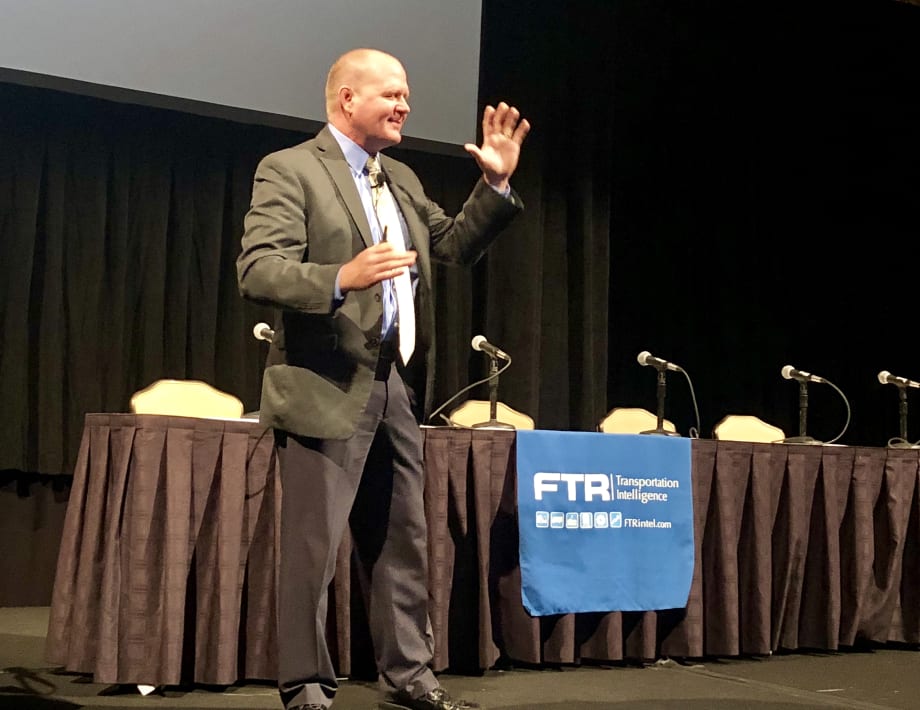
FTR's Eric Starks kicking off a session at the FTR Conference in Indianapolis in September.
David Cullen
A rising tide may float all boats, but it won’t ever be handing out free lunches. You have to work smart to get those. That thought came to mind while attending the FTR Transportation Conference, held in Indianapolis from Sept. to 11-13, where speaker after speaker attempted to capture just how hard-galloping the economy is and the positive if head-spinning impact that is having on the market for moving freight.
On hand to help attendees set an informed course in light of prevailing economic winds, was conference keynoter William Strauss, senior economist for the Federal Reserve Bank of Chicago. He said that the U.S. gross domestic product expanding 29% over the past year and several key growth indicators running “above trend” this year “suggest that [such a degree of] acceleration will be hard to maintain, but [we’re] still far away from recession.”
Strauss stressed that “we’re still in the second largest economic expansion in U.S. history, noting that growth this year is forecast to come in just under 3%. Then he allowed that “it’s possible to get a 3% or a 4% economic rise, but rhetorically asked if such rises are sustainable.
“Next year, the economy will moderate to around 2% and then in 2020, will be at a trend-line level.” He added that the Fed is “suggesting that economic gains will moderate by 2020.”
Strauss playfully called this period of “moderate and steady growth” that we’re in a “tortoise recovery,” given that “this expansion has had half the growth compared to prior recoveries.” He said a moderate but steady economic pace also means there’s little chance of “jackrabbiting” growth in some sectors, which can give economists pause.
The economy may be settling down some over the next two years, but Strauss was adamant that that does not mean a downturn is in sight. He said considering how long this expansion has been going, “some people will foolishly say we’re due for a recession. But no matter what I tell you today, and no matter how optimistic I may leave you, you’re not going to go back and put your feet up on the desk and say, ‘I’ve made enough money. I can just chill.’ That’s not how economies operate.”
He said the “risk of recession is low and has moved lower, even looking two quarters out.” In addition, with growth running above 2%, even a “shock to the system,” such as a terrorist attack, that cut GDP down by 2% would still allow for economic growth.
“The economy, because of the balance we appear to be in, has an opportunity to continue to expand at pace,” Strauss summed up. Given that, he said “we’re looking at a potential record expansion.”
Reflecting the continued strength of the economy are the “surging” orders for new trucks and trailers, said Don Ake, vice president of commercial vehicles for FTR.
“Class 8 net orders are at historically high levels,” said Ake. “Four of the top five order months ever have occurred this year. He added that Class 8 truck orders in 2018 are outpacing the 2011-2017 average.
Orders are also “much higher” than in high-flying 2015— but this year’s retail sales are only tracking those of 2015. “So, what’s wrong with retail sales? It comes down to supplier issues,” said Ake, “which made for a clog in the supply chain. Trucks couldn’t been built fast enough.
“That’s been alleviated some in the past few months” as suppliers have begun to catch up with OEM orders, he continued. “It was severe and now it has improved to where it is just very bad. But now there’s a new clog. They cannot get new trucks to dealers and customers fast enough because there are not enough drivers. Ake added, with a smile, that “the trucking industry is constraining itself.”
Ake noted that “as orders fill up, the OEMs may run out of [production] capacity this fall, but it will still end up a record year.” In terms of hard numbers, FTR is pegging Class 8 production to come in at 315,000 units this year and then rising to 340,000 next year.
“To get there, suppliers will have to supply,” said Ake. If they can ramp up, he said the 340,000 forecast for 2018 might come in higher. Looking further out, he said to expect production to drop to 280,000 units in 2020, to 250,000 in 2021, and to 245,000 units in 2022.
As for trailers, they are humming along, too. FTR is projecting a trailer build of 310,500 units this year, which equals an 85,000-unit increase from its projections in 2016. Ake said the trailer orders are being pushed up by higher GDP growth, industrial production, and truck loadings.
Trailer makers have also been dealing with production issues. Ake said supply-chain disruptions hit trailers earlier, but not as severely as trucks. He said that trailer issues arising in mid- winter were resolved by July. Not surprisingly, the biggest one is very familiar to many of trailer customers: Suppliers were having trouble hiring more workers quickly in this high-employment economy.
Eric Starks, FTR chairman and CEO, said that near-term freight demand together with continued economic growth “could hold demand higher as we move into 2019.” He said that it’s crucial to grasp the cyclical nature of the market so participants can “identify when the fundamentals will shift.”
Starks said “risk factors” for the economy have been growing in the past 12 months, chief among them being “political uncertainty, leading to concern over U.S. isolationism and trade wars” by American consumers.
He said there is also concern about NAFTA being renegotiated, but advised that “the biggest concern we’re starting to see is wage inflation, but we’re not yet seeing that in the data. “There are more jobs now than people looking for them,” so wage inflation bears watching going forward.
Turning specifically to trucking, Starks said that truck freight levels are “showing strong growth,” both in terms of the ATA Truck Tonnage Index and the FTR Truck Loadings Index. “The overall trend is up.” Not surprisingly then, he noted that total truckload rates— including spot and contract, but without fuel surcharges— are “showing “strong increases.”
More Fleet Management

Nominations Open for HDT Emerging Leaders
Heavy Duty Trucking is looking for accomplished trucking fleet professionals under 40 who are making an impact and helping lead the industry forward.
Read More →
Why Private Fleets Are Taking More Freight
Private fleets are putting their own trucks on demanding customers and high-cost lanes as companies seek greater control over service, costs, and capacity.
Read More →
Color Match Smarter: Tools That Restore & Perform
For fleet managers and collision repair professionals keeping heavy-duty trucks on the road, getting the color right the first time isn't just about appearance — it's about efficiency, turnaround time, and bottom-line results. Discover how today's digital color tools are transforming the repair process from guesswork to precision.
Read More →


FMCSA Pauses Biennial-Update Enforcement Amid Motus Transition
Carriers whose updates were due on or after June 1 have more time, while FMCSA works to stabilize its new registration system and warns of phishing sites impersonating its new carrier registration system, Motus.
Read More →
2026 Blueprint for Countering Smarter Supply Chain Theft
Cargo theft is no longer just the cost of doing business. It's a multi-billion-dollar criminal enterprise exploiting vulnerabilities across your fleet, drivers, and supply chain.
Read More →
How Telematics Improves Visibility, Control, and Performance in Refrigerated Fleets
Explore how telematics help refrigerated fleets improve visibility, uptime, efficiency, compliance, and cargo protection across connected cold chain operations.
Read More →
What the U.S.-Canada Trade War Means for Trucking
Escalating U.S.-Canada tariffs could disrupt cross-border freight, reduce truck volumes, raise costs, and create new uncertainty for carriers on both sides of the border.
Read More →
What Are Trucking’s Top Concerns for 2026?
The American Transportation Research Institute wants to know what's worrying trucking fleet managers, drivers, and other stakeholders in its annual Industry Issues survey.
Read More →
American Trucking Associations Looks for a New Leader
ATA President and CEO Chris Spear abruptly left his job at the association on August 21, at a pivotal time for the trucking industry.
Read More →
Public Wi-Fi Cybersecurity Risks: How Truck Drivers and Fleets Can Protect Their Data
Public Wi-Fi can expose truck drivers and fleets to credential theft, malware, and other cyber threats. Here’s how to reduce the risk on the road.
Read More →