




Related – FTR Conference: Digital Disruptions and the Future of Trucking
FTR: Future Transportation Will Require a Whole New Playbook
Changes on the way for trucking could be as sweeping as the deregulation of the early 1980s or the invention of the Interstate Highway System, according to analysts with FTR at the company's transportation conference.

Evan Lockridge・Former Business Contributing Editor
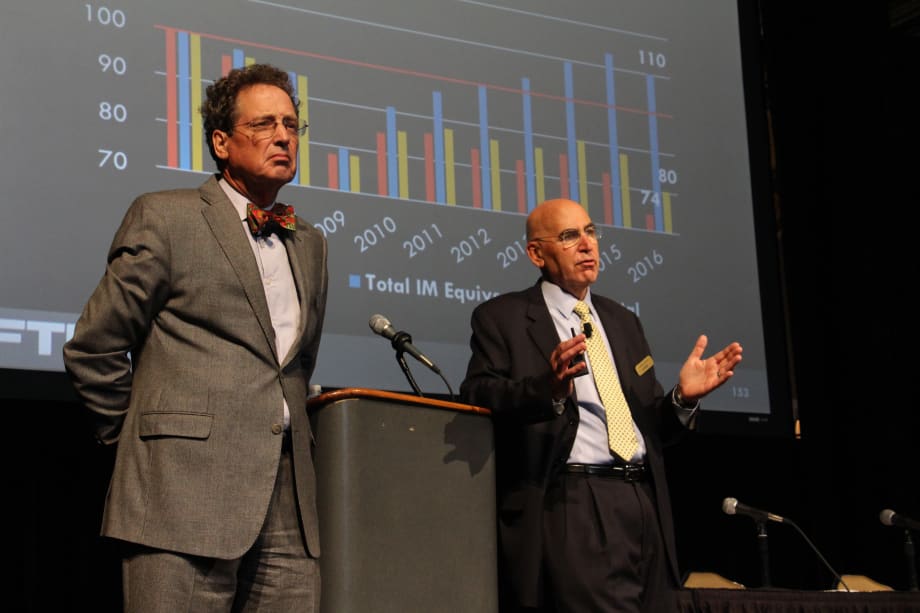
FTR's Noël Perry and Larry Gross talk about the future of trucking and other freight transportation modes on the final day of the FTR Transportation Conference in Indiana. Photo: Evan Lockridge
5 min to read
FTR's Noël Perry and Larry Gross talk about the future of trucking and other freight transportation modes on the final day of the FTR Transportation Conference in Indiana. Photo: Evan Lockridge
INDIANAPOLIS -- If you intend to be in business 10 to 15 years from now, there are some big issues you’ll face, as trucking and the rest of the surface transportation industry will see big changes – and that will mean companies will have to rewrite their playbooks.
And the danger of ignoring what’s to come, according to Noël Perry, truck and transportation expert and economist for FTR, could be catastrophic. For example, speaking at the final session of the FTR Transportation Conference in Indianapolis on Thursday, he noted that trucking deregulation more than 35 years ago eliminated most of the carriers that were operating at the time.
In other words, they were not prepared for the sweeping changes that took place.
“This change are even larger,” he said. “This change is as big as the invention of the Interstate Highway System.”
So what are these possible changes that Perry, along with Larry Gross, FTR’s intermodal truck and bus expert, detailed as they peered into the future?
One is the possibility that there may be a bubble out there that is unsustainable. Think the dot-com bubble of the 1990s or the housing bubble of the early 2000s. The next one Perry fears is the federal government’s debt.
Perry presented one slide in which he forecasts federal interest payments as a percentage of the federal budget ballooning from an average of around 12% now to between 43% to 75% of the federal government’s revenue by the year 2030.
“It’s clear that over the next 30 years, the borrowing habits of us as a nation are unsustainable, and at some point we are going to have to fix this – and that fix is going to be very painful,” he said.
While that doesn’t sound like a direct hit for trucking, such a fix would likely affect freight. For instance, if people’s taxes go up dramatically, that could easily translate into less money for them to spend on goods moved by truck.
Closer to trucking, and one of the industry’s pet projects, infrastructure funding (which includes money for roads and bridges) is another challenge.
According to Perry, so-called user charges (such as taxes on fuel) will have to be the source of this money, and “not somebody else’s pocket, because somebody else’s pocket has already been picked,” if interest payments on the federal debt rise as he is forecasting.
While it’s no secret the nation’s infrastructure needs work, Perry said that just to maintain the current performance or roads and bridges, trucking needs to pay 3 cents to 5 cents per mile more in the form of user fees. However, the price for greatly improving performance is far steeper, between 14 cents and 20 cents per mile more. This could even be as much as an additional $1.35 to $1.96 per mile if the U.S. starts taxing at the same rates as Europens do, with the money going for everything from infrastructure to the possibility of a single-payer health care system, according to Perry.
He believes there is a 50% to 60% probability that trucking will see over the next 15 years an increase of taxes on every mile of truck travel in the neighborhood of as much as $1.50 to $2.
According to Larry Gross, this hike of as much as $2 per mile would also be due to what he called a “bit of social engineering” in an effort to encourage the development and use of a rail system in the U.S. similar to what’s in Europe, which is much bigger than the U.S. railroad system.
Perry and Gross also looked at whether recent developments and talk about autonomous and self-driving trucks are a pipe dream or a near-term reality. While the technology for such vehicles is more likely a reality than ever before, it’s not a foregone conclusion yet. But if it happens, the savings automated trucking could reap for fleets could be huge.
By 2030, they said, these vehicles could save trucking more than $1.10 per mile on truckload linehaul movements. But it could also result in another big change – the price of moving freight could fall by half.
Gross believes automated trucking, or at least some form of it, such as platooning, will happen faster than most other changes that are on the horizon because “there is big money involved.”
“There is tremendous leverage to getting to a technology not just for trucks, but for cars that won’t text, play Pokeman Go, won’t spill coffee in its lap, don't get tired, don't get drunk,” he said. “Once we turn that [technology] corner, that is all going to happen fast, and that has big implications.”
The two also touched on the futures of railroad and intermodal, with Gross saying the rail freight industry is at a “critical crossroads.” The rail industry in the past several years, he said, has rested too much on the pillars of efficiency, cost reduction and raising rates faster than the rate in inflation, which he says gives the industry “a finite life.” Gross believes for rail to thrive and even survive, it has to come up with a way to take freight off the highways as trucking costs go down.
As for intermodal, Gross says it has to modify its existing strategy, as new truck technologies transform the Interstates into an “intermodal-like thruway.” While he says intermodal is doing some things right, such as increasing its footprint, and trying to get closer to the customers with terminals, the industry has to figure out better how to deal with mid-range and short-haul markets.
More Fleet Management

How MFA Helps Protect Trucking Fleets
Multi-factor authentication adds protection when passwords are stolen. Here’s how it works and where fleets should start.
Read More →
How Better Freight Data Helps Trucking Teams Get Ahead of Disruption
Trucking and logistics teams have plenty of data. The problem is getting the right information in front of the right people soon enough to act. Better-connected data can help teams spot trouble earlier and make smarter decisions before small problems become big ones.
Read More →
Trimble: Taking Artificial Intelligence in Trucking Beyond Faster Tasks
At Insight 2026, Trimble executives argued that fleets may need to redesign workflows to get more from AI as it introduced new products and enhancements. AI’s value will depend on how fleets combine automation with their people's knowledge.
Read More →
Sponsored•September 28, 2026
Build a bulletproof fleet: Uniting ELDs and dash cams for total compliance
An ELD can prove compliance, but it cannot always prove what happened on the road. Discover how uniting accurate ELD data with AI-powered dash cam video can help your fleet strengthen compliance, defend against liability, protect drivers and reduce operational costs.
Read More →
Nominations Open for HDT Emerging Leaders
Heavy Duty Trucking is looking for accomplished trucking fleet professionals under 40 who are making an impact and helping lead the industry forward.
Read More →
Why Private Fleets Are Taking More Freight
Private fleets are putting their own trucks on demanding customers and high-cost lanes as companies seek greater control over service, costs, and capacity.
Read More →
Sponsored•September 16, 2026
Color Match Smarter: Tools That Restore & Perform
For fleet managers and collision repair professionals keeping heavy-duty trucks on the road, getting the color right the first time isn't just about appearance — it's about efficiency, turnaround time, and bottom-line results. Discover how today's digital color tools are transforming the repair process from guesswork to precision.
Read More →
FMCSA Pauses Biennial-Update Enforcement Amid Motus Transition
Carriers whose updates were due on or after June 1 have more time, while FMCSA works to stabilize its new registration system and warns of phishing sites impersonating its new carrier registration system, Motus.
Read More →
Sponsored•September 14, 2026
2026 Blueprint for Countering Smarter Supply Chain Theft
Cargo theft is no longer just the cost of doing business. It's a multi-billion-dollar criminal enterprise exploiting vulnerabilities across your fleet, drivers, and supply chain.
Read More →
What the U.S.-Canada Trade War Means for Trucking
Escalating U.S.-Canada tariffs could disrupt cross-border freight, reduce truck volumes, raise costs, and create new uncertainty for carriers on both sides of the border.
Read More →