





Related News: HDT Test-Drives the 5th Generation Freightliner Cascadia
Freightliner Moves Spaceplane Closer to Orbit
A Freightliner Cascadia helped tow Sierra Space’s Dream Chaser during high-speed runway tests at Kennedy Space Center.
December 3, 2025
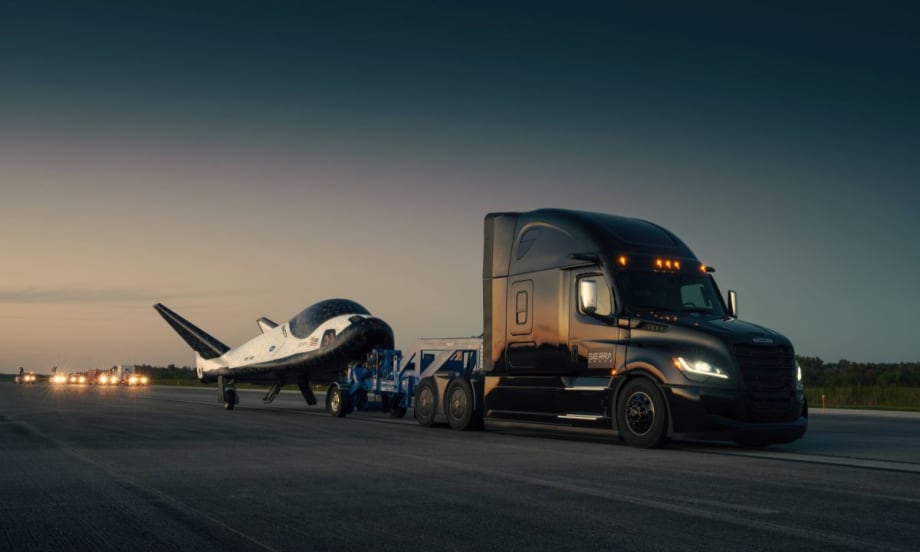
A fifth-generation Freightliner Cascadia tows Sierra Space’s Dream Chaser spaceplane on a runway at Kennedy Space Center as part of high-speed landing-sequence validation testing.
Photo: Rizon Trucks
2 min to read
Freightliner Trucks, a subsidiary of Daimler Truck North America, worked with Sierra Space on high-speed runway tow tests for the Dream Chaser autonomous spaceplane, designed to transport pressurized and unpressurized cargo to and from low Earth orbit. Sierra Space used a fifth-generation Freightliner Cascadia to simulate landing dynamics and validate parameters tied to Dream Chaser’s autonomous landing sequence.
DTNA product validation engineer Nate Fleming transported Dream Chaser about 10 miles from NASA’s Space Systems Processing Facility to the Launch and Landing Facility ahead of runway testing.
“There was a lot riding on this testing,” Fleming said. “Sierra Space trusted me to haul Dream Chaser, and trusted the Cascadia to carry it safely.”
Runway Tow Testing and Vehicle Setup
Dream Chaser is designed to launch vertically inside a rocket fairing, deploy its wings in orbit, maneuver in low Earth orbit using thrusters, and return to Earth for a runway landing. The vehicle uses tandem rear wheels and a single reinforced skid plate to reduce space and weight.
To support validation of that landing system, Sierra Space used an unmodified Cascadia sleeper with a 72-inch raised roof to tow Dream Chaser to speeds up to 70 mph on a 15,000-foot runway at Kennedy Space Center.
Powertrain Control and Mission Context
The tow testing required controlled acceleration, stability, and speed management. The fifth-generation Cascadia used its Detroit DD15 engine, DT12 automated manual transmission, and Detroit axles to move and control the trailer built for the landing-sequence test work.
“Dream Chaser is redefining how cargo moves in space, and that shared spirit of innovation made this partnership a natural fit,” said David Carson, senior vice president of sales and marketing at DTNA.
Sierra Space describes Dream Chaser as a reusable spaceplane intended to deliver payloads to space and return them to Earth via runway landing, which can place cargo closer to processing and delivery destinations.
“This test is about proving we can land safely, reliably, and repeatedly,” said Klint Combs, vice president of test engineering at Sierra Space.
More Equipment

How Volvo Updated Its D13 for EPA 2027 [Watch]
Volvo’s updated D13 promises lower emissions without sacrificing performance or fuel economy. Take a closer look at what changed inside the engine in this HDT Spotlight video.
Read More →
Michelin Tire Improves Efficiency and Durability for Regional Fleets
The Michelin X Multi Energy D2 is a regional haul drive tire engineered to help fleets improve fuel efficiency, durability and traction in demanding stop-and-go operations.
Read More →
ZF Expands Commercial Vehicle Push in North America
ZF is expanding its North American commercial-vehicle presence with new transmission applications, electrification, trailer technology and autonomous-driving systems.
Read More →
Tesla Wants a Self-Driving Semi. Are Cameras Enough?
Could Tesla’s camera-only autonomous driving technology work on an 80,000-pound Semi? In this commentary, HDT's Deborah Lockridge takes a look at Tesla, Cybercab, and how autonomous trucks see the road.
Read More →
Kodiak: Driverless Long-Haul Truck Launch on Track for 2026
Kodiak AI says its driverless long-haul safety case is 93% complete and it remains on track to begin commercial operations by year-end 2026.
Read More →
What DOT’s Automated Vehicle Strategy Means for Trucking
The U.S. Department of Transportation issued a new automated-vehicle strategy that outlines plans for driverless-truck regulations, cross-state freight corridors, and federal safety standards.
Read More →
East Coast Port Launches $45M Electric Truck Push
The Port Authority of New York and New Jersey announced millions in incentives for zero-emission drayage trucks, yard tractors, and new charging hubs near the port.
Read More →
PlusAI Going Public to Fund Autonomous Truck Launch
A SPAC deal could provide PlusAI with up to $300 million as it works toward a 2027 commercial launch of factory-built autonomous trucks.
Read More →
NHTSA Moves to Rewrite Truck Fuel-Economy Rules
The National Highway Traffic Safety Administration says it lacks authority to regulate medium- and heavy-duty truck engines separately from complete vehicles, but the existing standards have not yet been eliminated.
Read More →
Detroit Opens Orders for EPA 2027 Engines
Detroit isn’t starting from scratch to meet EPA 2027 diesel emissions standards. Its Gen 6 DD13 and DD15 engines keep much of today’s platform while updating the fuel and aftertreatment systems.
Read More →