





Related: COVID-19 Economic Conditions Catch up to Spot Market
Freight Volume, Rates Hit the Skids
While COVID-19 related demand boosted freight volume and spot freight in the first part of March, the latter part of the month saw a reversal, and April is looking ugly.
April 14, 2020
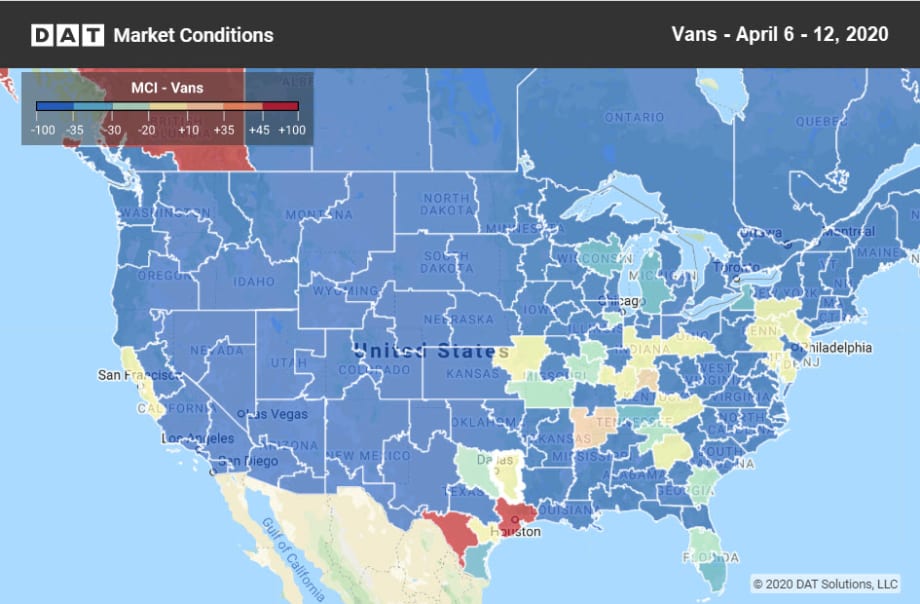
According to DAT, the only "hot spot" for spot freight is in south Texas.
Image: DAT Solutions
2 min to read
While COVID-19 related demand boosted freight volume and spot freight in the first part of March, the latter part of the month saw a reversal, and April is looking ugly.
The Cass Transportation Indexes revealed that North American freight volumes fell 9.2% year over year in March, with truckload linehaul rates falling back to 2009 levels during the global financial crisis – and Cass analysts predicted April will be worse. The Cass indexes measure changes in North American freight activity and costs based on $28 billion in paid freight expenses for the Cass customer base of hundreds of large shippers.
Cass noted that the linehaul index has a strong correlation to the quarterly yield metrics reported by the publicly traded truckload carriers. “The fact that January-March rates were so soft looks like another tough 1Q20 earnings season for publicly traded truckload companies.”
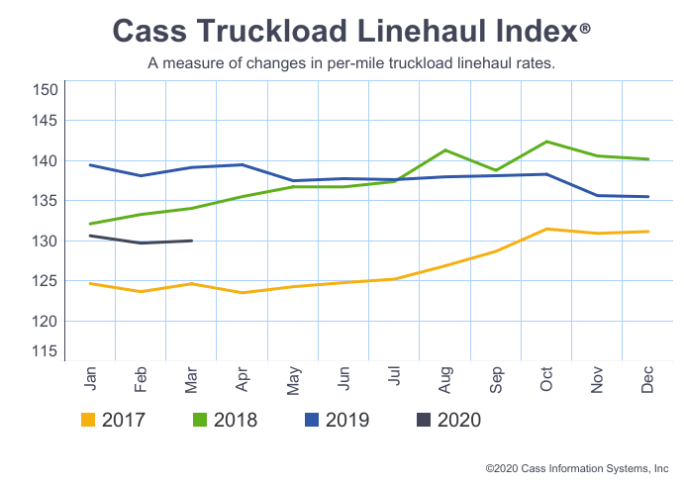
The Cass Truckload Linehaul Index is a measure of changes in per-mile linehaul rates.
Image: Cass
Another measure of the health of the freight market, the DAT Truckload Volume Index, showed that spot truckload volumes and rates rose sharply for dry van and refrigerated freight during the first three weeks of March, before cresting and spending the final week of the month well below seasonal norms.
“The increases in March were based on exceptional demand from shippers through March 22, at which point the market turned dramatically,” said Peggy Dorf, senior market analyst at DAT Solutions. “Consumers and supply chains began to adjust to disruptions caused by the COVID-19 pandemic, and the urgency to replenish inventory and secure available capacity on the spot market fell significantly.”
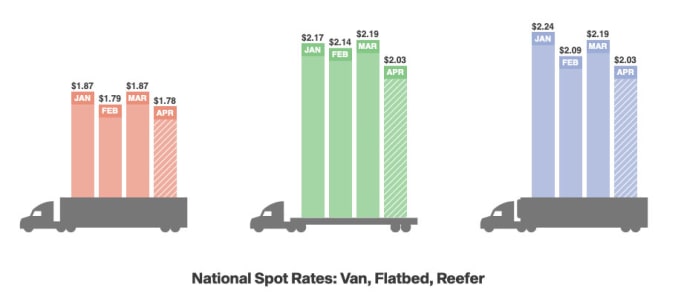
Spot rates are down significantly the first two weeks of April.
Image: DAT Solutions
Looking at April, DAT reported van spot freight volumes lost 20% in the past two weeks (as of the week ending April 12). National average rates lost 8¢ per mile, to $1.78, reflecting declines all over the country. Refrigerated freight trends weren't much better, and the flatbed sector has been slow for months. Tornadoes in the South and high winds up the East Coast didn’t help.
“According to the new Market Conditions map in DAT Power and RateView, there are exactly two hot spots in the U.S. for carriers: Houston and Laredo,” wrote Dorfin the DAT blog. “If you're in South Texas, you should be able to find a load, and possibly a decent rate. A handful of markets are lukewarm, neutral, or cool, but most are an icy cold, deep blue.”
More Fleet Management

Sponsored•September 16, 2026
Color Match Smarter: Tools That Restore & Perform
For fleet managers and collision repair professionals keeping heavy-duty trucks on the road, getting the color right the first time isn't just about appearance — it's about efficiency, turnaround time, and bottom-line results. Discover how today's digital color tools are transforming the repair process from guesswork to precision.
Read More →
FMCSA Pauses Biennial-Update Enforcement Amid Motus Transition
Carriers whose updates were due on or after June 1 have more time, while FMCSA works to stabilize its new registration system and warns of phishing sites impersonating its new carrier registration system, Motus.
Read More →
Sponsored•September 14, 2026
2026 Blueprint for Countering Smarter Supply Chain Theft
Cargo theft is no longer just the cost of doing business. It's a multi-billion-dollar criminal enterprise exploiting vulnerabilities across your fleet, drivers, and supply chain.
Read More →


Sponsored•September 1, 2026
How Telematics Improves Visibility, Control, and Performance in Refrigerated Fleets
Explore how telematics help refrigerated fleets improve visibility, uptime, efficiency, compliance, and cargo protection across connected cold chain operations.
Read More →
What the U.S.-Canada Trade War Means for Trucking
Escalating U.S.-Canada tariffs could disrupt cross-border freight, reduce truck volumes, raise costs, and create new uncertainty for carriers on both sides of the border.
Read More →
What Are Trucking’s Top Concerns for 2026?
The American Transportation Research Institute wants to know what's worrying trucking fleet managers, drivers, and other stakeholders in its annual Industry Issues survey.
Read More →
American Trucking Associations Looks for a New Leader
ATA President and CEO Chris Spear abruptly left his job at the association on August 21, at a pivotal time for the trucking industry.
Read More →
Public Wi-Fi Cybersecurity Risks: How Truck Drivers and Fleets Can Protect Their Data
Public Wi-Fi can expose truck drivers and fleets to credential theft, malware, and other cyber threats. Here’s how to reduce the risk on the road.
Read More →
For Nicky Cupp, Fleet Innovation Starts With Frustration
HDT Truck Fleet Innovator Nicky Cupp turns everyday pain points at Fraley & Schilling into opportunities for better technology and smarter processes.
Read More →
Adam Buttgenbach’s Approach to Electric Trucks: Start With Where They Fit
HDT Truck Fleet Innovator Adam Buttgenbach helped PepsiCo build one of North America’s largest EV fleets by focusing on where electric trucks make operational sense.
Read More →