




Freight Spending, Shipments Continue Decline
Both the number of shipments and expenditures on freight transportation by shippers continued their downward slide in December, according to latest Cass Freight Index.

Both the number of shipments and expenditures on freight transportation by shippers continued their downward slide in December, according to latest Cass Freight Index.
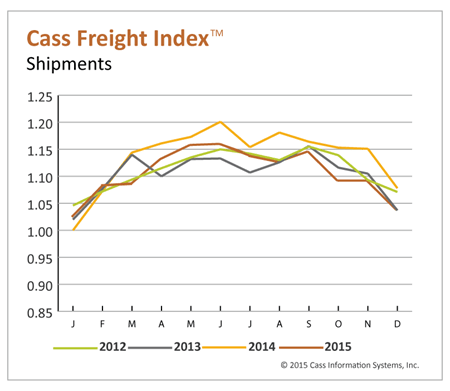
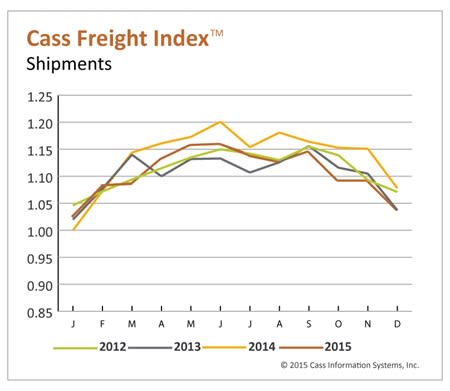
The shipments index fell 4.9% to a reading of 1.038, its lowest level since January 2015. The freight spending index dropped 2.7% from the month before for a reading of 2.345, also the lowest since January. Both indexes cap a second quarter of declines.
The indexes represent monthly levels of shipment activity based upon the domestic freight shipments of hundreds of clients of freight-payment processor Cass Information Systems, representing a broad spectrum of industries.
According to the report, 2015 did not even begin to reach the heights seen in 2014. By the end of 2015, both shipment volume and expenditures fell back to 2013 levels. Expenditures for freight transportation were 5.2% lower in December compared to the end of 2014 as shipment volume fell 3.7%.
However, this year-end drop is not as big as the more than 6.2% declines in December 2013 and 2014, said Rosalyn Wilson, supply chain expert, and senior business analyst with the management services firm Parsons, who provides analysis for the report.
“Holiday season retail store sales were strong, but did not meet expectations in 2015,” she said. “Online sales blew past last year’s record and more than made up for lower brick and mortar sales. The discounting started early again this year, muddying Black Friday sales figures, and consumers waited until goods were marked down further before buying. The holiday season was especially a boon for small parcel carriers.”
Freight payments fell for the third month in a row in December. Wilson said this follows a seasonal pattern and aligns somewhat with the drop in shipments.
“It also reflects falling spot rates caused by excess capacity,” she said. “There was an increase in spot rates in the week leading up to Christmas, but this was not enough to offset lower expenditures due to lower volume.”
The bottom line, according to Wilson, is that despite favorable employment/unemployment reports and moderate growth in household wealth and income, consumers are still very conservative when it comes to spending their money. Also, high inventories remain a problem for retailers, wholesalers and manufacturers, so a majority of goods were discounted.
“The Federal Reserve raised interest rates in December, which puts more pressure on firms holding inventory,” she said. “Inventory carrying costs rise with interest rates, and the money tied up in inventory that is not moving becomes a liability. And this may get worse, as the Fed has discussed plans to raise rates several times in the coming year. Low warehouse vacancy rates are pushing the price of warehouse space. In short, the nation’s bloated inventories are becoming a problem.”
In other words, with manufacturing slowing, inventories high, companies rationalizing employees and a six-month slide in freight volume and expenditures, 2016 will get off to a slow start.
More Fleet Management

Color Match Smarter: Tools That Restore & Perform
For fleet managers and collision repair professionals keeping heavy-duty trucks on the road, getting the color right the first time isn't just about appearance — it's about efficiency, turnaround time, and bottom-line results. Discover how today's digital color tools are transforming the repair process from guesswork to precision.
Read More →
FMCSA Pauses Biennial-Update Enforcement Amid Motus Transition
Carriers whose updates were due on or after June 1 have more time, while FMCSA works to stabilize its new registration system and warns of phishing sites impersonating its new carrier registration system, Motus.
Read More →
2026 Blueprint for Countering Smarter Supply Chain Theft
Cargo theft is no longer just the cost of doing business. It's a multi-billion-dollar criminal enterprise exploiting vulnerabilities across your fleet, drivers, and supply chain.
Read More →


How Telematics Improves Visibility, Control, and Performance in Refrigerated Fleets
Explore how telematics help refrigerated fleets improve visibility, uptime, efficiency, compliance, and cargo protection across connected cold chain operations.
Read More →
What the U.S.-Canada Trade War Means for Trucking
Escalating U.S.-Canada tariffs could disrupt cross-border freight, reduce truck volumes, raise costs, and create new uncertainty for carriers on both sides of the border.
Read More →
What Are Trucking’s Top Concerns for 2026?
The American Transportation Research Institute wants to know what's worrying trucking fleet managers, drivers, and other stakeholders in its annual Industry Issues survey.
Read More →
American Trucking Associations Looks for a New Leader
ATA President and CEO Chris Spear abruptly left his job at the association on August 21, at a pivotal time for the trucking industry.
Read More →
Public Wi-Fi Cybersecurity Risks: How Truck Drivers and Fleets Can Protect Their Data
Public Wi-Fi can expose truck drivers and fleets to credential theft, malware, and other cyber threats. Here’s how to reduce the risk on the road.
Read More →
For Nicky Cupp, Fleet Innovation Starts With Frustration
HDT Truck Fleet Innovator Nicky Cupp turns everyday pain points at Fraley & Schilling into opportunities for better technology and smarter processes.
Read More →
Adam Buttgenbach’s Approach to Electric Trucks: Start With Where They Fit
HDT Truck Fleet Innovator Adam Buttgenbach helped PepsiCo build one of North America’s largest EV fleets by focusing on where electric trucks make operational sense.
Read More →