





Related: ATRI Data Shows Ongoing COVID-19 Impacts on Trucking
Freight Rates Plummet, Small Fleets Struggle
As stay-at-home orders in response to the COVID-19 pandemic took hold across much of the country in the latter part of March, the level of freight available – and the rates to haul it – plummeted. This means many of the smallest companies that make up the vast majority of motor carriers are seriously hurting.
April 23, 2020
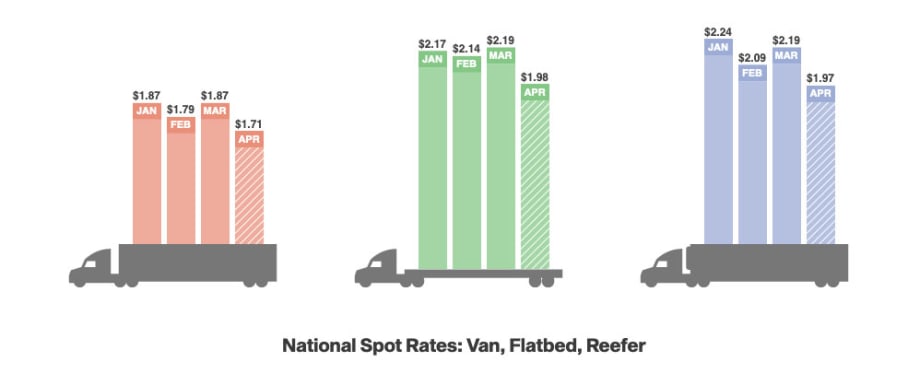
Spot rates continue to fall for vans, reefers, and flatbeds, and declining load-to-truck ratios signal that a rebound is not happening just yet. The weak freight market reflects the economic malaise due to coronavirus-related shutdowns and historically low oil prices.
Graphic: DAT Solutions
4 min to read
As stay-at-home orders in response to the COVID-19 pandemic took hold across much of the country in the latter part of March, the level of freight available – and the rates to haul it – plummeted. This means many of the smallest companies that make up the vast majority of motor carriers are hurting.
“I’ve been hearing [from members] that people are being offered things for literally less money than it takes to drive the truck,” Norita Taylor, spokesperson for the Owner-Operator Independent Drivers Association, told HDT in an interview. “It would cost them to take that load.”
Some small companies believe brokers are taking advantage of the situation.
Brent Higgins Trucking, which runs a 22-truck refrigerated fleet in Arkansas, told HDT in an April 15 interview that business had “slowed way down” in the previous five days. “Fortunately, our customers have come through for us and we didn't have to haul free loads,” said Vice President Connie Higgins. Founder and General Manager Brent Higgins said he suspects that unscrupulous brokers are pocketing a hefty (and unfair) percentage of what shippers are actually paying.
Earlier this week, dozens of truck drivers in Houston staged a protest on the I-610 East Loop, with signs calling for “honest prices on loads, “broker regulations” and complaining about “cheap brokers.”
Spot Market Dropping
Freight rates on the spot market continued to fall last week. According to DAT, the volume of loads moved, load-to-truck ratios, and the national rolling average rates for April fell again across all three equipment types during the week ending April 19, as truckers contemplate whether their next load will even cover their running costs.
Spot truckload rates have fallen quickly and across the board on high-volume lanes since the third week of March, DAT said, rivaling levels from 2016 when the country was in a manufacturing recession.
DAT forecasting models indicate that spot rates are expected to flatten in May, helped by seasonal trends like produce harvests. Easing personal-distancing restrictions around certain economic sectors and regions may help, too, but they’re not necessarily dialed into the models.
So far, rolling averages for the month, including fuel, are:
Van: $1.72 per mile, 15 cents lower than the March average
Flatbed: $2.00 per mile, down 19 cents compared to March
Reefer: $1.99 per mile, down 20 cents compared to March
Pricing has weakened throughout April as volumes have declined, so current rates are actually lower.
The next two to four weeks are crucial for small carriers and independent operators, which provide vital capacity for fruit and vegetable producers, DAT reported. If many can’t financially survive into produce season, or rates are too low to operate, or crop yields are poor, the impact on the agriculture and food supply chains could be significant.
March Data
The first few weeks of March saw strong freight levels as stores had to re-stock all those groceries and toilet paper bought by consumers hunkering down for COVID-19 stay-at-home orders. But by the end of the month, that trend had reversed.
According to the American Trucking Associations, tonnage rose in March – but it expects April tonnage to be “very soft.”
ATA’s advanced seasonally adjusted For-Hire Truck Tonnage Index rose 1.2% in March after increasing 1.8% in February. In March, the index equaled 120.4 (2015=100) compared with 119 in February.
“March was the storm before the calm, especially for carriers hauling consumer staples, which experienced strong freight levels,” said ATA Chief Economist Bob Costello. “But there was a huge divergence among freight types. While freight to grocery stores and big box retailers was strong in March, especially late March, due to surge buying by households, freight was anemic in other supply chains, like that for gasoline, restaurants, and auto factories.
“Because of this, and the continued shuttering of many parts of the economy, I would expect April tonnage to be very soft,” he said.
Similarly, the latest release of ACT Research’s For-Hire Trucking Index, with March data, showed further contraction for both volumes and freight rates, now at 42.4 and 43.2 respective index readings. Productivity, while neutral at 50.0, likely was supported by the temporary pantry-stocking phenomenon. This is a monthly survey of for-hire trucking service providers. ACT Research converts responses into diffusion indexes, where the neutral or flat level is 50.
“Because of the talk surrounding a surge in freight driven by pantry stocking, the Volume Index decline was somewhat surprising, but likely reflects the start of shutdowns late in March,” said Tim Denoyer, ACT Research’s vice president and senior analyst.
Regarding the drop in freight rates, he said, “COVID-19 is adding a new level of pricing pressure due to the sharp decline in load volumes into an already overcapacitized market.”
The Wall Street Journal reported that Stephens Inc. analyst Jack Atkins anticipates a string of bankruptcies across the transportation sector. In a research note earlier this month, WSJ wrote, Atkins said. “We believe the next three to five quarters will be an extremely difficult time for small and mid-size carriers and for bigger truckers with limited liquidity.”
More Fleet Management

Sponsored•September 16, 2026
Color Match Smarter: Tools That Restore & Perform
For fleet managers and collision repair professionals keeping heavy-duty trucks on the road, getting the color right the first time isn't just about appearance — it's about efficiency, turnaround time, and bottom-line results. Discover how today's digital color tools are transforming the repair process from guesswork to precision.
Read More →
FMCSA Pauses Biennial-Update Enforcement Amid Motus Transition
Carriers whose updates were due on or after June 1 have more time, while FMCSA works to stabilize its new registration system and warns of phishing sites impersonating its new carrier registration system, Motus.
Read More →
Sponsored•September 14, 2026
2026 Blueprint for Countering Smarter Supply Chain Theft
Cargo theft is no longer just the cost of doing business. It's a multi-billion-dollar criminal enterprise exploiting vulnerabilities across your fleet, drivers, and supply chain.
Read More →


Sponsored•September 1, 2026
How Telematics Improves Visibility, Control, and Performance in Refrigerated Fleets
Explore how telematics help refrigerated fleets improve visibility, uptime, efficiency, compliance, and cargo protection across connected cold chain operations.
Read More →
What the U.S.-Canada Trade War Means for Trucking
Escalating U.S.-Canada tariffs could disrupt cross-border freight, reduce truck volumes, raise costs, and create new uncertainty for carriers on both sides of the border.
Read More →
What Are Trucking’s Top Concerns for 2026?
The American Transportation Research Institute wants to know what's worrying trucking fleet managers, drivers, and other stakeholders in its annual Industry Issues survey.
Read More →
American Trucking Associations Looks for a New Leader
ATA President and CEO Chris Spear abruptly left his job at the association on August 21, at a pivotal time for the trucking industry.
Read More →
Public Wi-Fi Cybersecurity Risks: How Truck Drivers and Fleets Can Protect Their Data
Public Wi-Fi can expose truck drivers and fleets to credential theft, malware, and other cyber threats. Here’s how to reduce the risk on the road.
Read More →
For Nicky Cupp, Fleet Innovation Starts With Frustration
HDT Truck Fleet Innovator Nicky Cupp turns everyday pain points at Fraley & Schilling into opportunities for better technology and smarter processes.
Read More →
Adam Buttgenbach’s Approach to Electric Trucks: Start With Where They Fit
HDT Truck Fleet Innovator Adam Buttgenbach helped PepsiCo build one of North America’s largest EV fleets by focusing on where electric trucks make operational sense.
Read More →