




Freight Indicators Hit or Near Record Highs
Two measures about the health of the U.S. trucking industry turned in either their best or near-record numbers for December.
Two measures about the health of the U.S. trucking industry turned in either their best or near-record numbers for December.
ATA
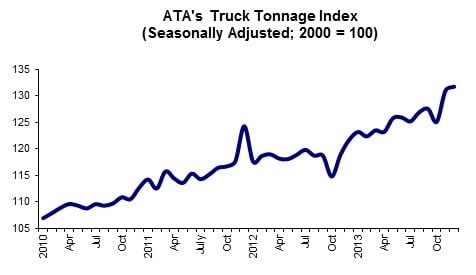
The American Trucking Associations’ advanced seasonally adjusted For-Hire Truck Tonnage Index increased 0.6% after surging 4.7% in November. The increase pushed the index 6.2% higher for the full year making marking its best performance since 1998.
November’s increase was significantly larger than the preliminary gain of 2.7% ATA reported on Dec. 20. In December, the index equaled 131.7 versus 130.9 in November. December’s level is a record high. Compared with December 2012, the seasonally adjusted index increased 8.2%.
The not seasonally adjusted index, which represents the change in tonnage actually hauled by the fleets before any seasonal adjustment, equaled 123 in December, 1.4% below the previous month at 124.8.
“Tonnage ended 2013 on a high note, which fits with many economic indicators as trucking is an excellent reflection of the tangible goods economy,” said ATA chief economist Bob Costello. “The final quarter was the strongest we’ve seen in a couple of years, rising 2.2% from the third quarter and 9.1% from a year earlier.”
Costello reiterated his statement from last month that the tonnage acceleration in the second half of last year is pointing to an economy that is likely stronger than some might believe.
“I’m seeing more broad-based gains now. The improvement is not limited to the tank truck and flatbed sectors like earlier in the year," he said. "With manufacturing and consumer spending picking up, coupled with solid volumes from hydraulic fracturing, I look for tonnage to be good in 2014 as well.”
Trucking serves as a barometer of the U.S. economy, representing 68.5% of tonnage carried by all modes of domestic freight transportation, including manufactured and retail goods.
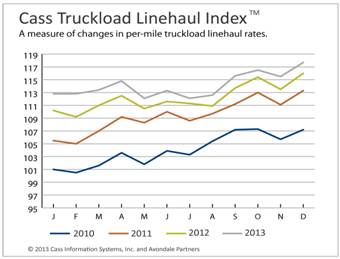
Meantime, a separate measure, the Cass Truckload Linehaul Index, set a new high in December at 117.7
Truckload shipping costs simply continue to climb, following an almost identical pattern in each of the last four years, according to Cass. In December 2013, shippers paid 1.5% more in linehaul charges than the year before. Throughout 2013, demand steadily improved while capacity remained stagnant, with neither the available driver pool nor truck count growing.
The investment firm Avondale Partners, which Cass works with in putting together the index, said it expects freight tonnage to continue to show strong growth in 2014.
“Truck tonnage is currently growing at the strongest rate in three and a half years,” said Avondale. “Importantly, we would also note that the most recent data suggest loads are growing at 4%, a reversal from the trend in fourth quarter of 2013 and the first quarter of 2013. . . We expect stronger industrial production, a modestly improved backdrop for the consumer, and the continued recovery in housing to support further growth in truck tonnage in 2014.”
The index is an indicator of market fluctuations in per-mile truckload pricing, that isolates the linehaul component of full truckload costs from other components, such as fuel and accessorials, providing an look at trends in baseline truckload prices. Data in it derived from actual freight invoices paid on behalf of Cass’ clients.
Finally, the Cass Intermodal Price index show intermodal costs (linehaul, accessorials and fuel) in December were 1.0% lower than a year earlier, while North American intermodal volumes remain high.
Avondale Partners’ December report predicted that intermodal shipping costs will remain relatively flat in the near term, with fluctuations influenced primarily by fuel costs. For now, they say, “the pricing dynamic in intermodal remains very competitive.”
The intermodal index, is an indicator of market fluctuations in per-mile U.S. domestic intermodal costs is based on freight invoices paid on behalf of Cass clients.
More Drivers

From One Generation to the Next: How Mentorship Builds Safer Truck Drivers
After three decades in trucking, Harold Perry shares what he's learned about driver safety, mentorship, and helping the next generation build confidence behind the wheel.
Read More →
Truck Drivers Need More Than Another Alert
Fleets have more visibility into truck health, safety events, and driver activity than ever. The next challenge is turning all that information into useful guidance for the person who has to decide what to do next.
Read More →
FMCSA Removes 110 Truck Driver Training Schools from Certified ELDT List
Federal regulators also are targeting more than 160 additional training providers and launching a nationwide audit of third-party CDL skills testers as part of a broader crackdown on trucking fraud.
Read More →
Hours of Service Pilot Programs: FMCSA Readies for 2027 Rollout
Two pilot programs could eventually reshape hours-of-service rules, giving truck drivers options to pause their 14-hour clock or use longer split sleeper rest periods.
Read More →
Medical Cards, English Proficiency Reshape Roadcheck Violations
Medical-card violations jumped to the top of the driver out-of-service list during CVSA’s 2026 International Roadcheck, while English-language proficiency violations appeared among the leading violations for the first time.
Read More →
Driver Trust Can Make or Break the Success of Fleet Safety Technology
New Teletrac Navman research suggests that onboarding, transparency about driver data, and positive feedback can play a significant role in how commercial drivers respond to safety and coaching technology.
Read More →
EEOC Sues KLLM Over Alleged Sex Discrimination in Driver Training
KLLM is facing a federal sex-discrimination lawsuit over policies the EEOC alleges put female truck driver trainees at a disadvantage.
Read More →
FMCSA Moves to Codify English Language Requirements for Commercial Drivers
By changing regulations on English-language proficiency requirements for commercial drivers, rather than relying on a guidance memo, the FMCSA said future administrations won't be able to walk back the Trump administration's stricter enforcement with just a memo.
Read More →
Drivers Put Western Star Trucks to the Test at Star Nation Experience
Watch to get an inside look at the Western Star trucks, technology, and community behind the Star Nation Experience 2026!
Read More →
Trump Administration Looks to Put More Veterans Behind the Wheel
The Freedom Haulers program pulls together existing and expanded programs at several federal agencies to recruit veterans to drive commercial heavy-duty trucks and cut the red tape for them to get a CDL, training, and employment.
Read More →