




Freight Index Hits Near All-Time High
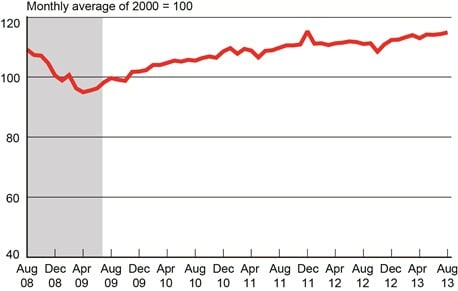
The amount of freight carried by the for-hire transportation industry in the U.S. rose 0.4% in August from July, rising for the second consecutive month to reach the second highest level in the history of the Bureau of Transportation Statistics’ Freight Transportation Services Index which goes back to 2000.

Credit: U.S. DOT
The amount of freight carried by the for-hire transportation industry in the U.S. rose 0.4% in August from July, rising for the second consecutive month to reach the second highest level in the history of the Bureau of Transportation Statistics’ Freight Transportation Services Index which goes back to 2000.
U.S. DOT
The new report from this part of the U.S. Transportation Department shows the August index level of 114.8 was 21% above the April 2009 low during the most recent recession.
The level of freight shipments in August was 0.3% below the all-time high level of 115.2 in December 2011.
August 2013 freight shipments were up 3.4 percent from August 2012
The Freight TSI measures the month-to-month changes in freight shipments by mode of transportation in tons and ton-miles, which are combined into one index. The index measures the output of the for-hire freight transportation industry and consists of data from for-hire trucking, rail, inland waterways, pipelines and air-freight.
The Freight TSI has increased in eight out of the last 10 months, growing from 108.4 to 114.8, an increase of 5.9% since October 2012. Most of the increase was in trucking and rail intermodal.
The DOT says the 10-month growth is consistent with steady growth in gross domestic product, industrial production and employment over the same time period. The growth in the economy has come particularly from housing, autos and energy, sectors that generate relatively large amounts of freight tonnage.
The Freight TSI remained above its 2012 range for the eighth month in a row. Beginning with January, every month in 2013 has exceeded the high point of 2012, 112.3 reached in December.
Freight shipments measured by the index were up 2.2 percent in August compared to the end of 2012.
More Drivers

Why Hiring Truck Drivers Is Getting Harder
Higher recruiting costs, a shrinking driver pool, and renewed pay competition are raising the stakes for fleets heading into 2027.
Read More →
Roehl Offers Truck Drivers $10,000 Retention Incentive
Payments begin after the first load and continue in mileage-based installments for eligible experienced drivers joining the fleet.
Read More →
Platform Science Adds Dispatch and Safety Tools
Four additions to PS Fleet help fleets monitor loads, manage driver coaching, share truck locations and adjust video system settings.
Read More →
When Language Stops the Truck: The Return of ELP Out-of-Service Orders
English language proficiency rules for commercial drivers aren’t new, but renewed out-of-service enforcement has raised the stakes. Here’s what carriers need to know before a driver reaches a roadside inspection.
Read More →
Samsara Launches Custom AI Agent Builder
Agent Studio lets fleets create AI tools for hours-of-service monitoring, reporting and driver support, including agents that communicate by phone.
Read More →
Trucker Path Expands Reserved Parking Network
Trucker Path has added close to 6,000 more truck parking spaces to its Trucker Path Reserved Parking Network with the addition of Safe Truck Parking.
Read More →
EEOC Sues Texas Trucking Company Over Driver Age Limits
The agency says Trancasa USA rejected applicants over 65 and applied tougher driving-record standards to those over 60.
Read More →
Nussbaum, Roehl Announce Second Driver Pay Increase This Year
This year has seen a swath of major truck driver pay increases as freight capacity has tightened.
Read More →
From One Generation to the Next: How Mentorship Builds Safer Truck Drivers
After three decades in trucking, Harold Perry shares what he's learned about driver safety, mentorship, and helping the next generation build confidence behind the wheel.
Read More →
Truck Drivers Need More Than Another Alert
Fleets have more visibility into truck health, safety events, and driver activity than ever. The next challenge is turning all that information into useful guidance for the person who has to decide what to do next.
Read More →