




Freight Awaits Business Buying Big
LOUISVILLE, KY -- The U.S. economy is "nowhere near” slipping into recession. But the economy is sending mixed signals, so what's going to happen to freight demand over the next several months? FTR's Eric Starks shared his insights at the MATS Fleet Forum Wednesday.

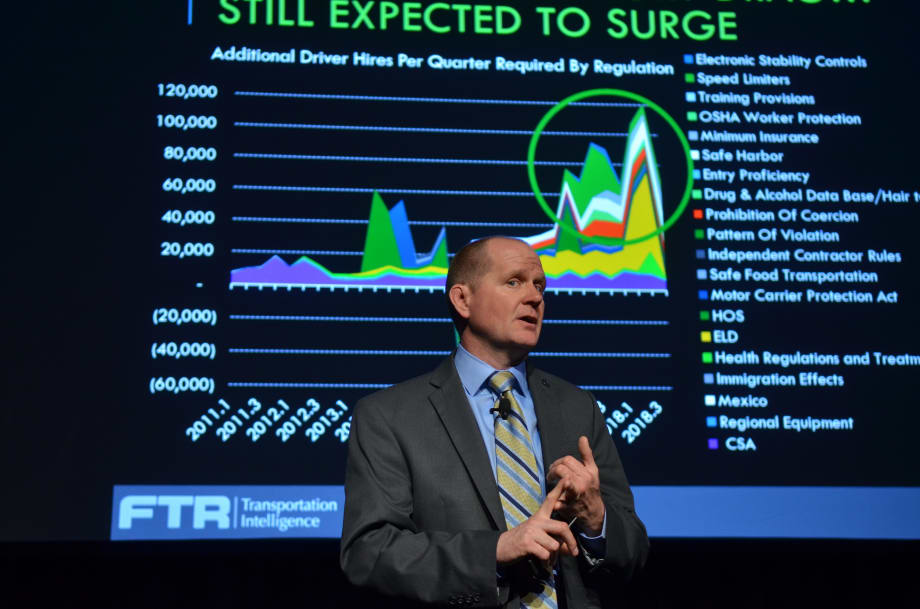
FTR's Eric Starks laying out where he sees freight headed at Fleet Forum in Louisville, Ky. Photo: Jim Park
FTR's Eric Starks laying out where he sees freight headed at Fleet Forum in Louisville, Ky. Photo: Jim Park
LOUISVILLE, KY. – The U.S. economy is "nowhere near” slipping into recession. But because in the short term the economy is sending mixed signals, “freight demand will rise only modestly over the next several months."
That was a key takeaway from forecaster Eric Starks’ presentation at the Fleet Forum business conference, co-sponsored by HDT, held here on March 30, the day before the Mid-America Trucking Show opened.
Starks, president of FTR Transportation Intelligence, said the U.S. manufacturing sector is “by and large robust” despite industrial production running “in fits and starts” and that freight capacity is currently “relatively loose.”
However, despite a number of positive economic indicators – including employment, auto and light truck sales, stable fuel prices, and, to a lesser extent, housing activity – both retail sales and business activity remain flat.
“For 2016, GDP growth is forecast at 1.8 to 2.0% – that’s sluggish growth,” said Starks. "The economy is moving along slowly, with continued growth.”
Starks said the lack of capital spending by businesses is a concern. “Employment generates spending. Job growth of over 200,000 per month indicates [economic] growth and, on average, we are holding above the 200,000 level.
“But business is holding back,” he continued. “The level of core capital goods orders shows that business activity remains flat — I would like to see those orders pick up.”
Starks said a big part of what’s holding businesses back is excessive inventories, which he cited as “a structural problem, throughout the commercial-vehicle market and the economy at large.
“Inventory levels are now problematic,” he continued. “Too much inventory reduces demand for freight transportation. We need to see inventories go down before [business] orders can pick up.”
Still, Starks added, freight loading originations (which he noted, “unlike a ton-mile, can be physically seen”) are trending up. He said the loading originations forecast “indicates modest freight growth going forward in 2016 into 2017.”
Starks also cautioned that the drag on fleet operations from regulations, such as for electronic log devices and speed-limiters, is expected to “surge” this year and next year will affect utilization.
He said it remains to be seen if this will result from fewer “quality drivers” being available or a need to make up for a decline in operational utilization. “A lot of [regulatory] pressure on drivers will compel carriers to boost productivity,” Starks noted. “Some of that will require educating shippers. Some may have to ‘fire’ shippers who don’t get what is happening.”
Starks added that “by and large, I don’t see changes in regulations [now in the works] even if the administration changes [hands] after the election.”
More Fleet Management

Color Match Smarter: Tools That Restore & Perform
For fleet managers and collision repair professionals keeping heavy-duty trucks on the road, getting the color right the first time isn't just about appearance — it's about efficiency, turnaround time, and bottom-line results. Discover how today's digital color tools are transforming the repair process from guesswork to precision.
Read More →
FMCSA Pauses Biennial-Update Enforcement Amid Motus Transition
Carriers whose updates were due on or after June 1 have more time, while FMCSA works to stabilize its new registration system and warns of phishing sites impersonating its new carrier registration system, Motus.
Read More →
2026 Blueprint for Countering Smarter Supply Chain Theft
Cargo theft is no longer just the cost of doing business. It's a multi-billion-dollar criminal enterprise exploiting vulnerabilities across your fleet, drivers, and supply chain.
Read More →


How Telematics Improves Visibility, Control, and Performance in Refrigerated Fleets
Explore how telematics help refrigerated fleets improve visibility, uptime, efficiency, compliance, and cargo protection across connected cold chain operations.
Read More →
What the U.S.-Canada Trade War Means for Trucking
Escalating U.S.-Canada tariffs could disrupt cross-border freight, reduce truck volumes, raise costs, and create new uncertainty for carriers on both sides of the border.
Read More →
What Are Trucking’s Top Concerns for 2026?
The American Transportation Research Institute wants to know what's worrying trucking fleet managers, drivers, and other stakeholders in its annual Industry Issues survey.
Read More →
American Trucking Associations Looks for a New Leader
ATA President and CEO Chris Spear abruptly left his job at the association on August 21, at a pivotal time for the trucking industry.
Read More →
Public Wi-Fi Cybersecurity Risks: How Truck Drivers and Fleets Can Protect Their Data
Public Wi-Fi can expose truck drivers and fleets to credential theft, malware, and other cyber threats. Here’s how to reduce the risk on the road.
Read More →
For Nicky Cupp, Fleet Innovation Starts With Frustration
HDT Truck Fleet Innovator Nicky Cupp turns everyday pain points at Fraley & Schilling into opportunities for better technology and smarter processes.
Read More →
Adam Buttgenbach’s Approach to Electric Trucks: Start With Where They Fit
HDT Truck Fleet Innovator Adam Buttgenbach helped PepsiCo build one of North America’s largest EV fleets by focusing on where electric trucks make operational sense.
Read More →