





FMCSA Seeks Input on Regulating Autonomous Commercial Vehicle Safety
FMCSA Proposes Study of Autonomous Trucks and Team Drivers
The Federal Motor Carrier Safety Administration is seeking to use driving simulators to study the potential use of team drivers in Level 4 autonomous trucks.
June 9, 2023
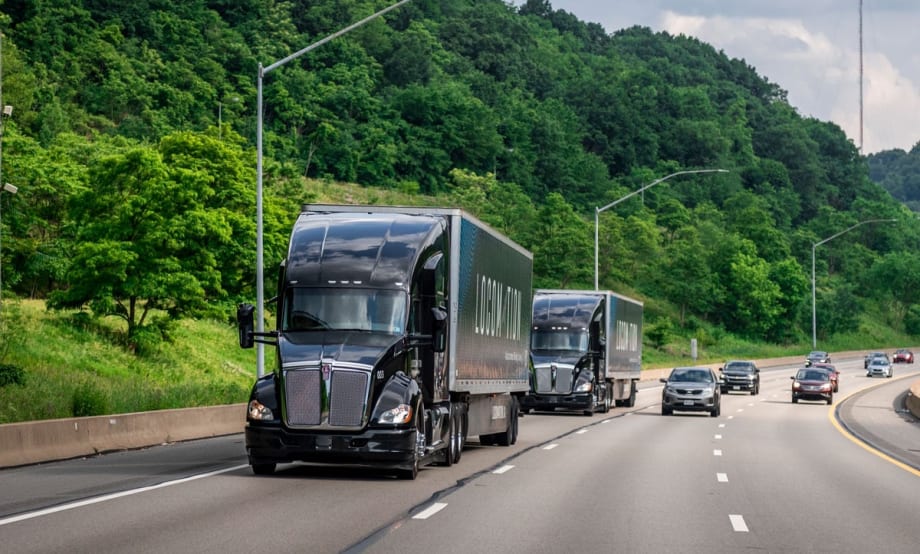
Companies such as Locomation have been studying one use case for automated technology and team drivers — platooning.
Photo: Locomation, 2021
3 min to read
The Federal Motor Carrier Safety Administration is seeking to use driving simulators to study the potential use of team drivers in Level 4 autonomous trucks.
In a notice published in the federal Register, FMCSA is inviting comments on a proposed study titled “Safety Impacts of Human-Automated Driving System (ADS) Team Driving Applications.”
It is a driving simulator study with a series of questionnaires that aims to quantify the safety implications of team driving applications between humans and ADS-equipped commercial motor vehicles, according to FMCSA.
Potential Relief From Hours of Service
Specifically, this study will focus on team driving applications with an SAE Level 4 (L4) CMV. In L4 automation, vehicles are capable of all functions and controls necessary for driving without human monitoring in limited conditions, and the human driver will not be asked to take over control of the vehicle. The L4 CMV will not operate outside of the conditions it was designed for without human control.
The study will assess the safety benefits of and potential problems with human-ADS team driving applications and support the analysis of potential requests for relief from FMCSA's hours-of-service regulations.
FMCSA cited a “paucity of … [FMCSA] research related to ADS-equipped CMVs.”
To date, it said, most commercial ADSs on U.S. roadways are in passenger vehicles, and CMV ADSs are only recently being implemented in real-world operations. Therefore, FMCSA needs more data on commercial motor vehicles equipped with these automated driving systems to understand the human factors surrounding team driving applications between humans and ADS-equipped CMVs.
Teaming Human Drivers With Autonomous Trucks
FMCSA outlined four use cases where a human could team with an ADS-equipped CMV:
In-vehicle driver teams with an ADS CMV;
In-vehicle driver teams with a following ADS-equipped CMV;
In-vehicle driver teams with a remote human to monitor and control an ADS CMV; and
Remote monitor/operator teaming with ADS CMV.
Each of the use cases offers different potential human factors benefits and challenges, the agency noted.
“However, it is unclear how each human-ADS teaming use case will affect safety, productivity, and efficiency. Each teaming combination may positively or negatively affect a driver's cognitive workload and level of fatigue, alertness, or distraction compared to the case of a traditional driver in a truck without ADS. For example, the in-vehicle drivers and remote monitors/operators in the above teaming use cases may experience varying workloads and differences in the development of fatigue.”
The study includes data collection from a series of questionnaires and a driving-simulator focused experiment. The collected survey data will support the simulator experiment data.
Approximately 80 commercial vehicle drivers are expected to participate in the study. Eligible drivers will hold a valid commercial driver's license, currently drive a CMV, be 21 years of age or older, and pass a motion sickness history screening questionnaire.
Comments must be received no later than August 7.
More Safety & Compliance

From One Generation to the Next: How Mentorship Builds Safer Truck Drivers
After three decades in trucking, Harold Perry shares what he's learned about driver safety, mentorship, and helping the next generation build confidence behind the wheel.
Read More →
FMCSA Pauses Biennial-Update Enforcement Amid Motus Transition
Carriers whose updates were due on or after June 1 have more time, while FMCSA works to stabilize its new registration system and warns of phishing sites impersonating its new carrier registration system, Motus.
Read More →
ZF Expands Commercial Vehicle Push in North America
ZF is expanding its North American commercial-vehicle presence with new transmission applications, electrification, trailer technology and autonomous-driving systems.
Read More →
Truck Drivers Need More Than Another Alert
Fleets have more visibility into truck health, safety events, and driver activity than ever. The next challenge is turning all that information into useful guidance for the person who has to decide what to do next.
Read More →
Tesla Wants a Self-Driving Semi. Are Cameras Enough?
Could Tesla’s camera-only autonomous driving technology work on an 80,000-pound Semi? In this commentary, HDT's Deborah Lockridge takes a look at Tesla, Cybercab, and how autonomous trucks see the road.
Read More →
What DOT’s Automated Vehicle Strategy Means for Trucking
The U.S. Department of Transportation issued a new automated-vehicle strategy that outlines plans for driverless-truck regulations, cross-state freight corridors, and federal safety standards.
Read More →
NYC Expands Speed, Pedestrian Safety Tech Across Fleet
New York City is expanding intelligent speed assistance and pedestrian-alert systems across its municipal fleet, moving the technologies from pilot programs into vehicle procurement and retrofit requirements.
Read More →
FMCSA Removes 110 Truck Driver Training Schools from Certified ELDT List
Federal regulators also are targeting more than 160 additional training providers and launching a nationwide audit of third-party CDL skills testers as part of a broader crackdown on trucking fraud.
Read More →
Beyond DOT Compliance: What Makes a Trucking Fleet Truly Safe?
A trucking fleet can follow every rule and still make unsafe decisions. The real test comes when safety conflicts with freight, productivity, or cost.
Read More →
Hours of Service Pilot Programs: FMCSA Readies for 2027 Rollout
Two pilot programs could eventually reshape hours-of-service rules, giving truck drivers options to pause their 14-hour clock or use longer split sleeper rest periods.
Read More →