




FMCSA Posts Ban on Texting While Driving
Following up on guidance it issued earlier this year, the Federal Motor Carrier Safety Administration has posted a formal rule banning truck and bus drivers from texting while driving. The rule also prohibits carriers from requiring or allowing their drivers to text
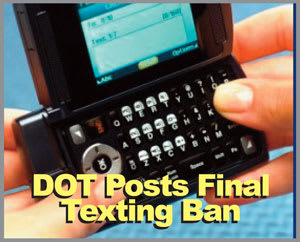
Following up on guidance it issued earlier this year, the Federal Motor Carrier Safety Administration has posted a formal rule banning truck and bus drivers from texting while driving. The rule also prohibits carriers from requiring or allowing their drivers to text.
The rule, which will be effective 30 days after it is published in the Federal Register, essentially codifies current federal enforcement practices.
The penalty for conviction can be a fine of $2,750 for the driver and $11,000 for the carrier. The driver also can be disqualified.
Dangerous Behavior
Texting is the cardinal sin among the numerous behaviors that fall under the general description of distracted driving. Research shows that texting increases by more than 23 times the chances of getting into an accident, compared to a driver who is not texting.
And texting in general has taken the country by storm. It grew 2,200 percent between 2005 and 2009, according to CTIA-The Wireless Association.
These are the central facts that prompted FMCSA to address texting separately from other distracted driving issues, and to do so quickly. It has taken the agency just over six months to get from proposal to final rule, a turnaround that reflects the urgency given to this issue by Transportation Secretary Ray LaHood.
LaHood also announced the DOT is initiating a rulemaking to ban texting by all drivers transporting hazardous materials, which would allow the agency to address intrastate hazmat drivers under the authority of the DOT's Pipeline and Hazardous Materials Safety Administration. The new final texting rule posted this week only affects interstate drivers.
Going Further
The agency has another rulemaking proposal under way to address other distraction issues in the truck cab.
The final texting rule contains a significant departure from the initial proposal, which suggested a texting ban only on cell phones. The agency decided to extend the texting ban to dispatching devices or keyboards that are used in a fleet management system, which can be used for purposes other than texting.
"The agency does not see any necessity for drivers to read text messages or type text responses on any device while the vehicle is being operated on public roads," FMCSA said in its commentary.
The agency declined to provide a clearer definition of the term "allow" in the language prohibiting carriers from allowing their drivers to text. There is ample precedent for the term in federal rules, and neither the industry nor the unions have cited any difficulty complying with these rules, the agency said.
Other issues
In the past several years, 30 states have posted laws banning texting. These bans remain in effect, provided they are compatible with the new federal rule, and the states may institute new prohibitions if they want to.
The agency received about 400 comments, most supporting the ban. Some who opposed it said that regulation should be handled by the states with federal guidance. Others argued that instead of a ban the government should require only outreach, education and company action on the issue.
There was concern among some commenters about enforcement of the ban. The Commercial Vehicle Safety Alliance, for example, pressed for more performance-based regulations, rather than a prescriptive ban, and the Owner-Operator Independent Drivers Association was concerned about giving officials access to the driver's electronic devices.
The agency responded that it does not think such questions should be a basis for not acting on to restrict texting. It will take a while for enforcement authorities to develop their enforcement procedures, the agency said.
More Drivers

Samsara Launches Custom AI Agent Builder
Agent Studio lets fleets create AI tools for hours-of-service monitoring, reporting and driver support, including agents that communicate by phone.
Read More →
Trucker Path Expands Reserved Parking Network
Trucker Path has added close to 6,000 more truck parking spaces to its Trucker Path Reserved Parking Network with the addition of Safe Truck Parking.
Read More →
EEOC Sues Texas Trucking Company Over Driver Age Limits
The agency says Trancasa USA rejected applicants over 65 and applied tougher driving-record standards to those over 60.
Read More →
Nussbaum, Roehl Announce Second Driver Pay Increase This Year
This year has seen a swath of major truck driver pay increases as freight capacity has tightened.
Read More →
From One Generation to the Next: How Mentorship Builds Safer Truck Drivers
After three decades in trucking, Harold Perry shares what he's learned about driver safety, mentorship, and helping the next generation build confidence behind the wheel.
Read More →
Truck Drivers Need More Than Another Alert
Fleets have more visibility into truck health, safety events, and driver activity than ever. The next challenge is turning all that information into useful guidance for the person who has to decide what to do next.
Read More →
FMCSA Removes 110 Truck Driver Training Schools from Certified ELDT List
Federal regulators also are targeting more than 160 additional training providers and launching a nationwide audit of third-party CDL skills testers as part of a broader crackdown on trucking fraud.
Read More →
Hours of Service Pilot Programs: FMCSA Readies for 2027 Rollout
Two pilot programs could eventually reshape hours-of-service rules, giving truck drivers options to pause their 14-hour clock or use longer split sleeper rest periods.
Read More →
Medical Cards, English Proficiency Reshape Roadcheck Violations
Medical-card violations jumped to the top of the driver out-of-service list during CVSA’s 2026 International Roadcheck, while English-language proficiency violations appeared among the leading violations for the first time.
Read More →
Driver Trust Can Make or Break the Success of Fleet Safety Technology
New Teletrac Navman research suggests that onboarding, transparency about driver data, and positive feedback can play a significant role in how commercial drivers respond to safety and coaching technology.
Read More →