




Fed Predicts Moderate but Good Economic Growth
Conditions appear to be in place for a good year for the U.S. economy, which is likely to be marked by moderate, sustainable growth and lower inflation, Federal Reserve Board Vice Chairman Donald Kohn recently told the Atlanta Rotary Club.
Conditions appear to be in place for a good year for the U.S. economy, which is likely to be marked by moderate, sustainable growth and lower inflation, Federal Reserve Board Vice Chairman Donald Kohn recently told the Atlanta Rotary Club.
Deceleration of economic activity in the second half of 2006 was concentrated in the housing and motor vehicle sectors. As of November, single-family housing starts were down 30 percent from the peak in January 2006, but there were tentative signs that the housing market may be stabilizing, he noted. House sales appear to have flattened out since mid-2006, mortgage applications have been increasing, and consumers’ perceptions of home-buying conditions have improved.
It’s hard to predict when the housing market will rebound because this downturn is different from those in the past, he explained. “It was not triggered by a restrictive monetary policy and high interest rates; indeed, relatively low intermediate and long-term interest rates are helping to support the stabilization of this sector.” Instead, the current contraction follows an unusually large run-up in sales and construction as well as prices relative to the return on other assets.
“Our uncertainty about what pushed home prices and sales to those elevated levels raises questions about how the market will adjust now that expectations of the rate of house price appreciation are being trimmed,” he said.
In the automotive sector, car and light truck production producers slashed output last year in an effort to reduce elevated inventories, Kohn pointed out. October production of light vehicles was the slowest in more than eight years but build rates increased in the final two months of 2006 and available data indicates that manufacturers will maintain that pace through first quarter.
“Thus, with sales reasonably well maintained through December, the drag for this sector’s inventory correction should be ending,” he said.
Recent softening in other manufacturing sectors “is not the leading edge of general economic weakness but instead an adjustment to a sustained pace of expansion that, necessarily, is less rapid than that from mid-2003 to mid-2006,” he said.
On the whole, business seems to be reasonably upbeat and it appears that consumer demand for non-housing goods and services has continued at a good pace. However, Kohn cautioned that some of the recent strength in consumer demand may be due to lower fuel prices “in which case part of the strong gain in spending in recent months may be transitory.” Another concern is that last year’s strong consumer spending was due in part to an earlier rise in household wealth. “In the wake of the current slowdown in house price gains, I expect that, over time, households will find it necessary to build their net worth by holding back on consumption,” he said.
Despite recent favorable price data, Kohn warned that it’s still too early to relax inflation concerns – a key factor in Fed decisions regarding interest rates. Some of the recent disinflation may represent one-time influences such as energy costs, which moved down in recent months but are expected to increase gradually. Despite slowdowns in manufacturing and home building, labor markets seem to have stayed fairly tight and growth of labor costs could pose a serious threat to price stability.
“A very gradual decline in the trend rate of inflation continues to be the most likely outcome, but that path is still by no means assured,” he said. “In my judgment such a decline remains critically important to the sustained prosperity of the U.S. economy.
More Fleet Management

How Telematics Improves Visibility, Control, and Performance in Refrigerated Fleets
Explore how telematics help refrigerated fleets improve visibility, uptime, efficiency, compliance, and cargo protection across connected cold chain operations.
Read More →
What the U.S.-Canada Trade War Means for Trucking
Escalating U.S.-Canada tariffs could disrupt cross-border freight, reduce truck volumes, raise costs, and create new uncertainty for carriers on both sides of the border.
Read More →
What Are Trucking’s Top Concerns for 2026?
The American Transportation Research Institute wants to know what's worrying trucking fleet managers, drivers, and other stakeholders in its annual Industry Issues survey.
Read More →

American Trucking Associations Looks for a New Leader
ATA President and CEO Chris Spear abruptly left his job at the association on August 21, at a pivotal time for the trucking industry.
Read More →
Public Wi-Fi Cybersecurity Risks: How Truck Drivers and Fleets Can Protect Their Data
Public Wi-Fi can expose truck drivers and fleets to credential theft, malware, and other cyber threats. Here’s how to reduce the risk on the road.
Read More →
For Nicky Cupp, Fleet Innovation Starts With Frustration
HDT Truck Fleet Innovator Nicky Cupp turns everyday pain points at Fraley & Schilling into opportunities for better technology and smarter processes.
Read More →
Adam Buttgenbach’s Approach to Electric Trucks: Start With Where They Fit
HDT Truck Fleet Innovator Adam Buttgenbach helped PepsiCo build one of North America’s largest EV fleets by focusing on where electric trucks make operational sense.
Read More →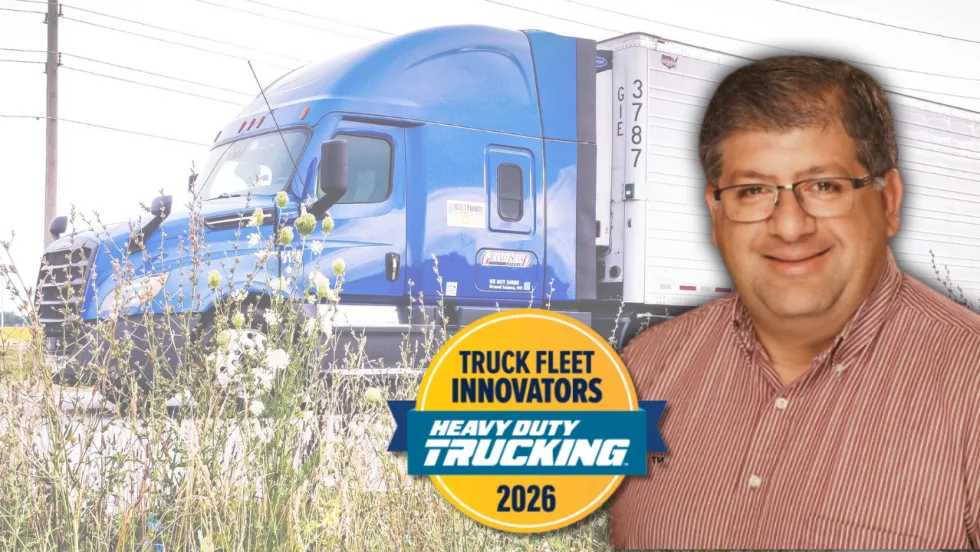
Deen Albert: Let Automation Do the Math, People Make the Decisions
HDT Truck Fleet Innovator Deen Albert makes sure people are still at the heart of operations at Grand Island Express, even while adopting artificial intelligence tools. AI-assisted dispatch helped boost revenue 25% with the same number of trucks.
Read More →
Trimble’s New AI Agent Takes Aim at Fleet Back-Office Busywork
Arc Agent works across Trimble TMS products to automate repetitive tasks such as freight orders, maintenance, invoices, fuel costs and more.
Read More →
How HDT’s 2026 Truck Fleet Innovators Are Rethinking Fleet Operations
Meet five trucking leaders who are challenging assumptions, solving operational problems, and putting innovative ideas to work.
Read More →