




FAA Working to Make Package Delivery by Drones a Reality
Package deliveries by drone will soon be a reality in the Dallas area, as the Federal Aviation Administration works to evolve its regulations to keep up with changing technology.

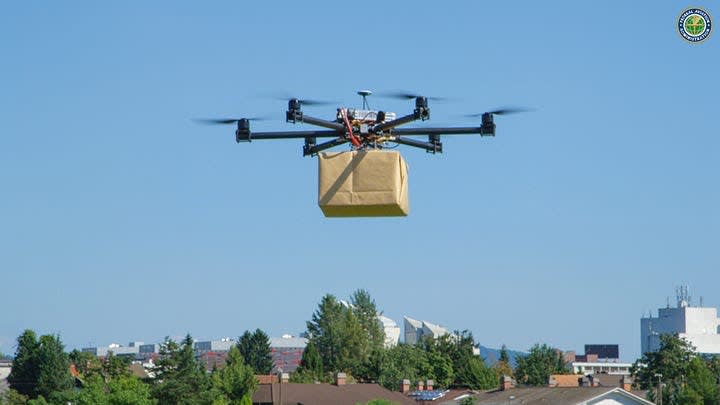
Regulations requiring drone operators to have line-of-sight to the drone have hampered their use in package delivery, but the FAA is working to change that.
FAA
The Federal Aviation Administration has authorized commercial drone flights without visual observers in the same Dallas-area airspace, which the agency said will allow two companies to offer drone package delivery — part of the agency's efforts to evolve its regulations to keep up with changing technology.
The authorizations for Zipline International and Wing Aviation allow them to deliver packages while keeping their drones safely separated using Unmanned Aircraft System Traffic Management (UTM) technology. In this system, the industry manages the airspace “with rigorous FAA safety oversight,” according to the agency.
Typically, when operating drones, the drone pilot must be able to always see the aircraft. However, new advancements in air traffic technology and procedures are providing a key step toward making these Beyond Visual Line of Sight (BVLOS) flights routine, FAA said.
The FAA expects initial flights using UTM services will begin in August and issuing more authorizations in the Dallas area soon.
Last fall, Walmart announced it was partnering with Wing Team, an on-demand drone delivery service provider, to expand airborne service to customers in the Dallas metro area. Wing is powered by Google’s parent company, Alphabet.
How do UTM Services for Drones Work?
Using UTM services, companies can share data and planned flight routes with other authorized airspace users. This allows the operators to safely organize and manage drone flights around each other in shared airspace. All flights occur below 400 feet altitude and away from any crewed aircraft.
The industry developed consensus standards, which the FAA accepted, for how to accommodate multiple layers of low-altitude drone operations through UTM services. This kind of system provides high levels of safety without the need for overly burdensome regulations, the FAA noted in a blog post on Medium.
“The industry is providing us with a lot of detailed documentation and we’re providing a lot of oversight,” said Jarrett Larrow, Regulatory and Policy Lead at the FAA’s UAS Integration Office, quoted in the Medium post. “These public-private partnerships are key to safely integrating drones into our National Airspace System.”
FAA Preparing Drone Proposed Rule
This comes as the FAA works to release the Normalizing UAS BVLOS Notice of Proposed Rulemaking, which would enable drone operators to expand operations while maintaining the same high level of safety as traditional aviation. The agency said it’s on track to release the proposal this year, following strong Congressional support in the recent FAA reauthorization.
“Drones represent a very different type of aircraft than traditional commercial aviation, and the FAA’s approach to this new NPRM has evolved accordingly,” said the FAA in its announcement.
“Industry has created the market and technology, and the agency has worked with them on creative solutions to ensure operations can be done safely – UTM services are a clear example of this innovative approach. The NPRM has been designed to allow operations to scale with the size of the industry.”
More Fleet Management

Color Match Smarter: Tools That Restore & Perform
For fleet managers and collision repair professionals keeping heavy-duty trucks on the road, getting the color right the first time isn't just about appearance — it's about efficiency, turnaround time, and bottom-line results. Discover how today's digital color tools are transforming the repair process from guesswork to precision.
Read More →
FMCSA Pauses Biennial-Update Enforcement Amid Motus Transition
Carriers whose updates were due on or after June 1 have more time, while FMCSA works to stabilize its new registration system and warns of phishing sites impersonating its new carrier registration system, Motus.
Read More →
2026 Blueprint for Countering Smarter Supply Chain Theft
Cargo theft is no longer just the cost of doing business. It's a multi-billion-dollar criminal enterprise exploiting vulnerabilities across your fleet, drivers, and supply chain.
Read More →


How Telematics Improves Visibility, Control, and Performance in Refrigerated Fleets
Explore how telematics help refrigerated fleets improve visibility, uptime, efficiency, compliance, and cargo protection across connected cold chain operations.
Read More →
What the U.S.-Canada Trade War Means for Trucking
Escalating U.S.-Canada tariffs could disrupt cross-border freight, reduce truck volumes, raise costs, and create new uncertainty for carriers on both sides of the border.
Read More →
What Are Trucking’s Top Concerns for 2026?
The American Transportation Research Institute wants to know what's worrying trucking fleet managers, drivers, and other stakeholders in its annual Industry Issues survey.
Read More →
American Trucking Associations Looks for a New Leader
ATA President and CEO Chris Spear abruptly left his job at the association on August 21, at a pivotal time for the trucking industry.
Read More →
Public Wi-Fi Cybersecurity Risks: How Truck Drivers and Fleets Can Protect Their Data
Public Wi-Fi can expose truck drivers and fleets to credential theft, malware, and other cyber threats. Here’s how to reduce the risk on the road.
Read More →
For Nicky Cupp, Fleet Innovation Starts With Frustration
HDT Truck Fleet Innovator Nicky Cupp turns everyday pain points at Fraley & Schilling into opportunities for better technology and smarter processes.
Read More →
Adam Buttgenbach’s Approach to Electric Trucks: Start With Where They Fit
HDT Truck Fleet Innovator Adam Buttgenbach helped PepsiCo build one of North America’s largest EV fleets by focusing on where electric trucks make operational sense.
Read More →