




'Eyes on the Economy' Panel Examines 'OK' Economy
The economy and freight continues to chug along in an "OK" mode, while stagnant capacity and new and pending regulations put the industry "on the cusp of a capacity crunch" if the economy speeds up, according to a panel of economic and industry experts at the American Trucking Associations' annual convention Sunday.


The 'Eyes on the Economy' panel featured, from left, ATA Chief Economist Bob Costello, ACT Research's Kenny Vieth, and Mark Vitner from Wells Fargo. (Photo by Evan Lockridge)
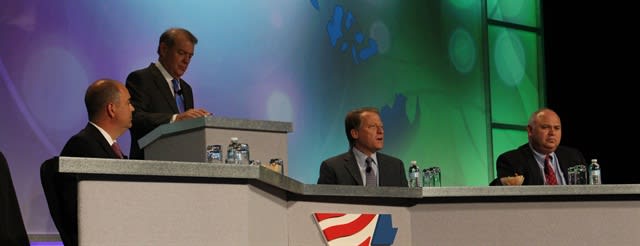
The 'Eyes on the Economy' panel featured, from left, ATA Chief Economist Bob Costello, ACT Research's Kenny Vieth, and Mark Vitner from Wells Fargo. (Photo by Evan Lockridge)
ORLANDO – The economy and freight continues to chug along in an "OK" mode, while stagnant capacity and new and pending regulations put the industry "on the cusp of a capacity crunch" if the economy speeds up, according to a panel of economic and industry experts at the American Trucking Associations' annual convention Sunday.
ATA Chief Economist Bob Costello, along with Kenny Vieth, president and senior analyst at ACT Research Co., and Mark Vitner, managing director and senior economist at Wells Fargo participated in the “All Eyes on the Economy” panel discussion.
The annual "Eyes on the Economy" panel was moderated again by Fox News Channel's Stuart Varney.
"The timing of ATA is absolutely perfect – right at the end of a government shutdown," Varney said. "Back in 2011, you scheduled it right after America's downgrade, and last year, it was right before the presidential election. Do you remember I confidently predicted a win by Gov. Romney? I'm surprised you had me back," he quipped to audience laughter.
After that, however, Varney plunged right into the tough economic questions.
The OK Economy
When asked about truck sales, Vieth said, "We've come out of the Great Recession, and I think right now we're in the great OK." The Class 8 truck population is stagnant, with fleets too uncertain about the economy and regulations to do much more than replace old trucks, if that.
Vitner pointed out that although financial assets are currently at a record high, that's not evenly spread across all incomes.
"The idea behind QE is to bring more liquidity back to the financial markets and produce a wealth effect for folks who are wealthy they go out and spend more," Vitner explained. The strongest growth in income and wealth has been concentrated at the upper end, he said, the top 7%. At the same time, we're seeing growth at the low end, bolstered by transfer payments such as food stamps. This is borne out in the retail sector, he said. "Companies like BMW, Nordstrom's and Saks are doing well. And stores like Dollar General are doing well, and Subway with their four-dollar lunches.
"Unemployment's come down but we haven't seen that much improvement in the job market," Vitner said, predicting we won't see a major improvement until the second half of 2014 or even into 2015.
"We need stronger economic growth and more income growth, particularly among middle income consumers, to get the economy going again."
The Freight Picture
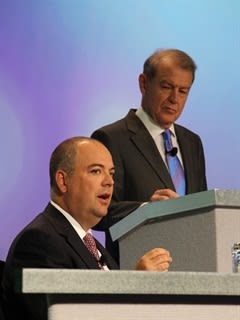
ATA Chief Economist Bob Costello says we are on the cusp of a capacity crunch. (Photo by Evan Lockridge)
So how does that just-OK economy relate to truck freight?
Costello pointed out that you get different results depending on how you look at freight. "It's very choppy." For instance, truck tonnage is up 5%, but truck loads are only up 0.4%. Similarly, if you look by type of trailer, flatbed is up 18%, temperature-controlled is up 2.7%, and tankers are up 5.4% -- but dry van loads are down.
"The parts of the economy that are growing the best just happen to generate heavy loads," Costello said. "You've got fracking for natural gas and crude; that's a lot of sand, water, and chemicals. Homestarts, that's heavy freight, and some of the auto production - engines, transmissions and so forth."
Costello said ATA will release September tonnage numbers on Tuesday. "Expect it to be pretty good," he predicted.
Housing is likely to be one of the bright spots in the economy, although lately results have been mixed to down because of a spike in interest rates after the Fed earlier this year talked about backing off its "quantitative easing" policy, according to Vitner. A record wet summer in the South, where more than half of the nation's homebuilding takes place, also has affected homebuilding, he said, but now that drier fall weather is here, he expects a stronger fall than usual.
Another concern, Vitner said, was the number of speculators in the business. "Prices are up 10% year to year even though the number of homeowners has been going down," he said. "We can't have a sustainable recovery without homeowners. I think the industry is transitioning back to more traditional buyers."
Costello admitted to sounding like a broken record, repeating his proclamation of the past couple of years: There's a capacity crunch coming.
“At the moment, fleets are expanding slowly,” Costello said, “which means that once we see more consistent, accelerated economic growth – think 2.75% or 3% increases in GDP on a regular basis – it will eventually cause very tight capacity.”
"I know I sound like a broken record, but it's got to happen. Maybe later next year, maybe in 2015, we've got to get two or three consecutive quarters of near 3 % GDP growth."
ATA's latest Trucking Activity Report shows capacity is up half a percent, but we're still at 5.7% fewer trucks than December 2007 in truckload, and LTL is really down, 1.6% currently and 15% since December 2007.
Less than 40% of fleets are adding trucks; the other 60% are holding their fleets the same size or decreasing.
With slow growth in loads and rising costs, Costello said fleets could see weakened margins in the near term.
“While we do see tightening capacity going forward, until we get to those consistent levels of growth, margins will be under pressure because the costs of fuel, driver recruitment and retention and equipment will rise faster than freight rates,” he said. “However, once capacity does tighten, carriers will see improvement on the bottom line.”
More Fleet Management

Kodiak Lines Up Fleets for Driverless Trucking
An agreement for 75 trucks, a new Texas freight lane, and progress on safety validation move Kodiak closer to its planned driverless highway launch.
Read More →
ITS Logistics Settles Religious Harassment Case
The Nevada-based logistics firm agreed to pay more than $396,000 to settle a religious harassment charge involving an employee's Jewish identity.
Read More →
Your Trucks Are Busy. That Doesn’t Mean They’re Winning.
High utilization doesn’t always mean strong margins. Looking beyond the current load can help fleets make better dispatch decisions and get more value from each truck’s time.
Read More →
Why This Trucking Recovery Is Different
Freight demand remains sluggish, but rising costs and tougher enforcement have taken enough capacity out of the market to change the outlook for motor carriers.
Read More →
Platform Science Adds Dispatch and Safety Tools
Four additions to PS Fleet help fleets monitor loads, manage driver coaching, share truck locations and adjust video system settings.
Read More →
PrePass Intelligence Mines Fleet Bypass, Toll and Safety Data
PrePass Intelligence helps fleets measure bypass savings, flag potential toll overcharges, and spot suspicious transactions by combining data from separate systems.
Read More →
Motive Adds AI Agents for Fleet Operations
New tools automate follow-up on fleet data, from maintenance work orders to driver alerts, with two-way voice conversations planned for later this year.
Read More →
Can You Beat Our Trucking Trivia Challenge?
Test your truck knowledge with 19 trivia questions from Heavy Duty Trucking Exchange. Can you keep up with the fleet pros?
Read More →
BeyondTrucks Adds Rules Checks to Dispatch
New Compatibility Engine checks driver qualifications, equipment requirements and fleet policies before loads are dispatched.
Read More →
Diesel Prices Hijack Trucking’s Worry List
ATRI’s annual survey finds cautious optimism about freight, but diesel costs, litigation, and insurance continue to squeeze fleets. Drivers have different priorities on several issues.
Read More →