





Related: Embark Hauling Refrigerators to Prove Out Autonomous Truck Tech
Embark's New Road to Autonomous
Embark COO Mike Reid says his company's approach to autonomous trucks will help resolve driver shortage issues while delivering immediate value for fleets.
December 18, 2017
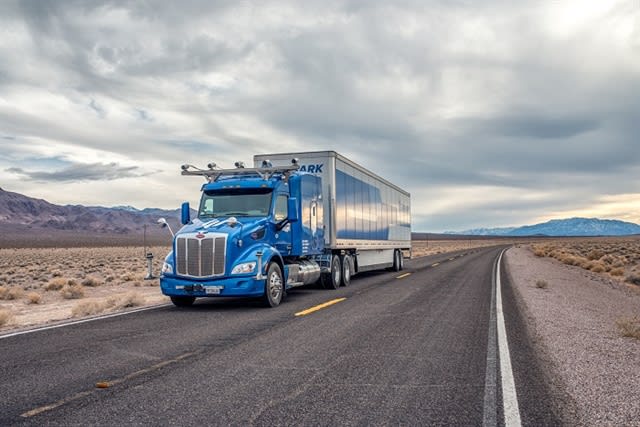
Embark says its initial autonomous vehicle control system will focus on weather-friendly routes with high freight volumes. Photo: Embark
3 min to read
Embark says its initial autonomous vehicle control system will focus on weather-friendly routes with high freight volumes. Photo: Embark
The conversation in trucking has moved beyond debating if autonomous vehicle technology will be applied to commercial vehicles to pondering what the timeline for driverless trucks will be and how comprehensive those systems will be.
Embark is a Silicon Valley-based technology developer that is developing a truck-specific approach to autonomous driving. COO Mike Reid said Embark will address many of the immediate personnel issues in trucking today – and may even create jobs as in-home grocery and last-mile deliveries heat up in the coming months.
Reid, in an exclusive interview with HDT, said that there is “no question” the advent of autonomous vehicle technology will fundamentally change how fleets operate – and that Embark is focusing its initial autonomous vehicle systems to capitalize on those changes.
He said Embark is currently working on a deep-learning autonomous vehicle system that will focus exclusively on dedicated long-haul trucking corridors as a way to introduce the technology with immediate value for early adopters.
That’s why, according to Reid, Embark’s first autonomous vehicle system will be designed to take a semi-truck on long highway runs, with human drivers slipping behind the wheel at “transition points” off the highway to take the trucks into distribution centers, where freight can be offloaded and put on vehicles better suited for urban and last-mile delivery routes.
“A truck running on a long, boring 1,500-mile route is also operating in an environment where its exposure to the number of different and dynamic driving scenarios is seriously constrained,” Reid said. In other words, even at highway speeds, there’s simply a lot less going on that the vehicle’s autonomous control has to anticipate, track, and contend with than in a stretch of urban traffic with pedestrians, bicyclists, congestion, and all the other variables there that come into play.
And instead of developing an autonomous vehicle control system that is simply released onto American streets and expected to deal with the infinite number of variables that human drivers deal with on a daily basis, Reid said Embark will focus on both a retrofit and a new, OEM-spec system that is focused on very specific truck routes with favorable weather conditions and high freight volumes.
“The software ‘brain’ on these trucks will be capable of running these predetermined routes, providing value for fleets from the outset,” he said.
Reid said the result will be a truck that is capable of taking on jobs in a market segment that is proving difficult for fleets to recruit drivers for, while improving their bottom lines. “Our business case to the fleets for our autonomous technology is very simple,” he said. “What if every driver on that route drove their truck like your absolute best driver day in and day out in terms of speed limits, fuel economy, braking, turning, and overall safety? We think those are the sorts of things that will really appeal to fleets – superior vehicle performance with more efficient operations.”
And, Reid noted, dedicated long-haul autonomous technology would allow fleets to shift human drivers away from stressful, hard-to-full routes and instead employ them in urban and last-mile jobs that get them home every night. “There are a lot of issues in play, from legislation to the average age of the current driver pool that make us think we’ll see autonomous vehicles begin to play a role in the trucking industry sooner, rather than later,.
Embark recently announced that it has partnered with Peterbilt as well as Ryder System, and Reid said the company is in the process of proving out its autonomous vehicle concept with commercialization to follow “as soon as possible.”
More Drivers

Why Hiring Truck Drivers Is Getting Harder
Higher recruiting costs, a shrinking driver pool, and renewed pay competition are raising the stakes for fleets heading into 2027.
Read More →
Roehl Offers Truck Drivers $10,000 Retention Incentive
Payments begin after the first load and continue in mileage-based installments for eligible experienced drivers joining the fleet.
Read More →
Platform Science Adds Dispatch and Safety Tools
Four additions to PS Fleet help fleets monitor loads, manage driver coaching, share truck locations and adjust video system settings.
Read More →
When Language Stops the Truck: The Return of ELP Out-of-Service Orders
English language proficiency rules for commercial drivers aren’t new, but renewed out-of-service enforcement has raised the stakes. Here’s what carriers need to know before a driver reaches a roadside inspection.
Read More →
Samsara Launches Custom AI Agent Builder
Agent Studio lets fleets create AI tools for hours-of-service monitoring, reporting and driver support, including agents that communicate by phone.
Read More →
Trucker Path Expands Reserved Parking Network
Trucker Path has added close to 6,000 more truck parking spaces to its Trucker Path Reserved Parking Network with the addition of Safe Truck Parking.
Read More →
EEOC Sues Texas Trucking Company Over Driver Age Limits
The agency says Trancasa USA rejected applicants over 65 and applied tougher driving-record standards to those over 60.
Read More →
Nussbaum, Roehl Announce Second Driver Pay Increase This Year
This year has seen a swath of major truck driver pay increases as freight capacity has tightened.
Read More →
From One Generation to the Next: How Mentorship Builds Safer Truck Drivers
After three decades in trucking, Harold Perry shares what he's learned about driver safety, mentorship, and helping the next generation build confidence behind the wheel.
Read More →
Truck Drivers Need More Than Another Alert
Fleets have more visibility into truck health, safety events, and driver activity than ever. The next challenge is turning all that information into useful guidance for the person who has to decide what to do next.
Read More →