




Electric Trucks Dominate Future-Tech Panel at Aftermarket Meeting
No trucking industry meeting would be complete without a discussion of future technology, and Heavy Duty Aftermarket Dialogue in Dallas Jan. 27 did its part, featuring a panel that focused largely on electric trucks.


An HDAD panel on future technology focused largely on electric trucks.
Photo: John G. Smith
No trucking industry meeting would be complete without a discussion of future technology, especially given all the technology changes currently in the works. Heavy Duty Aftermarket Dialogue in Dallas Jan. 27 did its part to make sure trucking suppliers were educated on future technology, featuring a panel that focused largely on electric trucks.
The panel consisted of Joe Plomin, senior vice president, aftermarket and industrial and trailer, for Meritor; Mike Roeth, executive director of the North American Council for Freight Efficiency; and Gio Sordoni, co-founder and COO of electric-truck startup XOS.
Moderator Brian Daughtery, chief technology officer for the Motor & Equipment Manufacturers Association, kicked off the session by asking panelists to talk about the time frame and applications for deployment of electric vehicles.
Sordoni cited government statistics that show that two-thirds of the freight moved in the U.S. in 2018 only moved 100 miles. “Routes that are short — 150 miles or less — and return to base and predictable routes are suited for electric vehicles,” he said.
Roeth said electrification will start with smaller and medium-duty trucks. “There are early adopters where electric trucks make sense, not from an if standpoint, but from a when, where and how many perspective.”
Plomin noted that one high-use case for electric vehicles is the bus market — both transit and school.
What about the grid?
In conversations about widespread adoption of electric trucks, there always are concerns about the readiness of the charging infrastructure.
Roeth said typically, new technologies follow a crawling, walking, running model, and that lessons learned in the early stages of adoption of electric vehicles need to be passed on quickly.
Sordoni noted, “The availability of electric power will inform real estate decisions for fleets.” He added that while there are only a few places that currently could handle charging a Class 8 vehicle, there are plenty of places with enough power to charge medium-duty trucks, especially if they are not all charged at the same time and if fleets rely on smart and dynamic charging. He also said that utility companies are motivated to help with the transition to electric vehicles – in fact, there are programs available that will cover the costs of the infrastructure to get the electricity to the charging station.
Electric Truck ROI
Return on investment is a key concern for fleets regardless of the technology they choose to invest in.
Plomin said the market is showing interest in electric trucks, but contended that without government help there is no business case for them.
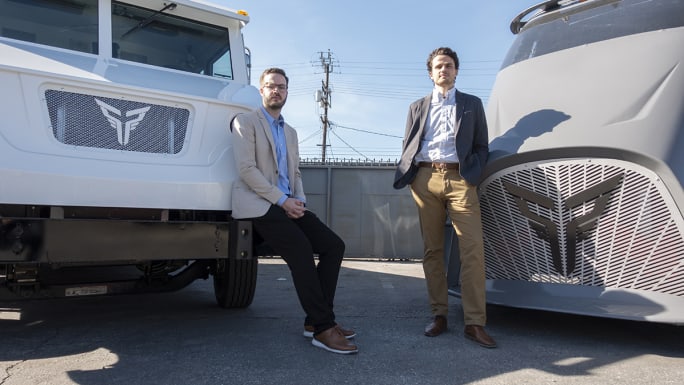
According to XOS’ Sordoni (right) utility companies are motivated to help with the transition to electric vehicles, including programs that will cover the costs of the infrastructure.
Photo: Vince Taroc
Fleets look at total cost of operation when determine ROI, and unfortunately, according to Roeth, “There is a question about resale value of [electric] trucks.” He added that it is not yet clear if fleets will keep electric-powered vehicles longer to get better return, but added that prices are coming down, which will impact ROI.
Sordoni explained that early electric trucks will be more expensive because no one OEM will be building enough to achieve the advantages of scale. He added, “We have not seen any great success in the resale of EVs because the technology is changing so quickly.”
Recent developments indicate that hydrogen fuel cells might help address some of the questions about battery-electric trucks.
Roeth said EV in commercial applications currently have limitations. “When you look at trucks going 400 miles, you are talking a lot of batteries. But there are different ways to store energy, so there are other options.”
One of those options is hydrogen fuel cells. “Electric vehicles do not have a good answer for hauling more than 200 to 300 miles. For longer distances the technology for EVs is not there. For those cases we recommend hydrogen fuel cells.”
A Question of Support
Audience members were able to ask the panel questions, and several people wondered about how some of the new start-up OEMs that are making electric vehicles would support the aftermarket. Plomin said, “The traditional OEMs’ strength is in relationships, and startups will try to replicate that. That will take cooperation.”
Sordoni acknowledged that “there are lot of good companies that make good trucks.” In fact, XOS actually contracts out the truck assembly and keeps its focus on the battery technology.
Since HDAD is an aftermarket event, one audience member asked about what the distribution channel needs to do to get ready for electric vehicles. Plomin said that distributors count on suppliers to educate and train them. “Training needs a multi-pronged approach.” He also reminded meeting attendees that there will always be some mechanical parts, and added, “never underestimate the creativity of the aftermarket.”
Platooning and Autonomy
Several questions were asked about platooning and autonomous vehicles. Roeth said he believes platooning is not dead because of the 4% fuel savings it offers, but that fleets will have to do work on routing to make effective use of platooning.
As for autonomous vehicles, Sordoni pointed out that many drivers do more than just drive, including loading and loading. “They are often seen as the face of a business by its customers.” He added that “fleets are interested in safety, not necessarily autonomous trucks.” Many of the current advanced driver assistance systems that are making trucks safer are also the building blocks for more autonomous operation.
More Equipment

How Volvo Updated Its D13 for EPA 2027 [Watch]
Volvo’s updated D13 promises lower emissions without sacrificing performance or fuel economy. Take a closer look at what changed inside the engine in this HDT Spotlight video.
Read More →
Michelin Tire Improves Efficiency and Durability for Regional Fleets
The Michelin X Multi Energy D2 is a regional haul drive tire engineered to help fleets improve fuel efficiency, durability and traction in demanding stop-and-go operations.
Read More →
ZF Expands Commercial Vehicle Push in North America
ZF is expanding its North American commercial-vehicle presence with new transmission applications, electrification, trailer technology and autonomous-driving systems.
Read More →
Tesla Wants a Self-Driving Semi. Are Cameras Enough?
Could Tesla’s camera-only autonomous driving technology work on an 80,000-pound Semi? In this commentary, HDT's Deborah Lockridge takes a look at Tesla, Cybercab, and how autonomous trucks see the road.
Read More →
Kodiak: Driverless Long-Haul Truck Launch on Track for 2026
Kodiak AI says its driverless long-haul safety case is 93% complete and it remains on track to begin commercial operations by year-end 2026.
Read More →
What DOT’s Automated Vehicle Strategy Means for Trucking
The U.S. Department of Transportation issued a new automated-vehicle strategy that outlines plans for driverless-truck regulations, cross-state freight corridors, and federal safety standards.
Read More →
East Coast Port Launches $45M Electric Truck Push
The Port Authority of New York and New Jersey announced millions in incentives for zero-emission drayage trucks, yard tractors, and new charging hubs near the port.
Read More →
PlusAI Going Public to Fund Autonomous Truck Launch
A SPAC deal could provide PlusAI with up to $300 million as it works toward a 2027 commercial launch of factory-built autonomous trucks.
Read More →
NHTSA Moves to Rewrite Truck Fuel-Economy Rules
The National Highway Traffic Safety Administration says it lacks authority to regulate medium- and heavy-duty truck engines separately from complete vehicles, but the existing standards have not yet been eliminated.
Read More →
Detroit Opens Orders for EPA 2027 Engines
Detroit isn’t starting from scratch to meet EPA 2027 diesel emissions standards. Its Gen 6 DD13 and DD15 engines keep much of today’s platform while updating the fuel and aftertreatment systems.
Read More →