




Effort to Improve International Trucking at an Impasse
U.S. and Canadian trucking interests have for a couple of years been trying to get U.S. Customs and Border Protection to loosen its restrictions on the movement of empty international trailers, but with no success so far
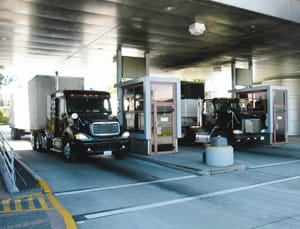
Commercial vehicles at the primary inspection line in Canada. (Photo courtesy of the Canada Border Services Agency)
U.S. and Canadian trucking interests have for a couple of years been trying to get U.S. Customs and Border Protection to loosen its restrictions on the movement of empty international trailers, but with no success so far.
CBP's interpretation of the rules promotes business inefficiency, wastes fuel and increases air pollution, say American Trucking Associations and the Canadian Trucking Alliance.
The current rule makes no sense, say officials at both trucking groups. It results in needless double movements of tractors to reposition empty foreign trailers, said Margaret Irwin, director of Customs, Immigration and Cross Border Operations at ATA.
The rules are the same on both sides of the border, but the Canadian government is willing to change if the U.S. will consent, said David Bradley, CEO of the Canadian Trucking Alliance.
"It's a funny little issue but there's an extremely important principle here," Bradley said. "If our governments are serious about making our economies competitive, if they are serious about facilitating legitimate trade, if they are serious about removing archaic bureaucratic barriers to legitimate business, then show us. If we can't accomplish this minor thing, how can they have any credibility in terms of the bigger picture? This for us is low-hanging fruit and if we can't do this then shame on us."
The U.S. and Canadian associations have petitioned half-dozen U.S. agencies for help but the buck has stopped at CBP, which contends that loosening this restriction would grant foreign drivers access to the domestic labor market.
Bradley scoffed at this view. "I would suppose that there are situations where in order to reposition a foreign empty trailer, you would have a U.S. driver with a U.S. tractor pulling an empty Canadian trailer," he said. "And right in front of him or right behind him is a Canadian tractor with a Canadian driver that's bobtailing to the distribution center so he can pick up a loaded trailer to go home. I don't know how many jobs that is, but does that make any sense?"
Bradley said that CBP has expressed concern that if the rule was relaxed, Canadian companies would set up shunt services in the U.S.
"That's ridiculous," he said. "If you enter and exit with the same trailer, an empty repositioning move is allowed. What we have here is an interpretation of the rules from many years ago that appeared in the old customs field manual. We are convinced that if the Department of Homeland Security and CBP specifically wished to make this happen, they could. The fact that they don't is something of a mystery to us."
Both Irwin and Bradley remain optimistic, however.
"There could be some kind of breakthrough," Irwin said. "The Canadians could talk to DHS Secretary Janet Napolitano. We're open to anything."
Bradley put it this way: "If you are tenacious enough and persistent enough, and if what you are proposing makes sense, common sense will prevail. These things sometimes take years, sadly, but we don't intend to simply drop the issue."
More Drivers

From One Generation to the Next: How Mentorship Builds Safer Truck Drivers
After three decades in trucking, Harold Perry shares what he's learned about driver safety, mentorship, and helping the next generation build confidence behind the wheel.
Read More →
Truck Drivers Need More Than Another Alert
Fleets have more visibility into truck health, safety events, and driver activity than ever. The next challenge is turning all that information into useful guidance for the person who has to decide what to do next.
Read More →
FMCSA Removes 110 Truck Driver Training Schools from Certified ELDT List
Federal regulators also are targeting more than 160 additional training providers and launching a nationwide audit of third-party CDL skills testers as part of a broader crackdown on trucking fraud.
Read More →
Hours of Service Pilot Programs: FMCSA Readies for 2027 Rollout
Two pilot programs could eventually reshape hours-of-service rules, giving truck drivers options to pause their 14-hour clock or use longer split sleeper rest periods.
Read More →
Medical Cards, English Proficiency Reshape Roadcheck Violations
Medical-card violations jumped to the top of the driver out-of-service list during CVSA’s 2026 International Roadcheck, while English-language proficiency violations appeared among the leading violations for the first time.
Read More →
Driver Trust Can Make or Break the Success of Fleet Safety Technology
New Teletrac Navman research suggests that onboarding, transparency about driver data, and positive feedback can play a significant role in how commercial drivers respond to safety and coaching technology.
Read More →
EEOC Sues KLLM Over Alleged Sex Discrimination in Driver Training
KLLM is facing a federal sex-discrimination lawsuit over policies the EEOC alleges put female truck driver trainees at a disadvantage.
Read More →
FMCSA Moves to Codify English Language Requirements for Commercial Drivers
By changing regulations on English-language proficiency requirements for commercial drivers, rather than relying on a guidance memo, the FMCSA said future administrations won't be able to walk back the Trump administration's stricter enforcement with just a memo.
Read More →
Drivers Put Western Star Trucks to the Test at Star Nation Experience
Watch to get an inside look at the Western Star trucks, technology, and community behind the Star Nation Experience 2026!
Read More →
Trump Administration Looks to Put More Veterans Behind the Wheel
The Freedom Haulers program pulls together existing and expanded programs at several federal agencies to recruit veterans to drive commercial heavy-duty trucks and cut the red tape for them to get a CDL, training, and employment.
Read More →