




Economic Watch: Service Sector Loses Steam, Consumer Confidence Up
The latest reading on the health of the nation’s non-manufacturing/service sector of the economy shows it starting the year with slower growth. A separate report shows consumers aren’t paying much heed to recent volatility in financial markets as Federal Reserve officials begin a two-day meeting.

Evan Lockridge・Former Business Contributing Editor
4 min to read

The latest reading on the health of the nation’s non-manufacturing/service sector of the economy shows it starting the year with slower growth. A separate report shows consumers aren’t paying much heed to recent volatility in financial markets as Federal Reserve officials begin a two-day meeting.
The just released Flash U.S. Services Purchasing Managers’ Index from the financial information services provider Markit fell to 53.7 in January from 54.3 in December. Although business activity continues expanding, the headline reading has now signaled weaker overall growth in four of the past five months.
A reading above 50 indicates the service sector is expending; one below 50 shows contraction.
According to the report, service sector firms continued to cite improving domestic economic conditions and rising client demand. However, a number of survey respondents suggested that spending cutbacks across the energy sector had a negative impact on their business activity. There were also some reports that the strong U.S. dollar remained a headwind to growth at the start of 2016.
Growth of new business accelerated from December’s 11-month low, but was still weaker than seen on average in 2015. The survey also indicated that around seven times as many U.S. service providers, 36%, anticipate a rise in business activity over the next 12 months as those that forecast a decline, 5%. Survey respondents mainly attributed their optimism to supportive economic conditions and expected new business gains.
“A struggling manufacturing economy is being accompanied by a services sector where growth showed further signs of losing momentum in January even before the bad weather hit,” said Chris Williamson, chief economist at Markit. “The data are by no means disastrous, signaling a 1.5% annualized rate of economic growth at the start of the year, but the drop in business confidence to one of its lowest levels for over five years suggests that firms are bracing themselves for worse to come.”
He said worries about financial market volatility, the impact of slower growth overseas, a downturn in the energy sector and uncertainty about higher interest rates all took their toll and set the scene for further weakness in coming months.
Consumer Confidence at Three-Month High
Meantime, a report from the private research group The Conference Board shows consumers’ overall feeling are better than they were a month ago.
Its Consumer Confidence Index, which had increased in December to a revised 96.3, improved moderately in January to 98.1. This compares to a post-recession high of 102.6 hit last September. The latest number is the best in three months.
The Present Situation Index was unchanged at 116.4, while the Expectations Index increased from 83 to 85.9 in January.
“Consumer confidence improved slightly in January, following an increase in December,” said Lynn Franco, director of economic indicators at The Conference Board. “Consumers’ assessment of current conditions held steady, while their expectations for the next six months improved moderately. For now, consumers do not foresee the volatility in financial markets as having a negative impact on the economy.”
The percentage of consumers saying business conditions are “good” was virtually unchanged at 27.2%, while those saying business conditions are “bad” declined slightly from 18.9% to 18.5%. Consumers’ assessment of the labor market was modestly more positive.
Their optimism about the short-term outlook improved somewhat in January. The percentage of consumers expecting business conditions to improve over the next six months rose from 14.5% to 16.2%, while those expecting business conditions to worsen edged down from 10.8% to 10.3%.
Consumers’ outlook for the labor market was also slightly more optimistic. Those anticipating more jobs in the months ahead increased from 12.4% to 13.2%, while those anticipating fewer jobs decreased slightly from 16.8% to 16.5%.
Both reports come as the U.S. Federal Reserve’s Open Market Committee began two days of meetings on Tuesday in which it expected to release a statement on Wednesday.
The conventional wisdom is that policymakers will hold off any hike in interest rates following one last month, the first hike in seven years, and the ugly start financial markets experienced early this year.
Since the last Fed meeting, most readings of the economy has been anything but stellar with housing being one of the few bright spots. And while manufacturing has rebounded this month, according to a preliminary report, its still at its second lowest level in a little more than two years.
More Fleet Management

How Innovative Trucking Leaders Turn Change Into an Advantage
As the pace of change accelerates in trucking, the fleets that adapt best have more than the latest technology. They have cultures that embrace improvement.
Read More →
Freight Broker Bonds Just Got Harder to Get. Here's What That Means for Your Fleet.
When it gets harder for a freight broker to prove they are financially sound, the ones who cannot clear that bar get pushed out of the market. And those are exactly the brokers who used to leave motor carriers holding the bag.
Read More →
Long-Awaited Canadian Border Bridge to Open in Detroit
For trucking, the bridge opening should offer immediate improvements in efficiency and reliability, with new customs facilities, expanded inspection capacity, and direct freeway-to-freeway connections.
Read More →
Aurora Rolls Out Next Generation of Driverless Trucks for Commercial Freight
Aurora's latest autonomous trucks it's rolling out with International feature lower-cost hardware designed for a million miles as the company expands commercial driverless freight operations across the U.S. Sun Belt.
Read More →
Freight Tonnage Down, Rates up, as Lower Capacity Powers Trucking Recovery
The recovery from the freight recession continues to be driven by reduction in capacity rather than by increased demand.
Read More →
Think Your Trucking Fleet Isn't Using Much AI? Think Again
Shadow AI — the use of unauthorized artificial intelligence tools at work — is becoming increasingly common, putting sensitive company data at risk. Learn how trucking fleets can protect sensitive data while embracing AI.
Read More →
ArcBest Consolidates Brands, Cuts Workforce
The company will bring three business units under the ArcBest brand, eliminate about 2% of positions, and expects the changes to generate $40 million in annual savings.
Read More →
Trucking Fleets Faced Record Operating Costs During Third Year of Freight Recession
ATRI's annual operational cost report shows carriers trimmed fleets, delayed equipment purchases, and ran older trucks as expenses continued to outpace freight rates.
Read More →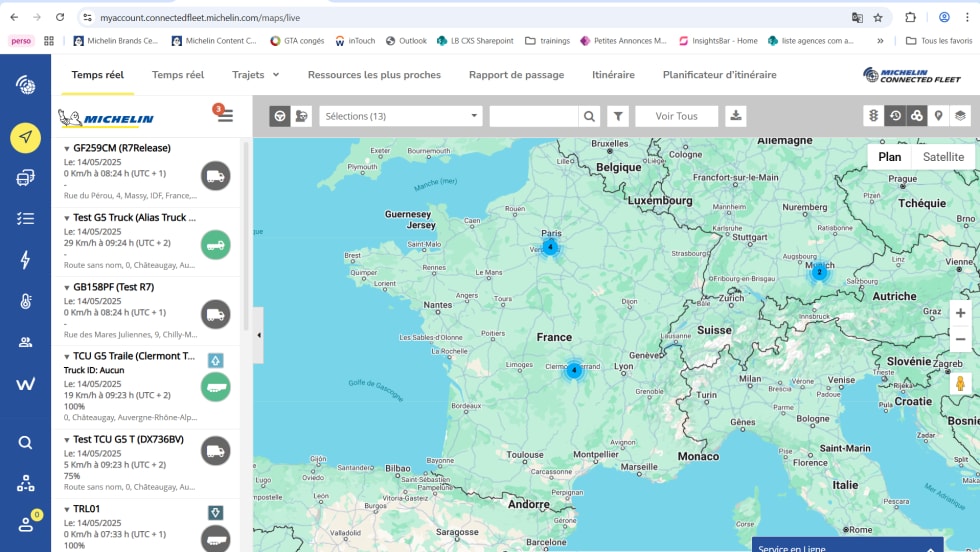
Michelin Adds AI Assistant to MyConnectedFleet Platform
Michelin’s new generative AI tool delivers instant fleet insights, helping managers analyze fuel use, tire maintenance, vehicle status, and operational performance without manually creating reports.
Read More →
LytxOne Platform Now Features AI, Compliance, and Asset Tracking Tools
New enhancements add AI-powered insights, asset tracking, compliance automation, and configurable privacy controls to Lytx's all-in-one fleet management platform.
Read More →