




Economic Watch: Manufacturing, Service Sectors Decline, Employment Jumps
Shipments of manufactured goods in the U.S. increased slightly in November, according to a new and full government report, while new orders posted its third decline in the last four months.



Shipments of manufactured goods in the U.S. increased slightly in November, according to a new and full government report, while new orders posted its third decline in the last four months.
The Commerce Department reports factory shipments increased 0.2% from the month before, following a 0.7% drop in October from September. Movements of manufactured durable goods, items designed to last three years or more, increased 0.8% in November following a 1.2% October gain.
In contrast, new factory orders fell 0.2% in November after a 1.3% increase in October. New orders for manufactured durable goods were virtually unchanged in November following a 2.8% October improvement.
The figures are revised from an earlier advance report released late last month that initially indicated higher shipment levels. New orders levels in this latest report are little changed.
The closely watched non-defense capital goods category, an indicator of future business investment, saw new orders fall 0.4% while shipments fell 0.6%, both slightly higher than earlier-reported numbers. The latter number is used to calculate the nation’s gross domestic product (GPD), the widest measure of overall economic activity.
The manufacturing sector, which accounts for a little more than 10% of all U.S. economic activity, has been hit by headwinds in recent months, with a separate report earlier in the week showing manufacturing is at its lowest level since June 2009.
On a more positive note, manufacturing inventories fell 0.3% in November, while the same decline was seen in the durable goods manufacturing sector. They still remain higher than most analysts would like to see, likely dragging down factory activity, as unfulfilled orders for manufactured durable goods increased 0.2% in November following a 0.3% gain in October.
A separate survey of the nation’s purchasing managers show economic activity in the nation’s service sector slipped in December, but is still expanding.
The Institute for Supply Management’s Non-Manufacturing Index fell 0.6 of a percentage point to 55.9%, the lowest level since April 2014.
“While U.S. manufacturing remains under extreme pressure amid a myriad of factors – including a strong U.S. dollar and a widening gap between central bank policy, tepid international demand, and a hearty inventory overhang – the U.S. service sector has been trucking along, sustaining life in the U.S. economy,” said Stifel Fixed Income Chief Economist Lindsey Piegza. “At this point, while service activity remains the silver lining amid waning manufacturing activity, tepid trade figures, declining home sales and just lukewarm consumption, with back-to-back months of depleted momentum from a recent peak of 60.3 in July, any further decline in activity could undermine the notion of sustained growth in the service sector."
Despite this decline, RBC Economics Economist Laura Cooper expects the U.S. economy to keep the status quo.
“Headwinds facing the factory sector are expected to persist and limit a recovery in manufacturing activity, notably anemic global demand, low crude oil prices and a strong US currency. However, with domestic fundamentals expected to remain favorable for growth and with the Fed expected to only gradually unwind the highly accommodative monetary policy stance, the U.S. economy should remain on solid footing in 2016.”
Employment Booming
Finally, a first look at employment in the U.S. for the final month of last year shows 257,000 private sector jobs were added, according to payroll processor ADP. The report also comes ahead of federal employment and unemployment figures, scheduled for release on Friday.
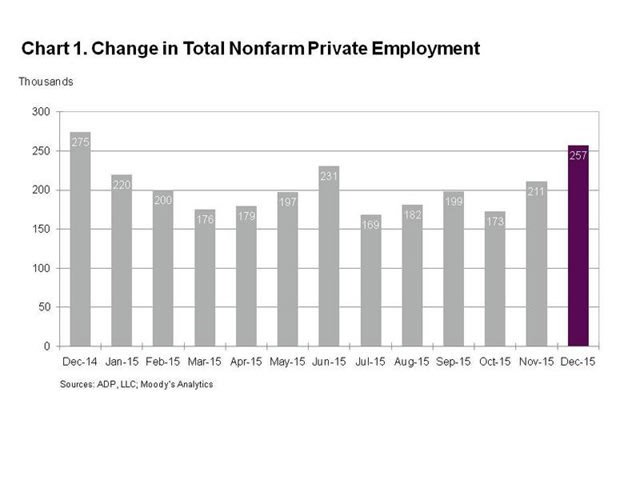
"2015 had a strong close with December, showing the largest job gains of the year," said Ahu Yildirmaz, VP and head of the ADP Research Institute. "Overall, the average monthly employment growth was just under 200,000 for the year in contrast to almost 240,000 jobs per month in 2014. Weakness in the energy and manufacturing sectors was mostly responsible for the drop-off."
Goods-producing employment rose by 23,000 jobs in December, well up from a downwardly revised loss of 2,000 the previous month. The construction industry added 24,000 jobs, which was roughly in line with the 21,000 average monthly jobs gained for the year. Meanwhile, manufacturing stayed in positive territory for the second straight month adding 2,000 jobs.
Service-providing employment rose by 234,000 jobs in December, up from an upwardly revised 213,000 in November. The report also shows that professional/business services contributed 66,000 jobs, the largest increase in this sector in 2015. Trade/transportation/utilities grew by 38,000, off a bit from an upwardly revised 41,000 the previous month.
Mark Zandi, chief economist of Moody's Analytics, said, "Strong job growth shows no signs of abating. The only industry shedding jobs is energy. If this pace of job growth is sustained, which seems likely, the economy will be back to full employment by mid-year. This is a significant achievement, given that the last time the economy was at full employment was nearly a decade ago."
More Fleet Management

Color Match Smarter: Tools That Restore & Perform
For fleet managers and collision repair professionals keeping heavy-duty trucks on the road, getting the color right the first time isn't just about appearance — it's about efficiency, turnaround time, and bottom-line results. Discover how today's digital color tools are transforming the repair process from guesswork to precision.
Read More →
FMCSA Pauses Biennial-Update Enforcement Amid Motus Transition
Carriers whose updates were due on or after June 1 have more time, while FMCSA works to stabilize its new registration system and warns of phishing sites impersonating its new carrier registration system, Motus.
Read More →
2026 Blueprint for Countering Smarter Supply Chain Theft
Cargo theft is no longer just the cost of doing business. It's a multi-billion-dollar criminal enterprise exploiting vulnerabilities across your fleet, drivers, and supply chain.
Read More →


How Telematics Improves Visibility, Control, and Performance in Refrigerated Fleets
Explore how telematics help refrigerated fleets improve visibility, uptime, efficiency, compliance, and cargo protection across connected cold chain operations.
Read More →
What the U.S.-Canada Trade War Means for Trucking
Escalating U.S.-Canada tariffs could disrupt cross-border freight, reduce truck volumes, raise costs, and create new uncertainty for carriers on both sides of the border.
Read More →
What Are Trucking’s Top Concerns for 2026?
The American Transportation Research Institute wants to know what's worrying trucking fleet managers, drivers, and other stakeholders in its annual Industry Issues survey.
Read More →
American Trucking Associations Looks for a New Leader
ATA President and CEO Chris Spear abruptly left his job at the association on August 21, at a pivotal time for the trucking industry.
Read More →
Public Wi-Fi Cybersecurity Risks: How Truck Drivers and Fleets Can Protect Their Data
Public Wi-Fi can expose truck drivers and fleets to credential theft, malware, and other cyber threats. Here’s how to reduce the risk on the road.
Read More →
For Nicky Cupp, Fleet Innovation Starts With Frustration
HDT Truck Fleet Innovator Nicky Cupp turns everyday pain points at Fraley & Schilling into opportunities for better technology and smarter processes.
Read More →
Adam Buttgenbach’s Approach to Electric Trucks: Start With Where They Fit
HDT Truck Fleet Innovator Adam Buttgenbach helped PepsiCo build one of North America’s largest EV fleets by focusing on where electric trucks make operational sense.
Read More →