




“Comments from the panel indicate mostly stable to improving business conditions, with the notable exception relating to the oil and gas markets."
Economic Watch: Jobs Growing, Manufacturing Expanding
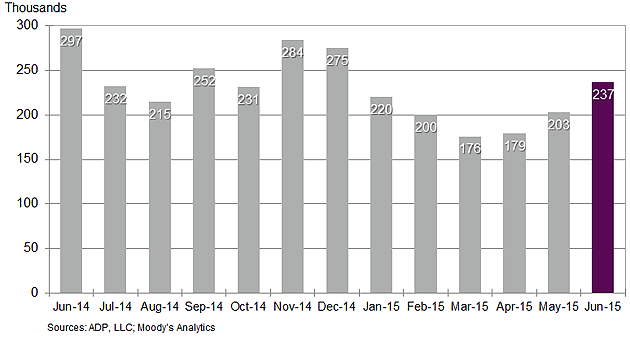
Private sector employment in June saw its biggest month-over-month improvement since December, the third month-over-month jump in a row.

Evan Lockridge・Former Business Contributing Editor
3 min to read

Private sector employment increased by 237,000 jobs from May to June, according to payroll processor ADP's National Employment Report. That's the biggest gain since last December and the third straight month-over-month improvement.
“The U.S. job machine remains in high gear,” said Mark Zandi, chief economist of Moody’s Analytics. “The current robust pace of job growth is double that needed to absorb the growth in the working age population. The only blemish in the job market is the loss of jobs in the energy sector. Most encouraging is the healthy rate of job growth among the nation’s smallest companies.”
Small business, those with 49 or fewer employees, accounted for just over half the job gains during June.
Goods-producing employment rose by12,000 jobs in June, after adding 11,000 in May. The construction industry had another solid month in June, adding 19,000 jobs, down from 28,000 last month. Meanwhile, manufacturing added 7,000 jobs in June, after losing 2,000 in May.
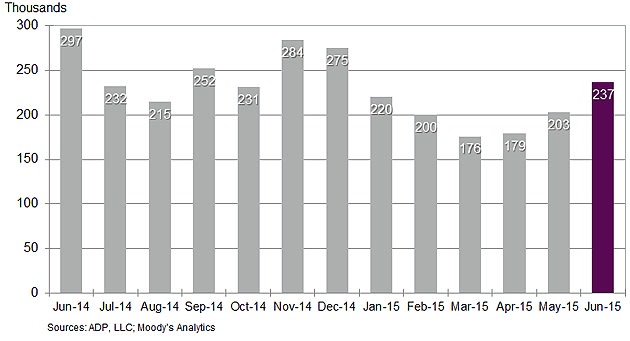
The May total of jobs added was revised from 201,000 to 203,000.
The report comes before federal job numbers, including unemployment, on Thursday are released for June.
Meantime, a separate report shows economic activity in the manufacturing sector expanded in June for the 30th consecutive month, according to the nation’s supply executives.
The Institute for Supply Management’s Purchasing Managers Index registered 53.5%, an increase of 0.7 of percentage point over the May reading of 52.8%.
A PMI in excess of 43.1%, over a period of time, generally indicates an expansion of the overall economy, according to the group.
The New Orders Index registered 56%, an increase of 0.2 of a percentage point from the reading of 55.8% in May while the Production Index registered 54%, 0.5 of percentage point below the May reading of 54.5%.
Of the 18 manufacturing industries, 11 reported growth in June.
“Comments from the panel indicate mostly stable to improving business conditions, with the notable exception relating to the oil and gas markets. Also noted is the negative effect on egg prices and availability due to the avian flu outbreak,” said Bradley J. Holcomb, chair of the Institute for Supply Management Manufacturing Business Survey Committee.
A separate report on the nation’s manufacturing sector was more sober in its assessment of conditions.
The seasonally adjusted final U.S. Manufacturing Purchasing Managers’ Index from the financial information services provider Markit registered 53.6 in June, down from 54 in May and the lowest reading since October 2013.
Despite the decline, the index remained above the 50 mark that separates expansion from contraction.
The report indicated a slower improvement in overall business conditions across the U.S. manufacturing sector, with softer output growth offsetting a slight pick-up in the pace of new business gains and job creation. The latest survey indicated that subdued export demand remained a key factor weighing down overall new order growth, as highlighted by a fall in new work from abroad for the third month running.
“Investment spending also appears to be waning, with recent months seeing the slowest growth of new orders for business equipment and machinery for two years,” said Chris Williamson, chief economist at Markit. “The investment slowdown suggests companies are becoming more risk averse and cautious in their spending. The current impressive rate of factory job creation could soon likewise wane unless the outlook improves."
He said the good news is that the export and investment drags are being offset by an ongoing surge in consumer spending, which is in turn most likely linked to falling prices in recent months.
“An upturn in growth of new orders for consumer goods helped drive an increase in overall manufacturing orders books during the month, providing a ray of hope that output growth will stabilize at its current modest pace,” Williamson said.
More Fleet Management

What the U.S.-Canada Trade War Means for Trucking
Escalating U.S.-Canada tariffs could disrupt cross-border freight, reduce truck volumes, raise costs, and create new uncertainty for carriers on both sides of the border.
Read More →
What Are Trucking’s Top Concerns for 2026?
The American Transportation Research Institute wants to know what's worrying trucking fleet managers, drivers, and other stakeholders in its annual Industry Issues survey.
Read More →
American Trucking Associations Looks for a New Leader
ATA President and CEO Chris Spear abruptly left his job at the association on August 21, at a pivotal time for the trucking industry.
Read More →
Public Wi-Fi Cybersecurity Risks: How Truck Drivers and Fleets Can Protect Their Data
Public Wi-Fi can expose truck drivers and fleets to credential theft, malware, and other cyber threats. Here’s how to reduce the risk on the road.
Read More →
For Nicky Cupp, Fleet Innovation Starts With Frustration
HDT Truck Fleet Innovator Nicky Cupp turns everyday pain points at Fraley & Schilling into opportunities for better technology and smarter processes.
Read More →
Adam Buttgenbach’s Approach to Electric Trucks: Start With Where They Fit
HDT Truck Fleet Innovator Adam Buttgenbach helped PepsiCo build one of North America’s largest EV fleets by focusing on where electric trucks make operational sense.
Read More →
Deen Albert: Let Automation Do the Math, People Make the Decisions
HDT Truck Fleet Innovator Deen Albert makes sure people are still at the heart of operations at Grand Island Express, even while adopting artificial intelligence tools. AI-assisted dispatch helped boost revenue 25% with the same number of trucks.
Read More →
Trimble’s New AI Agent Takes Aim at Fleet Back-Office Busywork
Arc Agent works across Trimble TMS products to automate repetitive tasks such as freight orders, maintenance, invoices, fuel costs and more.
Read More →
How HDT’s 2026 Truck Fleet Innovators Are Rethinking Fleet Operations
Meet five trucking leaders who are challenging assumptions, solving operational problems, and putting innovative ideas to work.
Read More →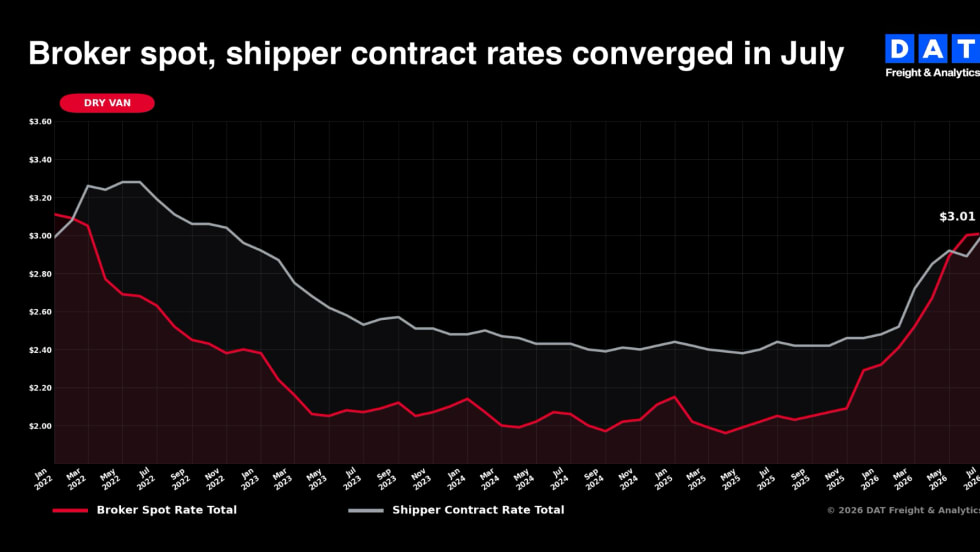
Tight Trucking Capacity Pushes Rates Higher Even as Freight Volumes Fall
“Spot rates moving ahead of contract rates have historically signaled a tightening market, but we haven’t seen a capacity-driven market quite like this one,” said DAT's Dean Croke.
Read More →