




Economic Watch: Job Gains Ease Last Month, Service Sector Expands
Employment in the private sector increased again in February, but it was the weakest gain in six months.

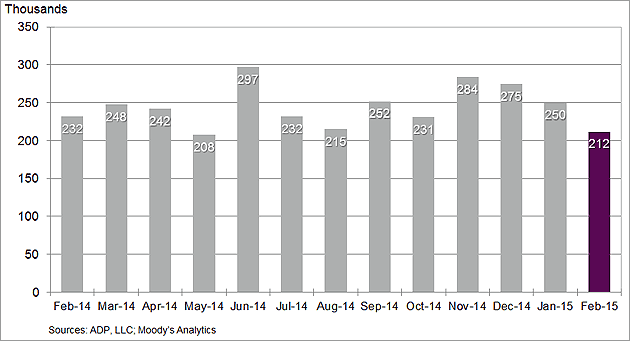
Change in nonfarm private employment. Graphic: ADP
Change in nonfarm private employment.Graphic: ADP
Employment in the private sector increased again in February, but it was the weakest gain in six months.
According to payroll processor ADP, there were 212,000 job gains in the U.S. in February, down from January’s figure that was revised from 213,000 to 250,000. The report comes two days before the government releases unemployment figures for February.
Goods-producing employment rose by 31,000 jobs in February, down from 45,000 jobs gained in January. The construction industry added 31,000 jobs, the same number as last month. Meanwhile, manufacturing added 3,000 jobs in February, well below January’s 15,000.
"While February’s job gains came in slightly lower than recent months, the trend of solid growth above 200,000 jobs per month continued,” said Carlos Rodriguez, president and chief executive officer of ADP. “What is also encouraging is that job gains are broad-based across all key industries.”
Service-providing employment rose by 181,000 jobs in February, down from 206,000 in January. The ADP National Employment Report indicates that professional/business services contributed 34,000 jobs in February, a drop-off from January’s 49,000. Expansion in trade/transportation/utilities grew by 31,000, a sharp decline from January’s 50,000. The 20,000 new jobs added in financial activities is an increase from last month’s 15,000 and marks the largest gain in that sector since March 2006.
“Job growth is strong, but slowing from the torrid pace of recent months. Job gains remain broad-based, although the collapse in oil prices has begun to weigh on energy-related employment,” said Mark Zandi, chief economist of Moody’s Analytics. “At the current pace of growth, the economy will return to full employment by mid-2016.”
Job gains were seen in businesses of all sizes but only those with 500 or more employees saw a level that was higher for the month than compared to January
The report is derived from ADP payroll data, which represents 411,000 U.S. clients employing nearly 24 million workers in the U.S.
See graphic at the bottom of this story for more employment figures.
Non-Manufacturing Activity Rises
U.S. service providers indicated stronger underlying growth trends in February, with output and new business volumes both rising at the fastest rates for four months.
The final February U.S. Services Business Activity Index from the financial information services provider Markit registered 57.1 for the month, up from 54.2 during January and the highest reading since October 2014.
This latest figure is up slightly from a level of 57 in the preliminary report released just over a week ago. A reading over 50 indicates growth in the sector.
Reports from survey respondents suggested that stronger client demand and improving economic conditions had boosted business activity in February. Firms noted that bad weather in the Northeast had caused disruptions early in February, but a number of respondents also suggested that there had been a catch-up effect towards the end of the month, according to the report.
“Even with the strong growth recorded in February, the average reading across the manufacturing and services surveys for the first quarter so far is up only slightly compared to the fourth quarter of last year, meaning growth this year is running at a rate similar to the 2.2% annualized pace seen late last year,” said Chris Williamson, chief economist at Markit. “That’s certainly not a pace of expansion that will worry the Federal Reserve into hiking interest rates any time soon. However, the ongoing resilience of the U.S. economy, and in particular the sustained robust job creation signaled in February, adds to the sense that policymakers will continue to prepare the ground for a rate rise later this year.”
Meantime, a separate report on economic activity in the nation’s services sector shows it grew again in February, according to the nation’s purchasing and supply executives.
The latest Non-Manufacturing Report on Business from the Institute for Supply Management shows the composite index registered 56.9% in February, up 0.2 of a percentage point from January. Like the report from Markit, a number over 50 indicates expansion.
The Non-Manufacturing Business Activity Index decreased to 59.4%, which is 2.1 percentage points lower than the January reading, reflecting growth for the 67th consecutive month, but at a slower rate. The New Orders Index registered 56.7%, 2.8 percentage points lower than the reading registered in January, while the Employment Index increased 4.8 percentage points to 56.4% from January, showing growth for the 12th consecutive month.
“According to the NMI, 14 non-manufacturing industries reported growth in February,” said Anthony Nieves, chair of the Institute for Supply Management Non-Manufacturing Business Survey Committee. “Comments from respondents have increased in regards to the affects of the reduction in fuel costs and the impact of the West Coast port labor issues on the continuity of supply. Overall, supply managers feel mostly positive about the direction of the economy."
More Fleet Management

Color Match Smarter: Tools That Restore & Perform
For fleet managers and collision repair professionals keeping heavy-duty trucks on the road, getting the color right the first time isn't just about appearance — it's about efficiency, turnaround time, and bottom-line results. Discover how today's digital color tools are transforming the repair process from guesswork to precision.
Read More →
FMCSA Pauses Biennial-Update Enforcement Amid Motus Transition
Carriers whose updates were due on or after June 1 have more time, while FMCSA works to stabilize its new registration system and warns of phishing sites impersonating its new carrier registration system, Motus.
Read More →
2026 Blueprint for Countering Smarter Supply Chain Theft
Cargo theft is no longer just the cost of doing business. It's a multi-billion-dollar criminal enterprise exploiting vulnerabilities across your fleet, drivers, and supply chain.
Read More →


How Telematics Improves Visibility, Control, and Performance in Refrigerated Fleets
Explore how telematics help refrigerated fleets improve visibility, uptime, efficiency, compliance, and cargo protection across connected cold chain operations.
Read More →
What the U.S.-Canada Trade War Means for Trucking
Escalating U.S.-Canada tariffs could disrupt cross-border freight, reduce truck volumes, raise costs, and create new uncertainty for carriers on both sides of the border.
Read More →
What Are Trucking’s Top Concerns for 2026?
The American Transportation Research Institute wants to know what's worrying trucking fleet managers, drivers, and other stakeholders in its annual Industry Issues survey.
Read More →
American Trucking Associations Looks for a New Leader
ATA President and CEO Chris Spear abruptly left his job at the association on August 21, at a pivotal time for the trucking industry.
Read More →
Public Wi-Fi Cybersecurity Risks: How Truck Drivers and Fleets Can Protect Their Data
Public Wi-Fi can expose truck drivers and fleets to credential theft, malware, and other cyber threats. Here’s how to reduce the risk on the road.
Read More →
For Nicky Cupp, Fleet Innovation Starts With Frustration
HDT Truck Fleet Innovator Nicky Cupp turns everyday pain points at Fraley & Schilling into opportunities for better technology and smarter processes.
Read More →
Adam Buttgenbach’s Approach to Electric Trucks: Start With Where They Fit
HDT Truck Fleet Innovator Adam Buttgenbach helped PepsiCo build one of North America’s largest EV fleets by focusing on where electric trucks make operational sense.
Read More →