




Economic Watch: Existing Home Sales Slip, Total U.S. Construction Falls
After four consecutive months of gains, existing-home sales slipped in August, according to the National Association of Realtors, but remains near its highest level so far this year.
After four consecutive months of gains, existing-home sales slipped in August, according to the National Association of Realtors, but remains near its highest level so far this year.
Total existing-home sales decreased 1.8% to a seasonally adjusted annual rate of 5.05 million in August from a slight downwardly revised 5.14 million in July. Sales were at the second-highest pace of 2014, but 5.3% below the 5.33 million level from last August, which was also the second-highest sales level of 2013.
Lawrence Yun, NAR chief economist, said sales activity remains stronger than earlier in the year, but fell last month as investors stepped away.
"There was a marked decline in all-cash sales from investors,” he said. "On the positive side, first-time buyers have a better chance of purchasing a home now that bidding wars are receding and supply constraints have significantly eased in many parts of the country. As long as solid job growth continues, wages should eventually pick up to steadily improve purchasing power and help fully release the pent-up demand for buying.”
Regionally, August existing home sales in the Northeast jumped 4.7% while in the Midwest, it gained 2.5%. Existing-home sales in the South declined 4.2% while existing-home sales in the West fell 5.1%.
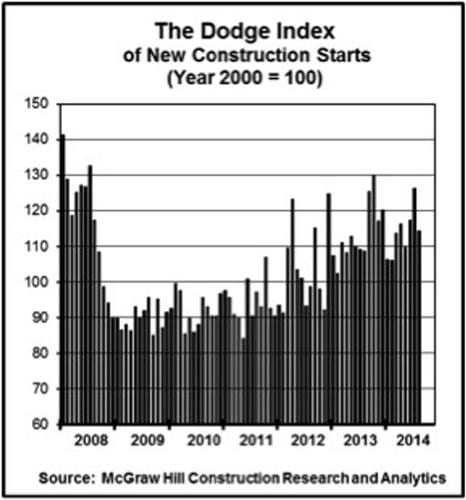
A separate report shows new construction starts in the U.S. during August dropped 9%, according to McGraw Hill Construction. The decline followed July's elevated volume, the strongest so far in 2014, and brought activity back to the average pace reported during the first seven months of this year.
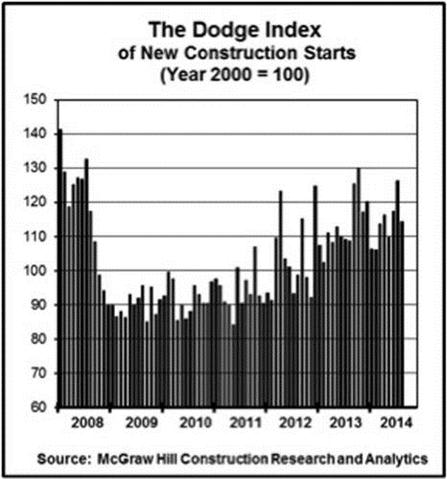
By major sector, nonresidential building fell sharply, after being lifted in July by the start of several large manufacturing plant projects, while nonbuilding construction, such as public works and electric utilities construction, also retreated. Residential building in August ran counter by posting a modest gain, helped by the continued growth for multifamily housing.
Through the first eight months of 2014, total construction starts on an unadjusted basis were $361.4 billion, up 4% from the same period a year ago.
"The broad trend for construction activity remains upward, but on a month-to-month basis there are still the occasional setbacks," said Robert A. Murray, chief economist for McGraw Hill Construction. "Nonresidential building over the past two months was boosted by the start of several unusually large energy-related manufacturing projects, so the pullback in August was not unexpected.”
He said the public works construction is now settling back with the August passage of the $10.8 billion patch to the Highway Trust Fund, which should help to keep the slide from getting too severe.
“Residential building continues to be supported by the ongoing strength shown by multifamily housing,” Murray said. “However, this year's pause for single family housing has emerged as an area of concern, limiting the growth that's being reported for total construction activity."
More Fleet Management

Why Private Fleets Are Taking More Freight
Private fleets are putting their own trucks on demanding customers and high-cost lanes as companies seek greater control over service, costs, and capacity.
Read More →
Color Match Smarter: Tools That Restore & Perform
For fleet managers and collision repair professionals keeping heavy-duty trucks on the road, getting the color right the first time isn't just about appearance — it's about efficiency, turnaround time, and bottom-line results. Discover how today's digital color tools are transforming the repair process from guesswork to precision.
Read More →
FMCSA Pauses Biennial-Update Enforcement Amid Motus Transition
Carriers whose updates were due on or after June 1 have more time, while FMCSA works to stabilize its new registration system and warns of phishing sites impersonating its new carrier registration system, Motus.
Read More →


2026 Blueprint for Countering Smarter Supply Chain Theft
Cargo theft is no longer just the cost of doing business. It's a multi-billion-dollar criminal enterprise exploiting vulnerabilities across your fleet, drivers, and supply chain.
Read More →
How Telematics Improves Visibility, Control, and Performance in Refrigerated Fleets
Explore how telematics help refrigerated fleets improve visibility, uptime, efficiency, compliance, and cargo protection across connected cold chain operations.
Read More →
What the U.S.-Canada Trade War Means for Trucking
Escalating U.S.-Canada tariffs could disrupt cross-border freight, reduce truck volumes, raise costs, and create new uncertainty for carriers on both sides of the border.
Read More →
What Are Trucking’s Top Concerns for 2026?
The American Transportation Research Institute wants to know what's worrying trucking fleet managers, drivers, and other stakeholders in its annual Industry Issues survey.
Read More →
American Trucking Associations Looks for a New Leader
ATA President and CEO Chris Spear abruptly left his job at the association on August 21, at a pivotal time for the trucking industry.
Read More →
Public Wi-Fi Cybersecurity Risks: How Truck Drivers and Fleets Can Protect Their Data
Public Wi-Fi can expose truck drivers and fleets to credential theft, malware, and other cyber threats. Here’s how to reduce the risk on the road.
Read More →
For Nicky Cupp, Fleet Innovation Starts With Frustration
HDT Truck Fleet Innovator Nicky Cupp turns everyday pain points at Fraley & Schilling into opportunities for better technology and smarter processes.
Read More →