



Series: Electrification Simplified, BAE-Style
Part 1: Eaton, BAE Systems Unveil Lightweight Electronic Powertrain
Part 2: BAE/Eaton's Class 7 Demonstrator EV Chassis: Keep it Simple
 MENU
MENU SEARCH
A new partnership between Eaton and BAE Systems is already delivering new technologies for commercial vehicle electrification.
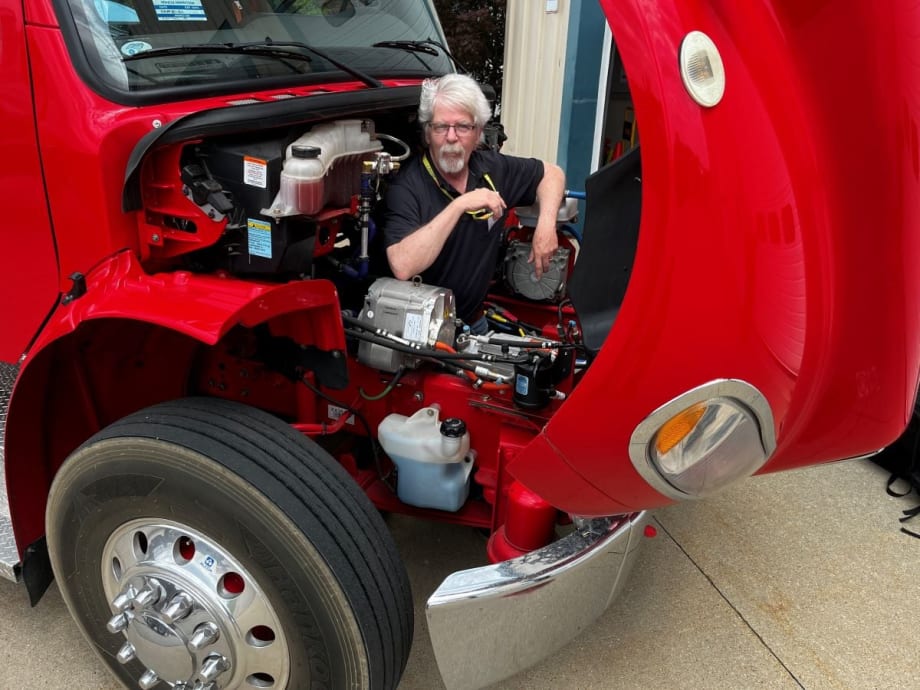
A high level of electronic integration and modular design reduces the parts count from 145 to 69, freeing up previously occupied chassis real estate and space under the hood. (the author is standing in the engine compartment between the frame rails with both feet planted firmly on the ground).
Photo: Jim Park
BAE Systems isn't a household name in trucking — but it might soon be. The fruits of a collaboration with Eaton are already generating a buzz among original equipment manufacturers and commercial vehicle modifiers, as I learned recently on a trip to the Eaton Proving Grounds outside of Marshall, Michigan, where they showed off a lightweight powertrain designed for electric trucks.
BAE is best known for its contributions to aerospace engineering: fighter jets, aero-engine controls, the Mars Rover lander, The James B. Webb telescope ... And propulsion systems for electric transit buses.
BAE has been developing electric propulsion systems for buses for over 25 years and currently powers nearly 18,000 of them across 25 different platforms. Those buses operate in dozens of challenging markets, including San Francisco, New York City, Boston, Seatle, Paris, and London.
"We're big, we're committed to electrification, and we've got a lot of experience with 5 billion miles of revenue service on Class 8 electrified vehicles," said Tom Webb, director of business development and strategy, power and propulsion systems at BAE Systems. "That's buses, mind you, not trucks, but there are similarities there."
The value proposition BAE intends to offer through its relationship with Eaton is a highly integrated powertrain at a fraction of the weight and cost of what could be called typical of today's Class 7 or Class 8 trucks.
Webb said it's about consolidating and integrating as many of the electric functions currently delivered by six, eight or even 12 separate control units, or "boxes," into a two-box solution, and eventually into a single controller.
"Our roadmap is to get to a one-box solution by 2027," Webb said, speaking at a media briefing held in June at Eaton's proving grounds in Marshall Michigan. "The obvious benefits are weight reduction, bill of material reduction, simplification, lower costs and improved reliability.
"And that brings us to modularity — the ability to separate or add and expand and configure those highly integrated components to match the needs of the vehicle and its duty cycle," he added. "For the OEM, it means getting to market faster while lowering their non-recurring expenses, particularly if they have wide product portfolio."
Come 2027, the so-called one-box option will still be offered in a two-box configuration, as it sits today. Webb said some OEMs may desire some chassis placement flexibility.
Integration can yield a weight reduction of about 50% compared to a typical first-generation Class 7 EV chassis, according to Webb, while reducing the parts count from 145 to 69. This would include significant reductions in high-voltage cable, connectors, coolant lines and fittings, components and component mounts while freeing up previously occupied chassis real estate and space under the hood.
Eaton's role in this is not insignificant. The company has enjoyed standard-spec placement on heavy and medium trucks for decades. Best known for clutches, manual and automated transmissions, differentials and gearing, and more, Eaton is expanding its product portfolio into the EV space with power electronics offerings, power distribution, EV gearing, torque control products and automated EV transmissions.
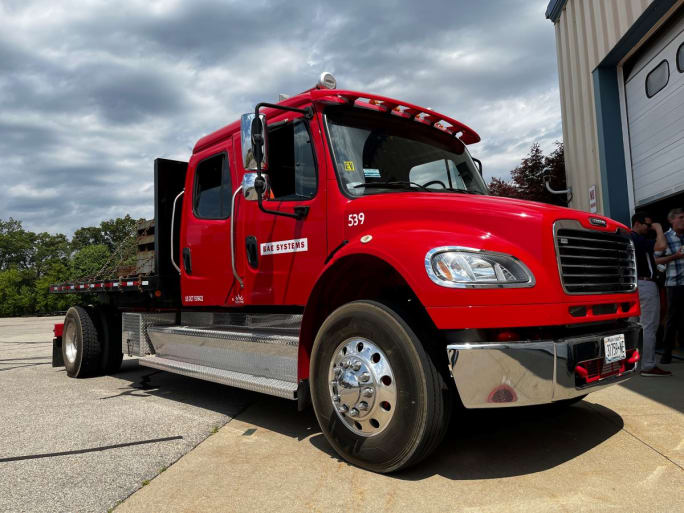
BAE Systems and Eaton unveiled this demonstration truck at the Marshall Proving Grounds in June. It combines BAE's suite of power dense, advanced power electronics with Eaton’s MD 4-speed EV transmission to provide a full heavy-duty EV system.
Photo: Jim Park
Interestingly, Eaton is a significant player in the electrical world, accounting for about two-thirds of the company's business. This includes everything from a 20-amp circuit breaker you can buy at any hardware store, to vacuum breakers used in medium-voltage electrical distribution substations.
"We offer a host of electrical components, switch gear and panel boards for data centers, etc.," said Justin Hopkins, Eaton's product director for EV gearing and transmissions. "We have a ton of experience there gained through the acquisition of companies like Westinghouse, Cutler Hammer, Cooper Bussmann and others over the past four decades or so.
"While that technology is from the Industrial side of Eaton, some of it will translate to the fleet side with charging solutions that will complement our on-vehicle powertrain solutions," he added.
Presently, Eaton's role in the EV space is limited to Thomas Built school buses, for which it provides a two-speed medium-duty transmission, and a soon-to-expire agreement with bankrupt transit bus maker Proterra. Eaton also provided the medium-duty four-speed transmission for the transit bus business.
"We do still have some of that lingering business, but obviously those dynamics changed with their reconfiguration on a bankruptcy," Hopkins said.
Eaton's strategic decision to not get into the electric motor space left a nice opening for this collaboration with BAE Systems. Eaton does not have the commercial vehicle inverters and the rest of the accessory power electronics that BAE does, and BAE is better served with proven application-tailored transmission.
"It made sense to work together because we do have such complementary portfolios, even though we're both involved in the segments with different technologies," Hopkins said. "EV transmissions was kind of a natural fit. I think both companies realized there are benefits to having a multi-speed transmission in some but not all applications."
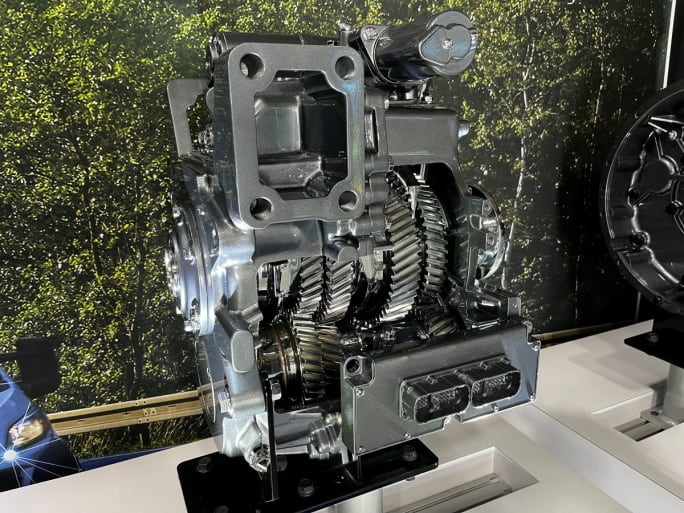
Eaton's MD 4-speed automated manual EV transmission improves startability and gradability while improving energy efficiency at highway speeds.
Photo: Jim Park
The agreement between BAE Systems and Eaton, announced last May, follows the signing of a memorandum of understanding between the two.
The MoU provided a non-exclusive, co-marketing arrangement where each can maintain the share of certain markets but collaborate in area of mutual benefit.
"Eaton continues selling transmissions to OEMs that may have selected a different motor and already partnered with different powertrain providers," Hopkins explained. "Likewise, BAE can and will continue to sell direct drive systems where there's no transmission and certainly are going to be open to selling their power electronics and motors to customers who may have a different transmission in mind."

Volvo’s updated D13 promises lower emissions without sacrificing performance or fuel economy. Take a closer look at what changed inside the engine in this HDT Spotlight video.
Read More →
Energy Vision estimates fleets could recover the higher purchase price of an RNG-fueled Class 8 tractor in 1.3 to 2.8 years under current fuel-price scenarios.
Read More →
Calstart is now Catalyst Mobility, reflecting the nonprofit’s growing national role in clean transportation, including zero-emission trucks, infrastructure and incentive programs.
Read More →
Average U.S. diesel prices have climbed to nearly $6 a gallon, surpassing the 2022 record as tight refinery capacity and Middle East disruptions keep fuel costs elevated.
Read More →
Fuel delivery depends on more than what happens at the injector. For fleet, maintenance and technical professionals, looking at the full path from pump to injector can provide useful context for understanding engine performance.
Read More →
The Port Authority of New York and New Jersey announced millions in incentives for zero-emission drayage trucks, yard tractors, and new charging hubs near the port.
Read More →
Why do battery-electric Class 8 trucks remain so expensive? A California bill headed to Gov. Gavin Newsom would give fleets and state agencies more visibility into what manufacturers charge.
Read More →
Detroit isn’t starting from scratch to meet EPA 2027 diesel emissions standards. Its Gen 6 DD13 and DD15 engines keep much of today’s platform while updating the fuel and aftertreatment systems.
Read More →
California, Oregon, Washington, British Columbia and Baja California are coordinating plans for truck charging and hydrogen fueling from Canada to Mexico.
Read More →
Learn more about Kenworth's T880E battery-electric vocational truck at the Paccar Technical Center, including its range, applications, upfitting considerations, and PTO options, in this HDT Spotlight video.
Read More →