




DTNA Rolls Out 5th Generation Cascadia Tractor
Just in time for ATA's Management Conference in Nashville, Daimler Truck North America rolled out the latest generation of its popular Cascadia Class 8 highway tractor.

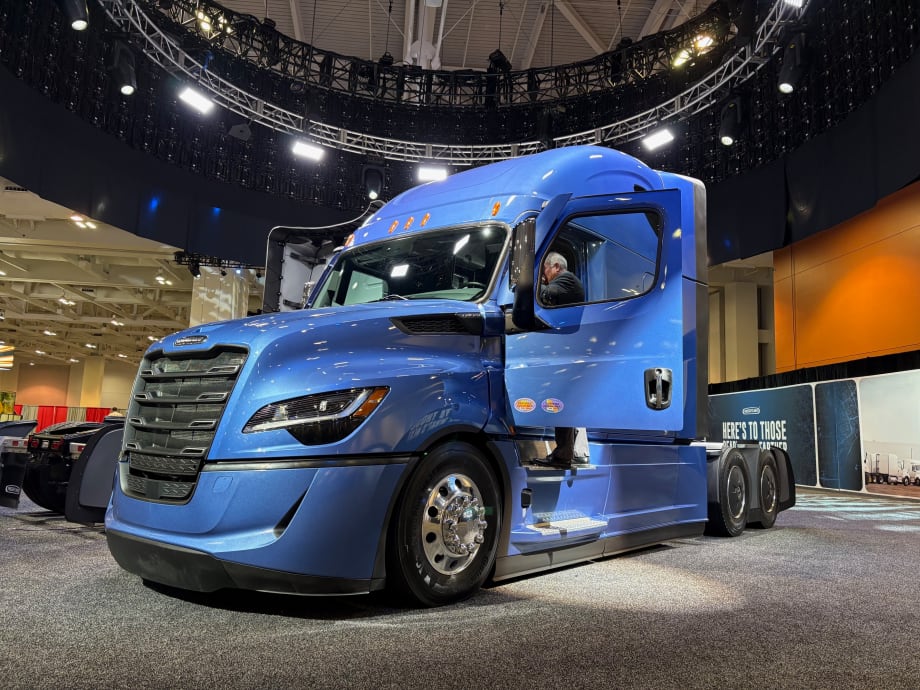
Daimler Truck North America unveiled the fifth-generation Freightiner Cascadia during American Trucking Associations' Management Conference in Nashville.
Photo: Deborah Lockridge
If you’ve been wondering when Freightliner would update its best-selling Class 8 Cascadia platform, wonder no more. The fifth generation Cascadia was publicly unveiled during the American Trucking Associations' Management Conference in Nashville.
And if you’re a Cascadia fan, don’t fret. With over 1 million trucks sold and 40% Class 8 market share, DTNA is fully aware that it has a winning formula on its hands. So DTNA engineers approached this new truck with a “If it ain’t broke, don’t fix it,” philosophy first and foremost in their minds.
The OEM held a press event in Detroit on Oct. 1 to give media a sneak-peek a the new truck. Greg Treinen, vice president, on-highway-market development, said the company is on a never-ending quest to improve the Cascadia. And customer feedback is extremely important in that ongoing process.
“The journey never stops with trying to find to continue to fight that battle against fuel costs and continuing to find space on the truck, to continue to improve airflow, to reduce fuel costs and improve fuel efficiency,” Treinen said.
“We listen to our customers, to continue to innovate in the safety space and to continue to make our driver, the driver safer, to make the public safer, and to continue to develop tools and connected services that help our customers continue to improve their profitability.”
Safety, Efficiency and Profitability
For the fifth generation Cascadia, the development mantra centered on three core design goals, Treinen noted: safety, efficiency and profitability.
“We feel like we've hit the mark in those three spaces with those ideas,” he added. “A big part of that is Cascadia’s new electrical system. This new electrical architecture is an enabler for a lot of the key features such as enhancements to Detroit Assurance Suite and safety systems, or whether it's the pairing with our new CTP3 connected services platform.
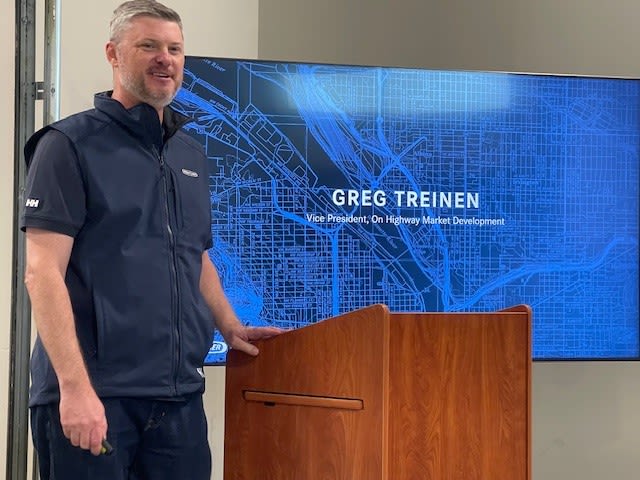
Greg Treinen, vice president, on-highway-market development, DTNA said safety, efficiency and profitability were the primary design drivers behind the fifth generation Freightliner Cascadia.
Photo: Jack Roberts
"So, it's about faster processing speed, about core memory and delivering the data to our customers that they care about to make better business decisions for their fleet.”
With those marching orders in hand, Freightliner engineers have delivered with all-new, expanded capabilities for the Detroit Assurance Suite of safety systems.
Notable system updates include enhanced computing power and an upgraded camera, as well as four new short-range radar sensors and an improved long-range radar sensor – all of which provide for new and updated safety offerings, including:
Active Brake Assist 6 (ABA6) is now capable of adding automatic braking when detecting vehicles stopped at odd angles, vehicles in curves, stopped vehicles across multiple lanes, and recognizing both moving – and now – stationary pedestrians.
Active Lane Assist 2 (ALA2), in addition to previous capabilities, now features Lane Change Assist – which can help mitigate out-of-lane accidents by providing counter-steering in case a truck attempts to enter an already occupied lane.
Attentive Driver Protection – when Lane Keep Assist, a feature of ALA2, is on and active – this monitors driver attention through steering wheel input and can initiate a sequence that keeps the Cascadia centered in its lane, slows the vehicle to a stop and turns on the hazard lights if the driver is not responsive.
Side Guard Assist 2 (SGA2) is now able to detect and warn drivers about objects on the driver’s side as well as the passenger side of the vehicle, from the cab to the end of the trailer.
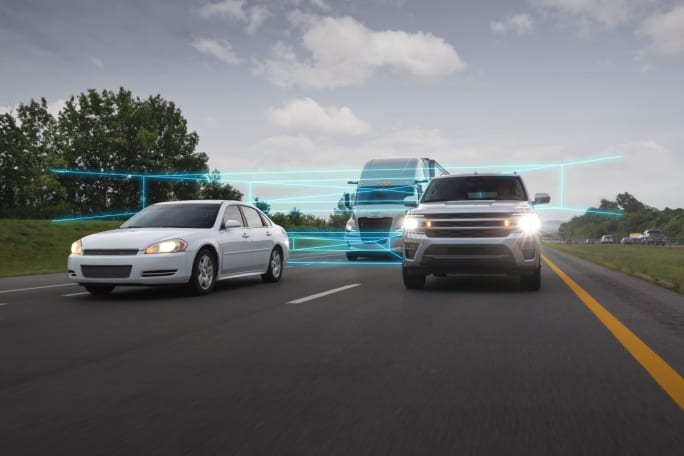
Active Brake Assist 6 (ABA6) is now capable of adding automatic braking when detecting vehicles stopped at odd angles, vehicles in curves, stopped vehicles across multiple lanes, and recognizing both moving – and now – stationary pedestrians.
Photo: DTNA
A New Intelligent Braking System
Treinen said an all-new Intelligent Braking Control System (IBCS) for the Freightliner Cascadia introduces proven brake-by-wire technology combined with backup pneumatics and employs wheel speed sensors and a chassis-mounted electronic control unit to help provide advanced deceleration control.
IBCS allows for the introduction of Comfort Braking, which provides brake force distribution, lining wear control and performance monitoring. These features ensure smoother, more confident braking – especially in sudden stops – and help to elongate brake pad life through even wear.
“This new system is designed to make the braking experience easier for the drivers,” Treinen added. “It's designed to deliver what we call Endurance Braking, which marries the engine brake with the surface brake, which helps to enhance the life of the brakes.
"It also delivers what we call Comfort Braking, which provides drivers smoother braking experience by evenly applying the braking pressure distribution, decreasing lining wear, and improving driver comfort on the road.”
Endurance Braking is designed to seamlessly blend the engine retarder and service brakes when the foot pedal is applied, helping to further extend brake life.
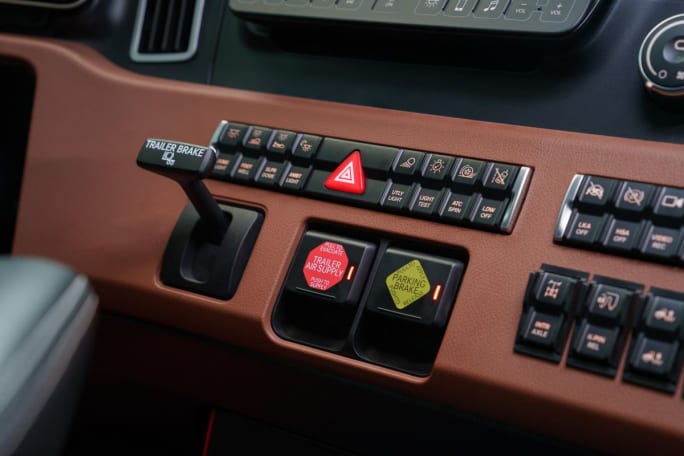
A new Rollaway Mitigation system, enabled by Cascadia’s new electronic park brake, automatically applies the parking brake when a driver leaves the seat or opens the door to help prevent costly rollaways and improve safety.
Photo: DTNA
Another notable feature Treinen pointed out is a new Rollaway Mitigation system, which is enabled by Cascadia’s new electronic park brake. This system automatically applies the parking brake when a driver leaves the seat or opens the door without setting the brake to help prevent costly rollaways and improve safety.
Also new are the Dual Stage Intelligent LED headlights, which offer increased durability and impact resistance. They are also engineered to melt away ice and eliminate condensation in minutes. With an increased beam pattern, auto high beam feature and easier beam adjustment capabilities, they enhance visibility, safety and driver comfort.
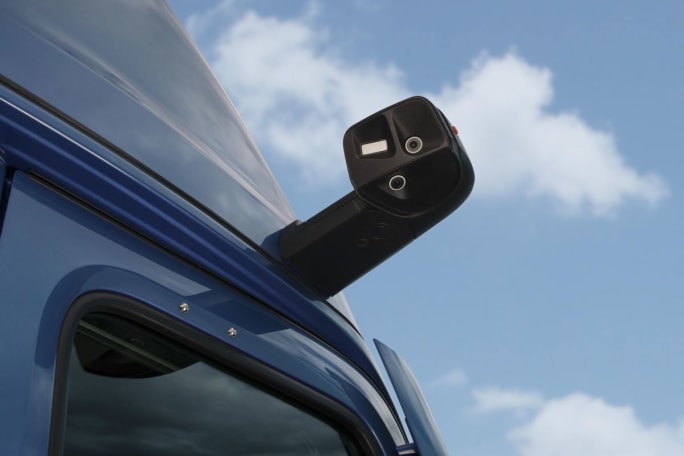
The fifth-generation Freightliner Cascadia comes with both regular rear-view mirrors and a rear-view camera system. Customers may choose to remove the traditional mirrors, but federal regulations still require new trucks to be made with traditional mirrors.
The fifth-generation Freightliner Cascadia offers the new factory-installed MirrorCam System, as well.
Treinen said MirrorCam is a state-of-the-art camera system that enhances driver visibility.
Cameras mounted high above the doors provide a wide field of view and are equipped with infrared technology and hydrophobic coatings to repel water and other contaminants.
According to Trienen, MirrorCam helps to improve visibility, especially at night and during inclement weather, and improve driver comfort by minimizing head and neck movement.
New Fuel Efficiency Gains
Through four generations of proven performance, the Freightliner Cascadia has continued to provide fuel efficiency gains of more than 35 percent since the model’s first introduction, according to Miranda Richardson, highway product marketing manager, DTNA.
She said that key aerodynamic improvements for the fifth generation provide an additional fuel economy benefit of 1.9%. They include a new hood design, a redesigned A-pillar deflector, three-piece front wheel well closeouts, a hood-to-bumper seal, and new bumper air ducts that direct airflow around the underbody and tires to increase efficiency.
Also available is the option of the new Max Aero Bumper, which brings even greater efficiency without sacrificing ground clearance, durability or serviceability.
“The bumper continues to remain a two-piece, durable feature that our customers have grown to love,” Richardson said. “But with the addition of these air ducts, we're able to continue to help guide air around the truck and out through the wheel. The air ducts also help maintain brake temperature, as well as they provide us a cooling element help guiding that air around.”
A new air dam at the front of the truck also gives the new Cascadia improved ground clearance, she added. “And what this does is help it protect all those major components under the body of the truck,” Richardson explained. “But it also helps keep air from getting up under the truck and into the underbody.
The air dam is a three-piece design, Richardson said, and very durable.
“It's been tested going forward, backwards and over all obstacles,” she noted. “And it also comes with these snap enclosures that are easy to snap on and off. So, should a technician need to get up under there, or you need to replace anything, you can easily snap these enclosures and just replace the affected area if needed.”
Cummins Power Options
The fifth generation Freightliner Cascadia, like its predecessors, offers a full lineup of engine options to suit the diverse operational needs of fleets and their drivers, Trienen said.
Available at launch are the Detroit DD13 and DD15 engines, with ratings of up to 505hp and 1,850 lb-ft of torque.
The Cummins X15 will be available for Cascadias built in 2025. In 2026, the X15N, the first natural gas engine designed specifically for heavy-duty and on-highway truck applications, will be an option. Both are available with 400 to 605 hp and 1,450 to 2,050 lb-ft of torque.
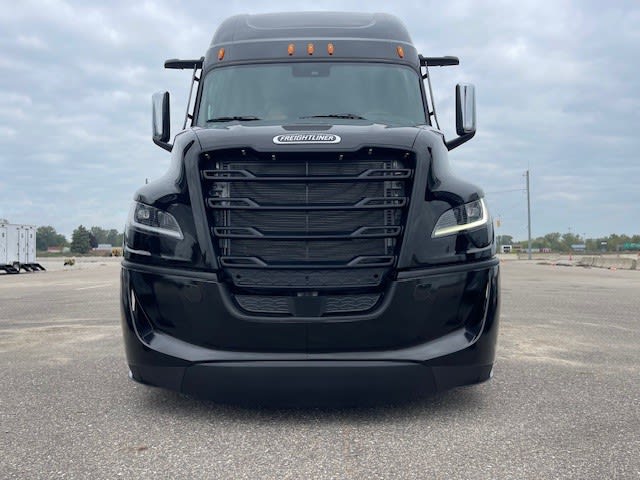
Beginning in 2026, fleets will be able to spec Cummins X15 and X15N engines in the Freightliner Cascadia.
Photo: Jack Roberts
To help improve uptime and furnish greater operational insights, the Cascadia comes equipped with advanced technology enabling both new and familiar business intelligence tools. The newest connected telematics platform powering Detroit Connect brings on-the-road benefits for drivers, as well as more real-time information relayed back to fleet managers.
Additionally, a new electrical architecture enhances cybersecurity and enables faster processing speeds.
New key features of Detroit Connect include:
Detroit Connect Video Capture 2.0 automatically records and captures data during safety events or when initiated by a driver, providing fleet managers with remote access to valuable insights on driver behavior and potential risks. Videos are available in near[1]real-time through an improved user interface within the Detroit Connect Portal.
Remote Lock and Unlock is a new feature derived directly from fleet manager feedback and brings the ability to lock and unlock vehicles on demand, reducing roadside assistance costs and increasing vehicle uptime.
Geofencing allows customers to create custom-defined geographic areas in the Detroit Connect Portal and receive notifications when vehicles enter or leave that area.
Detroit Connect Safety Plus is a subscription service that allows fleet managers to remotely track and receive notifications about the status and health of Detroit Assurance safety systems.
Premium Remote Parameter Updates expands the number of parameters available for update over the air from seven to more than 50.
The fifth generation Freightliner Cascadia is scheduled to begin production mid-2025.
More Equipment

How Volvo Updated Its D13 for EPA 2027 [Watch]
Volvo’s updated D13 promises lower emissions without sacrificing performance or fuel economy. Take a closer look at what changed inside the engine in this HDT Spotlight video.
Read More →
Michelin Tire Improves Efficiency and Durability for Regional Fleets
The Michelin X Multi Energy D2 is a regional haul drive tire engineered to help fleets improve fuel efficiency, durability and traction in demanding stop-and-go operations.
Read More →
ZF Expands Commercial Vehicle Push in North America
ZF is expanding its North American commercial-vehicle presence with new transmission applications, electrification, trailer technology and autonomous-driving systems.
Read More →
Tesla Wants a Self-Driving Semi. Are Cameras Enough?
Could Tesla’s camera-only autonomous driving technology work on an 80,000-pound Semi? In this commentary, HDT's Deborah Lockridge takes a look at Tesla, Cybercab, and how autonomous trucks see the road.
Read More →
Kodiak: Driverless Long-Haul Truck Launch on Track for 2026
Kodiak AI says its driverless long-haul safety case is 93% complete and it remains on track to begin commercial operations by year-end 2026.
Read More →
What DOT’s Automated Vehicle Strategy Means for Trucking
The U.S. Department of Transportation issued a new automated-vehicle strategy that outlines plans for driverless-truck regulations, cross-state freight corridors, and federal safety standards.
Read More →
East Coast Port Launches $45M Electric Truck Push
The Port Authority of New York and New Jersey announced millions in incentives for zero-emission drayage trucks, yard tractors, and new charging hubs near the port.
Read More →
PlusAI Going Public to Fund Autonomous Truck Launch
A SPAC deal could provide PlusAI with up to $300 million as it works toward a 2027 commercial launch of factory-built autonomous trucks.
Read More →
NHTSA Moves to Rewrite Truck Fuel-Economy Rules
The National Highway Traffic Safety Administration says it lacks authority to regulate medium- and heavy-duty truck engines separately from complete vehicles, but the existing standards have not yet been eliminated.
Read More →
Detroit Opens Orders for EPA 2027 Engines
Detroit isn’t starting from scratch to meet EPA 2027 diesel emissions standards. Its Gen 6 DD13 and DD15 engines keep much of today’s platform while updating the fuel and aftertreatment systems.
Read More →