




Driver Shortage A 'Primary Concern' to 3PLs & Shippers
The truck driver shortage remains a "primary concern” for third-party logistics providers and the shippers they serve, per the 2016 Third-Party Logistics Study.

Image via: 3plstudy.com
Image via: 3plstudy.com
Even as the entire logistics industry must deal with an “unprecedented” labor deficit, “the driver shortage remains a primary concern” for third-party logistics providers and the shippers they serve, per the 2016 Third-Party Logistics (3PL) Study.
The results were released in San Diego on Sept. 28 at a conference of the Council of Supply Chain Management Professionals..
Sponsored by Penske Logistics, the 22th annual report is based on responses from more than 260 shippers and logistics-service providers based in North America, Europe, the Asia-Pacific region and Latin America as well as a survey of the CEOs of 30 of the world's largest 3PLs.
It found that over 80 percent of the firms surveyed were profitable in 2014. North America and Asia-Pacific CEOs forecasted three-year revenue growth averages for their companies of 7.86 percent and 11.50 percent, respectively, while European CEOs forecasted 5.33 percent growth over the same period.
The report extensively details numerous challenge facing 3PLs, including tightening capacity as well as the impact of mergers and acquisitions, increasing regulations and “industry innovations” that are “altering competition, 3PL service offerings and shipper-3PL relationships.”
But it is the truck driver shortage that is clearly seen as the key factor driving the freight capacity crunch in the U.S.
“Within the U.S., 70% of freight tonnage is moved on a truck, and without drivers, that freight is likely to stand still,” they state. “The American Trucking Associations estimates a driver shortage of 35,000 to 40,000 in 2015, and that number jumps to 240,000 in 2020. Traditional driver recruiting became obsolete almost overnight with the trucking industry scrambling to find solutions or perhaps pursue the best recruiting method: a retainer strategy."
What’s more, tightened capacity is seen as “altering shippers’ ability to move loads as well as how these shippers interact with their third-party logistics providers.” The authors contend that “the need for shippers to find alternate methods and providers is apparent.”
The report points out that “almost 37% of the demand for drivers is to substitute the aging drivers, and the average age of a truck driver today is 55 years old or more. Even those now entering the industry are older than those entering in the past.”
As for solutions to the driver and overall logistics labor shortage, the authors suggest a number of strategies that could be deployed.
“To meet the growing labor needs, companies will likely develop built-in succession or talent pipeline programs, identifying opportunities for high-potential workers and creating structured paths for advancement. Training programs will help employers develop their existing talent pool, and there may be an increased number of partnerships between providers and driver schools or other industry groups. In Europe, the supply chain industry has focused on high school graduates as potential ‘captains of country roads,’ and launched employment campaigns to reach younger workers.”
The report also expects that cross-training will “play a greater role within the workforce as will workforce agility in which employers focus on hiring employees who are able to learn and adapt to shifting needs. Agility— a mindset and a behavior in which businesses and employees embrace unfamiliar situations—will allow companies to address the labor shortage and drive growth in new situations.”
The upshot of both tightened capacity and the increased consolidation of logistics-service providers is “fewer partners for 3PLs and increased prices,” according to the report. “As a result, 44 percent of survey respondents reported that they have enhanced relationships to guarantee shipping lanes and on-time shipments and 40 percent have increased rates. Among shippers, 29 percent said assets have not been available to move shipments when needed. Similarly, 29 percent have engaged with a larger number of 3PLs to get access to capacity.”
In addition, 3PLs are using technology and data to aid shippers in selecting the right shipment modes to maximize efficiency and reduce costs. Per the report, 60 percent of the respondents are using technology to increase visibility within orders, shipments and inventory; 40 percent are using technology for planning within transportation management; and 48 percent are using it for scheduling within transportation management.
“Last year, the logistics industry experienced one if its best years in many years and 2015 is on track to be a good year as well,” said Marc Althen, President of Penske Logistics, in a statement on the report’s release.
“The 3PL industry continues to deliver value, savings and efficiencies by collaborating closely with customers and adjusting to rapidly changing economic conditions, business challenges such as capacity and talent shortages, as well as consumer online shopping needs that demand new and agile supply chain and fulfillment models,” he added.
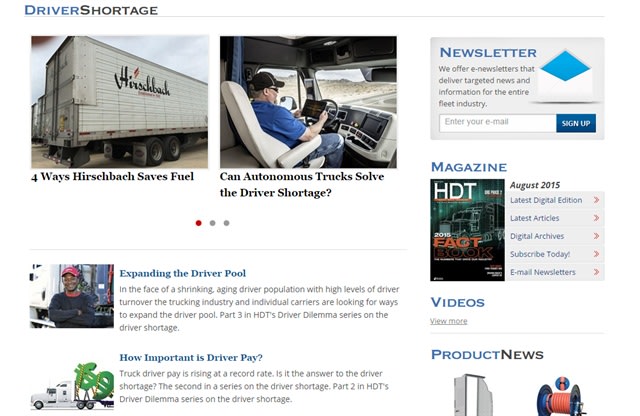
HDT's Driver Shortage page includes up-to-date, in-depth articles, analysis and news about how the trucking industry is handling this difficult crisis.
More Fleet Management

Geotab Links Fleet Card to Vehicle Data
The new card combines fuel discounts with telematics-based purchase controls. Geotab’s analysis also points to potential savings from choosing lower-priced fuel stops.
Read More →
How MFA Helps Protect Trucking Fleets
Multi-factor authentication adds protection when passwords are stolen. Here’s how it works and where fleets should start.
Read More →
How Better Freight Data Helps Trucking Teams Get Ahead of Disruption
Trucking and logistics teams have plenty of data. The problem is getting the right information in front of the right people soon enough to act. Better-connected data can help teams spot trouble earlier and make smarter decisions before small problems become big ones.
Read More →

Trimble: Taking Artificial Intelligence in Trucking Beyond Faster Tasks
At Insight 2026, Trimble executives argued that fleets may need to redesign workflows to get more from AI as it introduced new products and enhancements. AI’s value will depend on how fleets combine automation with their people's knowledge.
Read More →
Build a bulletproof fleet: Uniting ELDs and dash cams for total compliance
An ELD can prove compliance, but it cannot always prove what happened on the road. Discover how uniting accurate ELD data with AI-powered dash cam video can help your fleet strengthen compliance, defend against liability, protect drivers and reduce operational costs.
Read More →
Nominations Open for HDT Emerging Leaders
Heavy Duty Trucking is looking for accomplished trucking fleet professionals under 40 who are making an impact and helping lead the industry forward.
Read More →
Why Private Fleets Are Taking More Freight
Private fleets are putting their own trucks on demanding customers and high-cost lanes as companies seek greater control over service, costs, and capacity.
Read More →
Color Match Smarter: Tools That Restore & Perform
For fleet managers and collision repair professionals keeping heavy-duty trucks on the road, getting the color right the first time isn't just about appearance — it's about efficiency, turnaround time, and bottom-line results. Discover how today's digital color tools are transforming the repair process from guesswork to precision.
Read More →
FMCSA Pauses Biennial-Update Enforcement Amid Motus Transition
Carriers whose updates were due on or after June 1 have more time, while FMCSA works to stabilize its new registration system and warns of phishing sites impersonating its new carrier registration system, Motus.
Read More →
2026 Blueprint for Countering Smarter Supply Chain Theft
Cargo theft is no longer just the cost of doing business. It's a multi-billion-dollar criminal enterprise exploiting vulnerabilities across your fleet, drivers, and supply chain.
Read More →