




Double Stack Trains Provide More Fuel Savings Than Truck
Double stack freight rail transportation is up to five times more fuel efficient than truck transportation, according to a new report by the Federal Railroad Administration
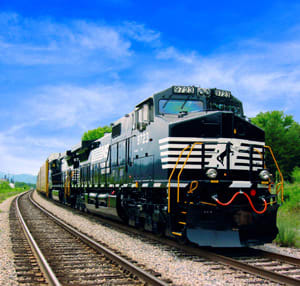
Since 1990, rail fuel efficiency has improved by about 20 percent, or 1.1 percent per year. Photo courtesy of Norfolk Southern
Double stack freight rail transportation is up to five times more fuel efficient than truck transportation, according to a new report by the Federal Railroad Administration.
The "Comparative Evaluation of Rail and Truck Fuel Efficiency on Competitive Corridors" report indicated that rail fuel efficiency has improved by about 20 percent, or 1.1 percent per year, between 1990 and 2006.
The improvement in the fuel efficiency of rail is attributed to changes in traffic mix, technological improvements, and changes in operating practices that lowered fuel consumption, the report said.
"While all types of transportation are vital to the distribution of goods across the country, this study shows that utilizing America's freight rail system can lead to significant fuel savings," said Joseph Szabo, FRA administrator. "The environmental benefits of these positive changes over the last two decades are enormous."
Another contributor to this fuel efficiency savings is the increasing popularity of double stack trains, which have become more predominant in the past two decades because of their fast and reliable transit times, the report said.
Double stack trains also tend to be more fuel efficient. The double stack rail-to-truck Fuel Efficiency Ratio ranged from 2.7 to 5.5 in this study, compared to a ratio of 2.5 to 3.4 in the 1991 study.
To view the entire FRA report, click here.
More Fleet Management

Geotab Links Fleet Card to Vehicle Data
The new card combines fuel discounts with telematics-based purchase controls. Geotab’s analysis also points to potential savings from choosing lower-priced fuel stops.
Read More →
How MFA Helps Protect Trucking Fleets
Multi-factor authentication adds protection when passwords are stolen. Here’s how it works and where fleets should start.
Read More →
How Better Freight Data Helps Trucking Teams Get Ahead of Disruption
Trucking and logistics teams have plenty of data. The problem is getting the right information in front of the right people soon enough to act. Better-connected data can help teams spot trouble earlier and make smarter decisions before small problems become big ones.
Read More →

Trimble: Taking Artificial Intelligence in Trucking Beyond Faster Tasks
At Insight 2026, Trimble executives argued that fleets may need to redesign workflows to get more from AI as it introduced new products and enhancements. AI’s value will depend on how fleets combine automation with their people's knowledge.
Read More →
Build a bulletproof fleet: Uniting ELDs and dash cams for total compliance
An ELD can prove compliance, but it cannot always prove what happened on the road. Discover how uniting accurate ELD data with AI-powered dash cam video can help your fleet strengthen compliance, defend against liability, protect drivers and reduce operational costs.
Read More →
Nominations Open for HDT Emerging Leaders
Heavy Duty Trucking is looking for accomplished trucking fleet professionals under 40 who are making an impact and helping lead the industry forward.
Read More →
Why Private Fleets Are Taking More Freight
Private fleets are putting their own trucks on demanding customers and high-cost lanes as companies seek greater control over service, costs, and capacity.
Read More →
Color Match Smarter: Tools That Restore & Perform
For fleet managers and collision repair professionals keeping heavy-duty trucks on the road, getting the color right the first time isn't just about appearance — it's about efficiency, turnaround time, and bottom-line results. Discover how today's digital color tools are transforming the repair process from guesswork to precision.
Read More →
FMCSA Pauses Biennial-Update Enforcement Amid Motus Transition
Carriers whose updates were due on or after June 1 have more time, while FMCSA works to stabilize its new registration system and warns of phishing sites impersonating its new carrier registration system, Motus.
Read More →
2026 Blueprint for Countering Smarter Supply Chain Theft
Cargo theft is no longer just the cost of doing business. It's a multi-billion-dollar criminal enterprise exploiting vulnerabilities across your fleet, drivers, and supply chain.
Read More →