





Related — Study: Automated Vehicles Won’t Displace Truck Drivers
DOT Updates Guidance on Autonomous Vehicles
The Department of Transportation has expanded its voluntary guidance for the development of what it calls “automated vehicles.”
October 4, 2018
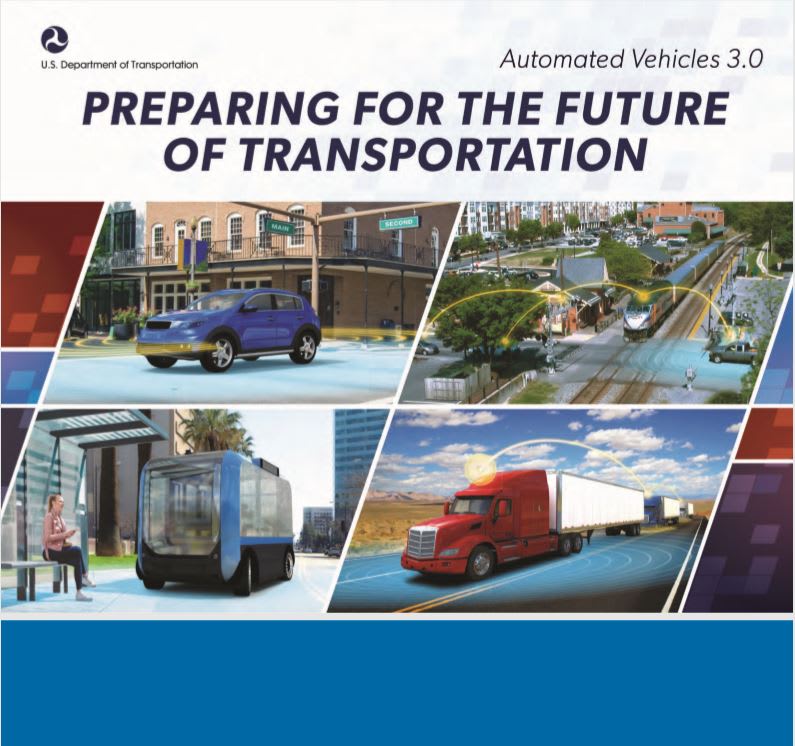
Per DOT, its latest guidance on autonomous vehicle technologies outlines "how automation will be safely integrated across passenger vehicles, commercial vehicles, on-road transit, and the roadways on which they operate."
Credit:
U.S. Department of Transportation
3 min to read
The Department of Transportation has expanded its voluntary guidance for the development of what it calls “automated vehicles.”
On Oct. 4 at DOT headquarters in Washington, DC, Secretary of Transportation Elaine Chao introduced the update, contained in an 80-pg document titled “Preparing for the Future of Transportation: Automated Vehicles 3.0,” or “AV3.0” for short. The prior guidance, AV 2.0, was released last September.
“The safe integration of automated vehicle technology into our transportation system will increase productivity, facilitate freight movement and create new types of jobs,” Secretary Chao said.
She stressed that AV 3.0 was developed with “extensive” input from stakeholders so that voluntary guidance could be offered to a “range of industry sectors,” including technology developers, infrastructure owners and operators, commercial motor carriers, and state and local governments.
According to DOT, the new document “supports the safe development of automated vehicle technologies by providing new multi-modal safety guidance; reducing policy uncertainty and clarifying roles, and “outlining a process for working with U.S. DOT as technology evolves.”
DOT said the AV 3.0 guidance specifically updates its initiatives relating to autonomous vehicles by:
“Stating that DOT will interpret and, consistent with all applicable notice and comment requirements, adapt the definitions of ‘driver’ or ‘operator’ as appropriate to recognize that such terms do not refer exclusively to a human, but may include an automated system.”
Identifying and supporting development of automation-related voluntary standards developed through organizations and associations, “which can be an effective non-regulatory means to advance the integration of automation technologies.”
Affirming that DOT is “continuing its work to preserve the ability for transportation safety applications to function in the 5.9 GHz spectrum.”
The AV 3.0 document also reveals several upcoming rulemakings and other actions DOT plans to take, including having the Federal Motor Carrier Safety Administration initiate an Advance Notice of Proposed Rulemaking to address automated vehicles. That pre-rule will be focused on identifying “regulatory gaps, including in the areas of inspection, repair, and maintenance for ADS [automated driving systems].”
Also, DOT said the National Highway Traffic Safety Administration will be requesting public comment on a proposal “to streamline and modernize the procedures it will follow when processing and deciding exemption petitions [concerning automated vehicle technologies].”
At this point, the new guidance is technically a draft document. The next step is for it to be published soon in the Federal Register, to allow for public review and comment.
During the rollout of the document at DOT, FMCSA Administrator Raymond Martinez remarked that the agency will keep on “engaging all [AV] stakeholders through outreach activities and meetings, with the shared goal of advancing both safety and transportation efficiency.
“FMCSA is working to facilitate automated driving systems in commercial vehicles by encouraging and supporting innovation that prioritizes safety and reduces roadway crashes,” he stated. Martinez noted that automated driving technologies is being developed around the world, stressing that FMCSA is “not operating in a vacuum. “Fully automated vehicles are not a vision of the distant future,” he added.
The American Trucking Associations reacted positively to the message of AV 3.0. “This is a sound and substantive framework that rightly recognizes commercial vehicles are essential to any serious AV policy,” said ATA President and CEO Chris Spear. “In reaching out to a broad group of stakeholders, the Department should be commended for its thoughtful approach, which will enable an informed decision-making process around new and emerging technologies.”
He noted that the new guidance “ensures that technological progress will not outpace the formation of key safety policy – and will enable America to maintain our role as world leaders both in innovation and in developing this framework.
“We look forward to working with the Secretary and FMCSA Administrator Martinez as this initiative rolls forward,” Spear added, “and to having trucking’s voice as a vital contributor throughout this process.”
More Safety & Compliance

FMCSA Pauses Biennial-Update Enforcement Amid Motus Transition
Carriers whose updates were due on or after June 1 have more time, while FMCSA works to stabilize its new registration system and warns of phishing sites impersonating its new carrier registration system, Motus.
Read More →
ZF Expands Commercial Vehicle Push in North America
ZF is expanding its North American commercial-vehicle presence with new transmission applications, electrification, trailer technology and autonomous-driving systems.
Read More →
Truck Drivers Need More Than Another Alert
Fleets have more visibility into truck health, safety events, and driver activity than ever. The next challenge is turning all that information into useful guidance for the person who has to decide what to do next.
Read More →
Tesla Wants a Self-Driving Semi. Are Cameras Enough?
Could Tesla’s camera-only autonomous driving technology work on an 80,000-pound Semi? In this commentary, HDT's Deborah Lockridge takes a look at Tesla, Cybercab, and how autonomous trucks see the road.
Read More →
What DOT’s Automated Vehicle Strategy Means for Trucking
The U.S. Department of Transportation issued a new automated-vehicle strategy that outlines plans for driverless-truck regulations, cross-state freight corridors, and federal safety standards.
Read More →
NYC Expands Speed, Pedestrian Safety Tech Across Fleet
New York City is expanding intelligent speed assistance and pedestrian-alert systems across its municipal fleet, moving the technologies from pilot programs into vehicle procurement and retrofit requirements.
Read More →
FMCSA Removes 110 Truck Driver Training Schools from Certified ELDT List
Federal regulators also are targeting more than 160 additional training providers and launching a nationwide audit of third-party CDL skills testers as part of a broader crackdown on trucking fraud.
Read More →
Beyond DOT Compliance: What Makes a Trucking Fleet Truly Safe?
A trucking fleet can follow every rule and still make unsafe decisions. The real test comes when safety conflicts with freight, productivity, or cost.
Read More →
Hours of Service Pilot Programs: FMCSA Readies for 2027 Rollout
Two pilot programs could eventually reshape hours-of-service rules, giving truck drivers options to pause their 14-hour clock or use longer split sleeper rest periods.
Read More →
New Guide Offers Pet Safety Tips for Truck Drivers
Hundreds of thousands of pets travel in truck cabs. A new safety guide from Volvo Trucks and the Center for Pet Safety offers practical advice for truck drivers who bring dogs and cats along for the ride.
Read More →