





Related — ELDs: The Final Countdown
Don’t Shortchange Training When Converting to ELDs
Lisa Gonnerman, vice president of safety and security for Transport America, detailed what the transition from AOBRDs to ELDs entailed for the Eagan, Minnesota-based carrier.
October 9, 2019
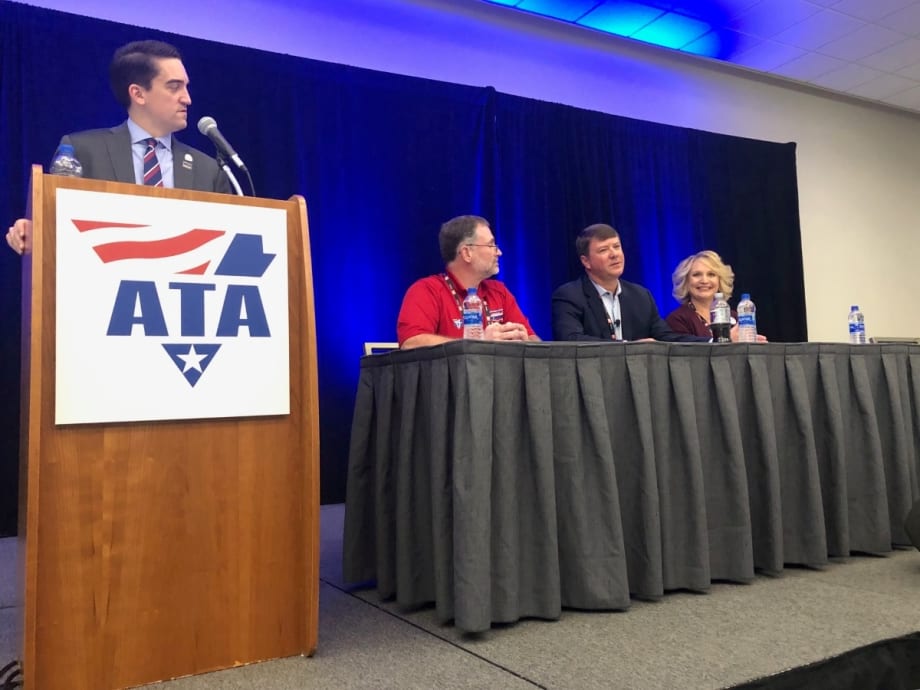
Moderator Dan Horvath of ATA and panelists (l-r) Bill Goins of Old Dominion Freight Lines, Jim Mullen of FMCSA, and Lisa Gonnerman of Transport America discuss real-world aspects of rolling out the ELD rule.
Photo: David Cullen
3 min to read
Come Dec. 16 — less than three months away — motor carriers still running with grandfathered automatic onboard recording devices to track hours-of-service will have to be switched over to devices that are compliant with the electronic logging device mandate that first went into effect almost two years ago.
Yet despite all that lead time, a multitude of warnings from experts that the switchover can be complex, and a rapidly closing compliance window, anecdotal evidence suggests more than a few trucking operations are cutting things really close.
“We don’t really have a good feel, quite candidly,” for the number of fleets that haven’t yet switched from AOBRDs to ELDs, said Jim Mullen, chief counsel for the Federal Motor Carrier Safety Administration, speaking on an Oct. 6 panel at the American Trucking Associations’ annual meeting in San Diego.
The decidedly unscientific raise-your-hand poll Mullen took of audience members indicated a majority had switched over, but that would be cold comfort for any manager still riding the grandfather clause who heard Lisa Gonnerman, vice president of safety and security for Transport America, detail what the transition entailed for the Eagan, Minnesota-based carrier.
Asked by moderator Dan Horvath, ATA’s vice president of safety policy, what she would do differently now the fleet’s conversion is complete, Gonnerman replied, “Different? I’d do more training.”
Transport America began the conversion process for its 1,700 trucks in February and as of now, all drivers have been trained, said Gonnerman. “There’s a lot of planning to do and it takes time. We started the training by piloting it first before beginning, in July, to bring the program to each of our terminals.”
The training included about an hour of “face-to-face instruction” on ELDs for each driver as well as hands-on training for roadside inspections so drivers know they should tell inspectors that they’re “now on an ELD.” Gonnerman credits that aspect with the fleet not having many issues at roadside.
A key element of driver training was to explain the difference between an AOBRD and an ELD. But it wasn’t just about drivers. “We did training for the safety department, including on how to get information [from the ELD] and understanding the reports that are generated,” said Gonnerman.
“There was also lots of training for the back office,” she continued. “The impact there [from switching logging devices] is substantial; we had to put some new policies in place, such as on how to handle log edits, and that takes time.” Also, allowing drivers to make use of personal conveyance mode results in “very challenging” auditing by the back office.
“We have kept tweaking the training based on questions that come in to us and by which questions are being repeated,” Gonnerman advised. “And even now, we keep sending out training reminders on ELDs to our drivers.”
Panelist Bill Goins, an Old Dominion Freight Line driver and an America’s Road Team captain, noted that while he was initially skeptical of ELDs, he has come to appreciate how they make his job much easier. “At the end of the day, I don’t have to sit down with apen and a ruler and a calculator before I can go to bed,” he said.
More Safety & Compliance

FMCSA Pauses Biennial-Update Enforcement Amid Motus Transition
Carriers whose updates were due on or after June 1 have more time, while FMCSA works to stabilize its new registration system and warns of phishing sites impersonating its new carrier registration system, Motus.
Read More →
ZF Expands Commercial Vehicle Push in North America
ZF is expanding its North American commercial-vehicle presence with new transmission applications, electrification, trailer technology and autonomous-driving systems.
Read More →
Truck Drivers Need More Than Another Alert
Fleets have more visibility into truck health, safety events, and driver activity than ever. The next challenge is turning all that information into useful guidance for the person who has to decide what to do next.
Read More →
Tesla Wants a Self-Driving Semi. Are Cameras Enough?
Could Tesla’s camera-only autonomous driving technology work on an 80,000-pound Semi? In this commentary, HDT's Deborah Lockridge takes a look at Tesla, Cybercab, and how autonomous trucks see the road.
Read More →
What DOT’s Automated Vehicle Strategy Means for Trucking
The U.S. Department of Transportation issued a new automated-vehicle strategy that outlines plans for driverless-truck regulations, cross-state freight corridors, and federal safety standards.
Read More →
NYC Expands Speed, Pedestrian Safety Tech Across Fleet
New York City is expanding intelligent speed assistance and pedestrian-alert systems across its municipal fleet, moving the technologies from pilot programs into vehicle procurement and retrofit requirements.
Read More →
FMCSA Removes 110 Truck Driver Training Schools from Certified ELDT List
Federal regulators also are targeting more than 160 additional training providers and launching a nationwide audit of third-party CDL skills testers as part of a broader crackdown on trucking fraud.
Read More →
Beyond DOT Compliance: What Makes a Trucking Fleet Truly Safe?
A trucking fleet can follow every rule and still make unsafe decisions. The real test comes when safety conflicts with freight, productivity, or cost.
Read More →
Hours of Service Pilot Programs: FMCSA Readies for 2027 Rollout
Two pilot programs could eventually reshape hours-of-service rules, giving truck drivers options to pause their 14-hour clock or use longer split sleeper rest periods.
Read More →
New Guide Offers Pet Safety Tips for Truck Drivers
Hundreds of thousands of pets travel in truck cabs. A new safety guide from Volvo Trucks and the Center for Pet Safety offers practical advice for truck drivers who bring dogs and cats along for the ride.
Read More →