




Domestic Containers Drive Intermodal Traffic Surge
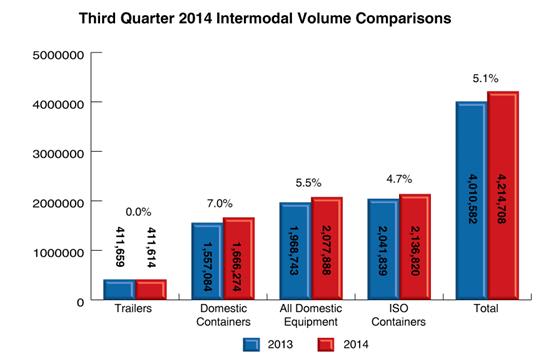
Total intermodal freight volume rose 5.1% in the third quarter of the year compared to the same time in 2013, while domestic U.S. and international volumes individually reported gains in of 5.5% and 4.7%, respectively.
Graphic: IANA
Graphic: IANA
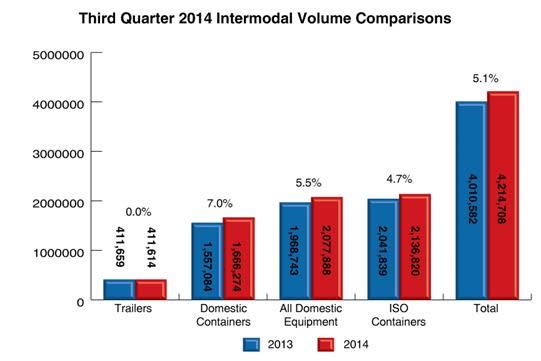
Total intermodal freight volume rose 5.1% in the third quarter of the year compared to the same time in 2013, while domestic U.S. and international volumes individually reported gains in of 5.5% and 4.7%, respectively.
While international loads had the strongest growth in the second quarter, domestic container traffic reclaimed its place as the best-performing market segment in third quarter with a 7% increase, according to the industry group the Intermodal Association of North America. This increase represents a minimal half of a percent slip from the second quarter’s volume. However, proof of the strength of domestic intermodal is the fact that for the first time since IANA began keeping data, domestic volumes were greater than international volumes, on a seasonally adjusted basis, according to the association.
“Both domestic and international intermodal volumes remain strong through the midpoint of this seasonal shipping peak,” said Joni Casey, president and CEO of IANA. “Domestic container movements have posted gains every quarter since the third quarter of 2005 and this trend is expected to continue as highway capacity tightens.”
On the heels of an outsized second quarter performance, international shipments recorded a 4.7% volume increase in the third quarter of the year compared to the same time in 2013. This suggests that the 9.6% growth seen in the second quarter for this segment was a result of shippers playing catch up after a harsh winter, as well as early import movements and continuing economic strength, according to IANA.
Intermodal trailer volume was flat in the third quarter, ending a three-quarter streak of gains and suggesting a weaker overall market outlook. Growth in this segment varied greatly among regions, with Eastern Canada posting a 12.3% increase and the Northwest U.S. reporting a 21.3% decrease. Trailer declines were also common in key corridors, such as the South Central-Southwest lane of the U.S., where volume dipped 5.5%. However, IANA said regional results were more encouraging in places like Eastern Canada, where trailer growth pushed overall intermodal growth above industry averages.
Eight of the nine IANA regions recorded overall volume gains in the third quarter. Western Canada and the South Central U.S. region reported volume growth of more than 10%. Growth in the U.S. Northeast and Southeast, along with the Eastern Canada regions, was above the overall industry average of 5.1%, while the Southwest, Midwest and Mountain Central regions of the U.S. recorded increases between 2% and 4% percent. Northwest U.S. volume reflected the only regional declines, falling 9.5% from the previous year’s level.
More Fleet Management

How Telematics Improves Visibility, Control, and Performance in Refrigerated Fleets
Explore how telematics help refrigerated fleets improve visibility, uptime, efficiency, compliance, and cargo protection across connected cold chain operations.
Read More →
What the U.S.-Canada Trade War Means for Trucking
Escalating U.S.-Canada tariffs could disrupt cross-border freight, reduce truck volumes, raise costs, and create new uncertainty for carriers on both sides of the border.
Read More →
What Are Trucking’s Top Concerns for 2026?
The American Transportation Research Institute wants to know what's worrying trucking fleet managers, drivers, and other stakeholders in its annual Industry Issues survey.
Read More →

American Trucking Associations Looks for a New Leader
ATA President and CEO Chris Spear abruptly left his job at the association on August 21, at a pivotal time for the trucking industry.
Read More →
Public Wi-Fi Cybersecurity Risks: How Truck Drivers and Fleets Can Protect Their Data
Public Wi-Fi can expose truck drivers and fleets to credential theft, malware, and other cyber threats. Here’s how to reduce the risk on the road.
Read More →
For Nicky Cupp, Fleet Innovation Starts With Frustration
HDT Truck Fleet Innovator Nicky Cupp turns everyday pain points at Fraley & Schilling into opportunities for better technology and smarter processes.
Read More →
Adam Buttgenbach’s Approach to Electric Trucks: Start With Where They Fit
HDT Truck Fleet Innovator Adam Buttgenbach helped PepsiCo build one of North America’s largest EV fleets by focusing on where electric trucks make operational sense.
Read More →
Deen Albert: Let Automation Do the Math, People Make the Decisions
HDT Truck Fleet Innovator Deen Albert makes sure people are still at the heart of operations at Grand Island Express, even while adopting artificial intelligence tools. AI-assisted dispatch helped boost revenue 25% with the same number of trucks.
Read More →
Trimble’s New AI Agent Takes Aim at Fleet Back-Office Busywork
Arc Agent works across Trimble TMS products to automate repetitive tasks such as freight orders, maintenance, invoices, fuel costs and more.
Read More →
How HDT’s 2026 Truck Fleet Innovators Are Rethinking Fleet Operations
Meet five trucking leaders who are challenging assumptions, solving operational problems, and putting innovative ideas to work.
Read More →