




Digital Freight Startup Convoy Hits Roadblock
“We were running up the down escalator…. and it kept speeding up," said Convoy co-founder Dan Lewis in an internal memo letting employees know the digital freight-matching startup was closing the doors on its core business.

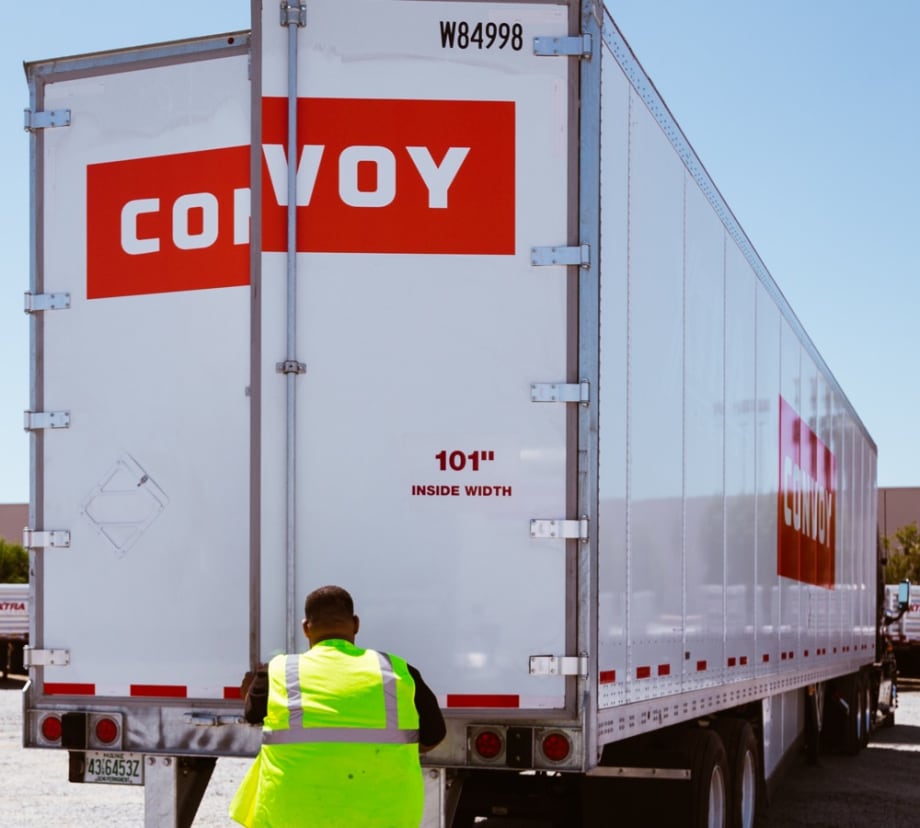
Convoy added services such as a trailer pool for power-only fleets and a power-only service for private fleets.
Photo: Convoy (2021)
Convoy, one of the early “Uber for Freight” tech brokerage startups, looks to be a casualty of the freight recession and the investor funding drought.
The company this week let most of its employees go, saying it is closing the doors on its core digital freight network business operations “and exploring and evaluating strategic options for what might come next.”
The Seattle-based startup officially launched in 2015 as an “on-demand trucking” company after raising $2.5 million in seed funding from an investment group that included Amazon founder Jeff Bezos and other high-profile investors. Its goal was to disrupt the trucking industry and drive out waste.
Last year, Convoy raised $260 million in a funding round that valued the business at $3.8 billion. Its customers have included major shippers such as Home Depot, Procter & Gamble, Unilever, and Anheuser-Busch.
But the high-flying spot market we saw driven by the supply chain challenges of pandemic has taken a nosedive over the past year or so, and Convoy has gone through several rounds of layoffs over the past 18 months, according to published reports. At the same time, investors have lost much of their taste for startups.
In a memo to employees shared in published news reports, CEO and Co-Founder Dan Lewis explained, “In short, we are in the middle of a massive freight recession and a contraction in the capital markets. This combination ultimately crushed our progress at the same time that it was crushing our logical strategic acquirer — it was the perfect storm….
“We were running up the down escalator…. and it kept speeding up.”
Lewis said company officials had spent more than four months “exhausting all viable strategic options for the business.”
Not all investment in the digital-freight arena has dried up, however. Transfix announced on Oct. 19 that it had closed a new $40 million funding round led by New Enterprise Associates and G Squared, with participation from Canvas, saying it "represents the continued conviction of large institutional investors in the company's business, in an otherwise difficult market."
Convoy’s Origins
Convoy provided an Uber-like service for booking on-demand shipments that also allowed users to track shipment location. Carriers were all pre-approved by Convoy and would complete jobs using Convoy’s mobile app, which also doubled as a tool for managing and growing their fleets.
As then chief product officer Ziad Ismail told HDT in a 2017 interview, co-founder Dan Lewis “had some experience in trucking, so while he was working at Amazon, he was looking at what is the next big market that is going to be changed dramatically by technology.
“And the more time we spent looking at trucking, the more we realized it was ripe for disruption,” Ismail said. “We defined the mission for the company as using … technology to drive the industry to reduce waste.”
Since then, however, many more companies offering digital freight matching or digital load matching have entered the industry. We’ve also seen longtime traditional freight brokers transform their businesses with algorithms and AI.
In May 2022, Transparency Market Research projected the digital freight brokerage market to reach $26 billion by 2030, explaining that Increasing capital investments from venture capitalists were leading to the entry of small-to-large players in the digital freight brokerage market.
Updated 10/23/23 to add information about Transfix
More Fleet Management

Why Private Fleets Are Taking More Freight
Private fleets are putting their own trucks on demanding customers and high-cost lanes as companies seek greater control over service, costs, and capacity.
Read More →
Color Match Smarter: Tools That Restore & Perform
For fleet managers and collision repair professionals keeping heavy-duty trucks on the road, getting the color right the first time isn't just about appearance — it's about efficiency, turnaround time, and bottom-line results. Discover how today's digital color tools are transforming the repair process from guesswork to precision.
Read More →
FMCSA Pauses Biennial-Update Enforcement Amid Motus Transition
Carriers whose updates were due on or after June 1 have more time, while FMCSA works to stabilize its new registration system and warns of phishing sites impersonating its new carrier registration system, Motus.
Read More →


2026 Blueprint for Countering Smarter Supply Chain Theft
Cargo theft is no longer just the cost of doing business. It's a multi-billion-dollar criminal enterprise exploiting vulnerabilities across your fleet, drivers, and supply chain.
Read More →
How Telematics Improves Visibility, Control, and Performance in Refrigerated Fleets
Explore how telematics help refrigerated fleets improve visibility, uptime, efficiency, compliance, and cargo protection across connected cold chain operations.
Read More →
What the U.S.-Canada Trade War Means for Trucking
Escalating U.S.-Canada tariffs could disrupt cross-border freight, reduce truck volumes, raise costs, and create new uncertainty for carriers on both sides of the border.
Read More →
What Are Trucking’s Top Concerns for 2026?
The American Transportation Research Institute wants to know what's worrying trucking fleet managers, drivers, and other stakeholders in its annual Industry Issues survey.
Read More →
American Trucking Associations Looks for a New Leader
ATA President and CEO Chris Spear abruptly left his job at the association on August 21, at a pivotal time for the trucking industry.
Read More →
Public Wi-Fi Cybersecurity Risks: How Truck Drivers and Fleets Can Protect Their Data
Public Wi-Fi can expose truck drivers and fleets to credential theft, malware, and other cyber threats. Here’s how to reduce the risk on the road.
Read More →
For Nicky Cupp, Fleet Innovation Starts With Frustration
HDT Truck Fleet Innovator Nicky Cupp turns everyday pain points at Fraley & Schilling into opportunities for better technology and smarter processes.
Read More →