




Related: EPA Offers $26M in Diesel Emissions Reduction Grants
Diesel Emissions Reduction Act Extension Introduced
U.S. Senator Tom Carper (D-Del.) has introduced a bill to extend the Diesel Emissions Reduction Act (DERA) through 2021 to continue to provide EPA grants to reduce diesel emissions.
by Staff
April 21, 2016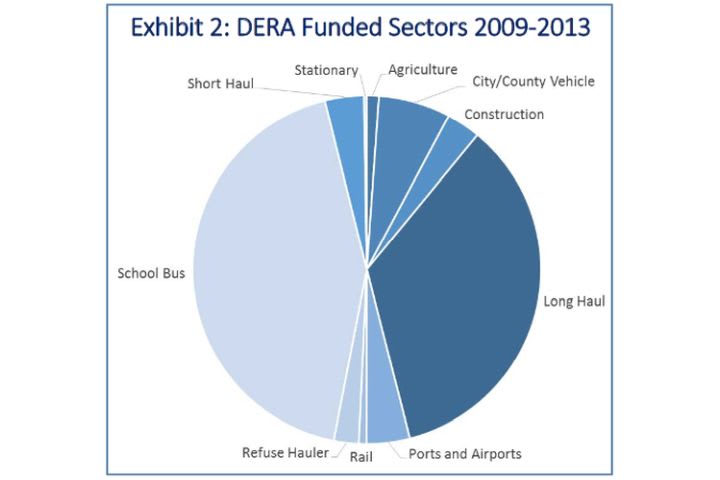
Chart courtesy of EPA.
2 min to read
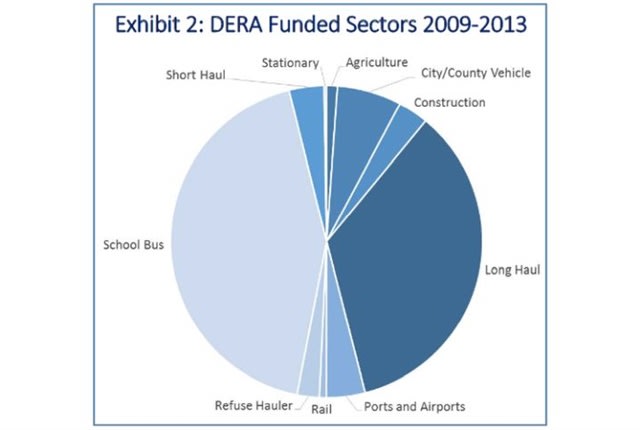
Chart courtesy of EPA.
U.S. Senator Tom Carper (D-Del.) has introduced a bill to extend the Diesel Emissions Reduction Act (DERA) through 2021 to continue to provide grants from the U.S. Environmental Protection Agency to reduce emissions from older diesel-powered trucks and equipment.
The act, which was first passed in 2005, was first renewed in 2010. It's set to expire this year, and has provided about $30 million a year in EPA-administered federal grants. Carper introduced the renewal bill April 20 that includes co-sponsors Sens. James Inhofe (R-Okla.), Barbara Boxer (D-Calif.), and Shelley Moore Capito (R-W.Va.).
"Retrofitting older, diesel engines with American-made technology can provide enormous environmental and public health benefits, while creating jobs here at home," Carper said. "This program continues to be a bipartisan, commonsense approach to curbing toxic diesel emissions, promoting public health, and spurring economic growth."
The DERA program helps reduce emissions from older diesel powered vehicles and equipment by providing incentive funding through a competitive process for equipment owners and operators toward the purchase of new technology engines, approved emission controls or retrofit devices to reduce emissions, or total engine replacements.
"While new diesel technology and fuels have achieved near zero emission levels, DERA is the leading program that upgrades or replaces older diesel engines with newer technology to reduce emissions," said Allen Schaeffer, executive director of the Diesel Technology Forum.
According to a new report issued by the U.S. Environmental Protection Agency in March, more than 73,000 older diesel powered engines were upgraded or replaced between 2008 to 2013 with DERA funding, which resulted in clean air benefits and fuel savings.
The DERA funding retrofitted or replaced 73,000 vehicles and equipment; reduced particulate matter emissions by 14,700 tons; saved 450 million gallons of fuel; and generated almost $13 billion in environmental benefits, according to the report. The program awarded $520 million in grants.
“The federal share of DERA funding represents a small share of the total cost of each project to encourage owners to retrofit or replace with new clean technologies,” Schaeffer said.
More Fuel Smarts

How Volvo Updated Its D13 for EPA 2027 [Watch]
Volvo’s updated D13 promises lower emissions without sacrificing performance or fuel economy. Take a closer look at what changed inside the engine in this HDT Spotlight video.
Read More →
Diesel Price Spike Shortens Payback for Natural Gas Trucks, Report Says
Energy Vision estimates fleets could recover the higher purchase price of an RNG-fueled Class 8 tractor in 1.3 to 2.8 years under current fuel-price scenarios.
Read More →
Calstart Becomes Catalyst Mobility, Reflecting Broader Focus
Calstart is now Catalyst Mobility, reflecting the nonprofit’s growing national role in clean transportation, including zero-emission trucks, infrastructure and incentive programs.
Read More →

Record Diesel Prices Squeeze Trucking Fleets
Average U.S. diesel prices have climbed to nearly $6 a gallon, surpassing the 2022 record as tight refinery capacity and Middle East disruptions keep fuel costs elevated.
Read More →
Sponsored•September 9, 2026
How Fuel Delivery Shapes Engine Performance
Fuel delivery depends on more than what happens at the injector. For fleet, maintenance and technical professionals, looking at the full path from pump to injector can provide useful context for understanding engine performance.
Read More →
East Coast Port Launches $45M Electric Truck Push
The Port Authority of New York and New Jersey announced millions in incentives for zero-emission drayage trucks, yard tractors, and new charging hubs near the port.
Read More →
California Bill Could Shed Light on Electric Truck Prices
Why do battery-electric Class 8 trucks remain so expensive? A California bill headed to Gov. Gavin Newsom would give fleets and state agencies more visibility into what manufacturers charge.
Read More →
Detroit Opens Orders for EPA 2027 Engines
Detroit isn’t starting from scratch to meet EPA 2027 diesel emissions standards. Its Gen 6 DD13 and DD15 engines keep much of today’s platform while updating the fuel and aftertreatment systems.
Read More →
Zero-Emission Truck Corridor Planned for West Coast
California, Oregon, Washington, British Columbia and Baja California are coordinating plans for truck charging and hydrogen fueling from Canada to Mexico.
Read More →
A Closer Look at Kenworth’s Electric T880E Vocational Truck [Video]
Learn more about Kenworth's T880E battery-electric vocational truck at the Paccar Technical Center, including its range, applications, upfitting considerations, and PTO options, in this HDT Spotlight video.
Read More →