




Daimler Unveils Pedestrian, Cyclist Avoidance in Mercedes-Benz Trucks
Daimler Trucks says it’s making pedestrian detection in trucks available for the first time, with new Sideboard Assist and Active Brake Assist 4 in Mercedes-Benz Trucks.
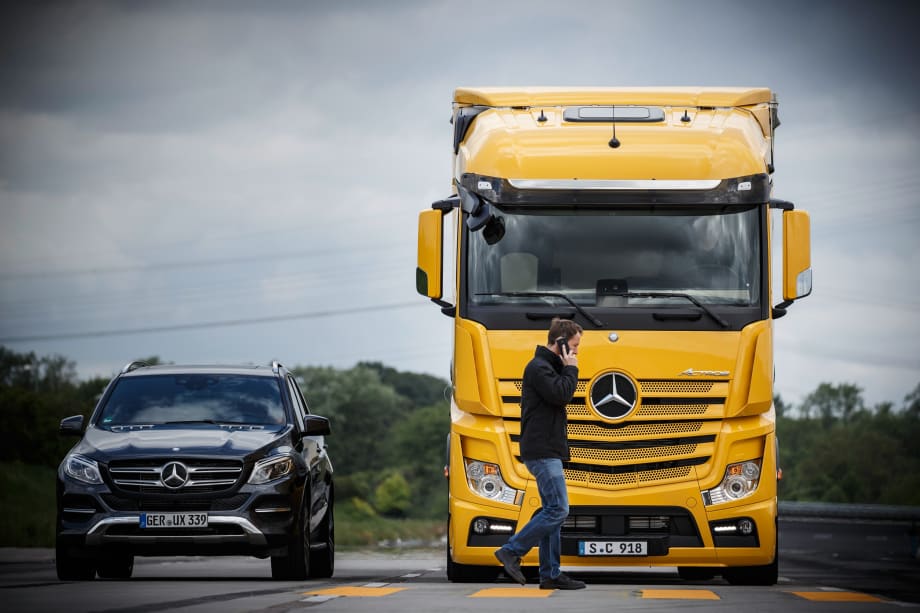
Daimler Trucks says it’s making pedestrian detection in trucks available for the first time, with new Sideboard Assist and Active Brake Assist 4 in Mercedes-Benz Trucks.
As part of a preview ahead of this fall’s IAA Commercial Vehicles Show in Hannover, Germany, company officials noted that to date, safety systems in trucks have served first and foremost to avoid serious accidents on highways. But the new Sideguard Assist and Active Brake Assist 4 Mercedes-Benz Trucks transfer high-tech safety technology into urban traffic and allows protection for pedestrians and cyclists.
While media coverage generally focuses on serious accidents on motorways and highways, in reality the situation is often quite different. In Germany, for example, around 30% of all traffic deaths occur in built-up areas – with regard to fatal traffic accidents involving goods transport vehicles, this figure is even in the region of 50%. Critical situations here are vehicles turning off or onto roads and traffic at junctions.
Active Brake Assist 4 is the first emergency braking system for trucks that can markedly reduce the risk of accidents with pedestrians in towns and cities, Daimler says. Whereas Active Break Assist 3 already initiates braking fully automatically in response to stationary and moving obstacles such as slow-moving vehicles in front or at the end of a tailback, the new ABA 4 now also detects pedestrians in urban traffic who are walking between parked cars onto the road.
Daimler says Sideguard Assist is the first assistance system available that draws the truck driver's attention to pedestrians and cyclists in cornering situations. The German Insurance Association expects that with a Sideguard Assist, about half of all accidents between trucks and pedestrians and cyclists can be avoided in the future.
More about ABA 4
Active Brake Assist 4 warns the driver of imminent collisions with pedestrians and simultaneously automatically initiates partial braking. In contrast to braking in response to moving and stationary obstacles, partial braking in response to moving pedestrians is not accompanied by a warning cascade, but rather the audible and visible warnings are output simultaneously with partial braking.
The long-range radar of Active Brake Assist 4 detects vehicles and obstacles in a direct line in front of the truck up to a distance of 250 meters and pedestrians up to a distance of 80 meters. Motorcycles, mopeds and cyclists are detectable up to a distance in between these two ranges (160 meters). The wide opening angle of 120 degrees enables Active Brake Assist 4 to detect vehicles and moving pedestrians at the sides of the area in front of the vehicle, where the range of vision is dependent on the topography, the course of the road, weather conditions and ambient influencing factors, such as pedestrians moving quickly into the traffic area or concealed pedestrians.
Active Brake Assist is able to detect moving pedestrians in virtually any traffic situation, for example if they walk into the truck's lane from the side, emerge from behind an obstacle or are moving along the vehicle's lane. Pedestrians are also detected within the range of the radar system when the truck turns off to the left and right. The automatic warning and braking reactions of the pedestrian detection system are effective up to a vehicle speed of 50 km/h. (The warning and braking reactions to stationary and moving obstacles apply throughout the entire speed range from 0 to 90 km/h).
The driver can override the system at any time as necessary, by means of a steering movement, kickdown or emergency braking, for example. If the driver does not brake firmly enough, the braking intensity of Active Brake Assist 4 takes precedence.
More about Sideguard Assist
The core of Sideguard Assist is a radar sensor system with two short-range radar sensors in front of the truck's rear axle on the co-driver's side. The system is oriented so as to cover the entire length of the truck. This applies equally to straight trucks, bobtail tractors and tractor-trailers. The length of the monitoring zone extends by 2 meters beyond the front of the truck and 1 meter behind the end of the vehicle.
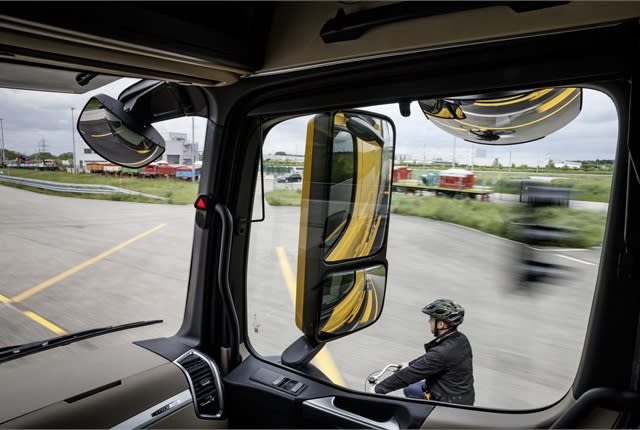
Sideguard Assist operates in several stages. It first informs the driver when a relevant object is located in the warning zone. In a second stage the driver is informed if they initiate or continue action and there is the danger of a collision.
If there is a moving object in the side monitoring zone, the driver is provided with a visible warning. An LED in the shape of a triangle lights up at the driver's eye level in the A-pillar on the co-driver's side. This lamp intuitively attracts the driver's attention to the situation alongside the vehicle and in the direction of the exterior mirrors on the co-driver's side.
If there is a risk of a collision, an additional visual and audible warning is triggered: The LED flashes brightly several times in red. After two seconds it remains permanently lit in red. A warning buzzer additionally sounds from a loudspeaker of the radio system on the side in question.
If the sensors additionally detect a stationary obstacle such as a traffic light or lamp in the tracking pattern of the truck during the process of turning off, there is also a visual and audible warning.
Sideguard Assist also helps when changing lanes or when maneuvering in areas such as loading docks and parking lots.
The tracking pattern warning operates in the speed range from 0 to 36 km/h. The other functions of Sideguard Assist are available throughout the entire speed range from 0 to 90 km/h.
Note: Headline corrected June 20, 5:45 EDT
More Safety & Compliance

FMCSA Pauses Biennial-Update Enforcement Amid Motus Transition
Carriers whose updates were due on or after June 1 have more time, while FMCSA works to stabilize its new registration system and warns of phishing sites impersonating its new carrier registration system, Motus.
Read More →
ZF Expands Commercial Vehicle Push in North America
ZF is expanding its North American commercial-vehicle presence with new transmission applications, electrification, trailer technology and autonomous-driving systems.
Read More →
Truck Drivers Need More Than Another Alert
Fleets have more visibility into truck health, safety events, and driver activity than ever. The next challenge is turning all that information into useful guidance for the person who has to decide what to do next.
Read More →
Tesla Wants a Self-Driving Semi. Are Cameras Enough?
Could Tesla’s camera-only autonomous driving technology work on an 80,000-pound Semi? In this commentary, HDT's Deborah Lockridge takes a look at Tesla, Cybercab, and how autonomous trucks see the road.
Read More →
What DOT’s Automated Vehicle Strategy Means for Trucking
The U.S. Department of Transportation issued a new automated-vehicle strategy that outlines plans for driverless-truck regulations, cross-state freight corridors, and federal safety standards.
Read More →
NYC Expands Speed, Pedestrian Safety Tech Across Fleet
New York City is expanding intelligent speed assistance and pedestrian-alert systems across its municipal fleet, moving the technologies from pilot programs into vehicle procurement and retrofit requirements.
Read More →
FMCSA Removes 110 Truck Driver Training Schools from Certified ELDT List
Federal regulators also are targeting more than 160 additional training providers and launching a nationwide audit of third-party CDL skills testers as part of a broader crackdown on trucking fraud.
Read More →
Beyond DOT Compliance: What Makes a Trucking Fleet Truly Safe?
A trucking fleet can follow every rule and still make unsafe decisions. The real test comes when safety conflicts with freight, productivity, or cost.
Read More →
Hours of Service Pilot Programs: FMCSA Readies for 2027 Rollout
Two pilot programs could eventually reshape hours-of-service rules, giving truck drivers options to pause their 14-hour clock or use longer split sleeper rest periods.
Read More →
New Guide Offers Pet Safety Tips for Truck Drivers
Hundreds of thousands of pets travel in truck cabs. A new safety guide from Volvo Trucks and the Center for Pet Safety offers practical advice for truck drivers who bring dogs and cats along for the ride.
Read More →