





Related: Daimler Acquires Majority Shares of Torc Robotics
Daimler Trucks, Torc Robotics Expand Autonomous Testing
Daimler Trucks and Torc Robotics are expanding testing of automated truck technology to new public routes in the U.S., with further development and validation efforts to continue in Virginia.
February 18, 2020
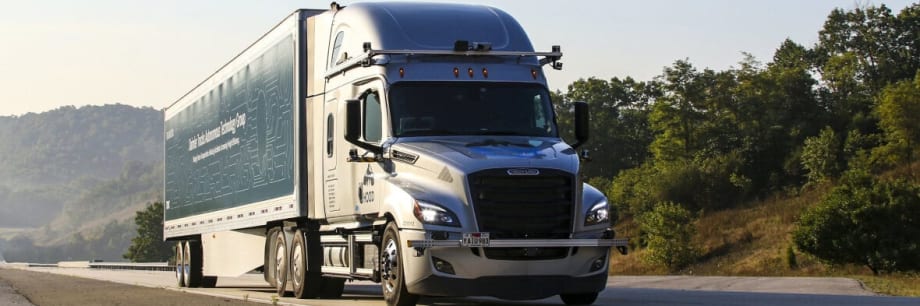
Daimler Trucks and Torc Robotics said public road testing efforts allow the teams to collect data from real-world traffic scenarios beyond what can be learned from computer simulations and closed road courses.
Photo: Daimler Trucks North America
3 min to read
Daimler Trucks and Torc Robotics, partners in Daimler Trucks’ Autonomous Technology Group, will soon expand testing of automated truck technology to new public routes in the U.S., the company announced.
According to Daimler, the team completed initial mapping of additional routes in January. These public road testing efforts allow the teams to collect data from real-world traffic scenarios, beyond what can be learned from computer simulations and closed road courses.
Initial public road testing started in southwest Virginia last year, where Torc is headquartered. The supportive state and local governments, combined with the well-developed infrastructure and highway systems, allow the teams to rigorously test, develop and deploy the automated system, according to Daimler. The Autonomous Technology Group will continue to test the next generation of automated driving software in Virginia and will add the upcoming new routes to the data collecting. This extensive testing is part of Daimler Trucks’ and Torc’s comprehensive validation approach to bring safe, highly automated trucks to the road.
“Safety is our highest priority,” said Peter Vaughan Schmidt, head, Autonomous Technology Group, Daimler Trucks. "By expanding our testing to new routes in the U.S., we are able to learn more, work with various partners, and apply our advanced testing methods to new environments. These learnings help us to achieve our goal of safe and reliable highly automated driving, delivering value to our customers and society.”
Strong Expertise in Vehicle and Software Testing
Daimler Trucks noted it has dozens of years of experience in testing and validating the durability, reliability, and safety of commercial vehicles around the world. With Active Drive Assist in Mercedes-Benz Actros and Fuso Super Great), and Detroit Assurance 5.0 with Active Lane Assist in Freightliner Cascadia, Daimler Trucks has brought partially automated driving features into series production.
Similarly, Daimler said, Torc’s Asimov autonomous driving system has been tested on public roads with zero accidents, including a cross-country journey.
Daimler Trucks and Torc said they have developed a comprehensive validation approach and safety protocols for automated driving and are aligned with the federal framework policy for testing and commercial deployment of SAE Level 4 automated trucks. All automated runs require both an engineer overseeing the system and a highly trained safety driver certified by Daimler Trucks and Torc. All safety drivers hold commercial driver’s licenses and are specially trained in vehicle dynamics and automated systems.
“Achieving our safety targets with highly automated driving systems requires extensive testing and building trust in the capabilities and benefits of these technologies," said Roger Nielsen, president and CEO, Daimler Trucks North America. "Proving the use case on U.S. roads is not only a technological challenge. It requires involvement and input from customers and drivers, legislators, local communities and the public. Each stakeholder plays an important role in developing the framework under which we operate."
More Equipment

How Volvo Updated Its D13 for EPA 2027 [Watch]
Volvo’s updated D13 promises lower emissions without sacrificing performance or fuel economy. Take a closer look at what changed inside the engine in this HDT Spotlight video.
Read More →
Michelin Tire Improves Efficiency and Durability for Regional Fleets
The Michelin X Multi Energy D2 is a regional haul drive tire engineered to help fleets improve fuel efficiency, durability and traction in demanding stop-and-go operations.
Read More →
ZF Expands Commercial Vehicle Push in North America
ZF is expanding its North American commercial-vehicle presence with new transmission applications, electrification, trailer technology and autonomous-driving systems.
Read More →
Tesla Wants a Self-Driving Semi. Are Cameras Enough?
Could Tesla’s camera-only autonomous driving technology work on an 80,000-pound Semi? In this commentary, HDT's Deborah Lockridge takes a look at Tesla, Cybercab, and how autonomous trucks see the road.
Read More →
Kodiak: Driverless Long-Haul Truck Launch on Track for 2026
Kodiak AI says its driverless long-haul safety case is 93% complete and it remains on track to begin commercial operations by year-end 2026.
Read More →
What DOT’s Automated Vehicle Strategy Means for Trucking
The U.S. Department of Transportation issued a new automated-vehicle strategy that outlines plans for driverless-truck regulations, cross-state freight corridors, and federal safety standards.
Read More →
East Coast Port Launches $45M Electric Truck Push
The Port Authority of New York and New Jersey announced millions in incentives for zero-emission drayage trucks, yard tractors, and new charging hubs near the port.
Read More →
PlusAI Going Public to Fund Autonomous Truck Launch
A SPAC deal could provide PlusAI with up to $300 million as it works toward a 2027 commercial launch of factory-built autonomous trucks.
Read More →
NHTSA Moves to Rewrite Truck Fuel-Economy Rules
The National Highway Traffic Safety Administration says it lacks authority to regulate medium- and heavy-duty truck engines separately from complete vehicles, but the existing standards have not yet been eliminated.
Read More →
Detroit Opens Orders for EPA 2027 Engines
Detroit isn’t starting from scratch to meet EPA 2027 diesel emissions standards. Its Gen 6 DD13 and DD15 engines keep much of today’s platform while updating the fuel and aftertreatment systems.
Read More →