




Daimler Truck, Volvo Group Form Fuel Cell Joint Venture
In a bold move, Daimler Truck AG and the Volvo Group agreed to join forces in an effort to speed up the development, establishment and acceptance of fuel cell vehicles – at a time when much of the focus on electric trucks among legacy truck makers has been on battery-electric solutions.


Daimler Truck AG's Martin Daum (left) and the Volvo Group's Martin Lundstedt were both on hand for the virtual announcement of the fuel-cell joint venture.
Photo: Daimler/Volvo
In a bold move, Daimler Truck AG and the Volvo Group agreed to join forces in an effort to speed up the development, establishment and acceptance of fuel cell vehicles – at a time when much of the focus on electric trucks among legacy truck makers has been on battery-electric solutions. The intention is to develop, produce and commercialize fuel cell systems for heavy-duty vehicle applications and other uses.
“Making fuel cell technology work is no small undertaking for any one company, thus we are convinced that combining the experience of both Daimler and Volvo is the right thing to do for us, our customers, and for society as a whole,” said Martin Daum, chairman of the board of management at Daimler Truck AG, adding that the two companies will “remain natural competitors in all other aspects.”
Daimler will first consolidate all its current fuel cell activities in the joint venture, with the Volvo Group acquiring 50% in the JV. The two companies signed a preliminary non-binding agreement, which will have to be further reviewed and approved by certain agencies.
“We are not starting from scratch," said Daum. “We’d rather build upon a reliable, available and mature foundation.”
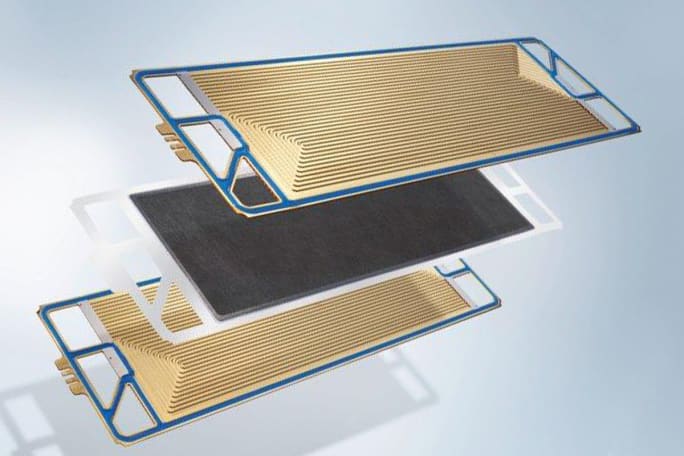
In the center of the fuel cell is a thin plastic film, the Proton Exchange Membrane (PEM), which is coated on both sides with a thin catalyst layer and a gas permeable electrode made of graphite paper. The membrane is surrounded by two bipolar plates into which gas ducts have been milled. Through these gas ducts flows hydrogen on the one side, and oxygen on the other. Several of these individual fuel cells can be stacked one behind the other to create a fuel cell stack.
Image: Daimler/Volvo
Combining the efforts of these two global OEMs will give them the ability to share the costs of developing this technology and to progress faster, according to Martin Lundstedt, Volvo Group president and CEO.
“We have not lost our sight on the long-term, strategic objective of our industry and for society – the number one issue still being climate change and reducing humanity’s carbon footprint,” said Lundstedt during an early-morning conference call timed to coincide with European markets. “We need to drive sustainable transportation to the next level. Today’s announcement is proof of our determination to contribute to this goal."
In the end, the partners plan to develop heavy-duty vehicles with fuel cells for demanding long-haul applications in series production in the second half of the decade. Also, other automotive and non-automotive use cases are also being considered for the new joint venture.
The creation of new Daimler Truck fuel cell unit will include the allocation of the operations of Mercedes-Benz Fuel Cell GmbH, which has been developing fuel cell and hydrogen storage systems for various vehicle applications, to Daimler Truck AG. Main operations will exist at Mercedes-Benz Fuel Cell GmbH location in Nabern, Germany, with production facilities in Germany and Canada. While the preliminary agreement is non-binding, a final agreement is expected by Q3, closing before the end of the year.
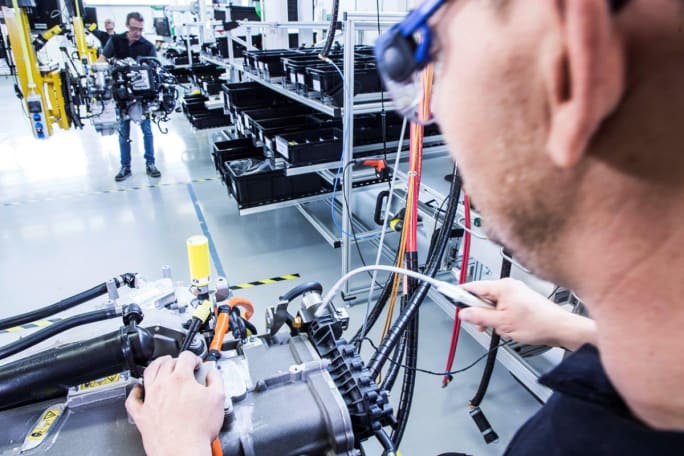
The assembly line for a fuel cell drive unit in Kirchheim-Nabern. After all the connections are double-checked, the circulation systems for the hydrogen, air and coolant are all inspected.
Photo: Daimler/Volvo
“We know transport and logistics is a key enabler for society to grow and prosper, and we know the need for transport will increase with the growing world population and urbanization. We must meet that need with solutions that are more sustainable than today’s,” said Lundstedt.
More Fuel Smarts
Paper Transport Puts RNG to Work for Shipper
Eight renewable natural gas trucks are hauling freight for Graphic Packaging, part of Paper Transport’s growing mix of alternative-fuel transportation options that also includes a Tesla Semi pilot.
Fleet Costs Shape ACT Expo 2027 Agenda
With diesel prices high and operating expenses under pressure, ACT Expo's 2027 agenda emphasizes fuel efficiency, AI, safety and the return on fleet technology investments.

How GP Transco Builds Fuel Savings a Fraction at a Time
Aerodynamic specs, solar panels, and driver incentives help GP Transco turn small efficiency gains into savings it can reinvest in its people.

Trucking’s Diesel Squeeze Isn’t Letting Up
With diesel topping $6 a gallon nationally, ATA's Bob Costello explains why fleets should prepare for continued pressure at the pump.
FlowBelow Redesigns Trailer AeroSlider to Cut Fuel Use
The lighter trailer aerodynamic system installs in less than 45 minutes, according to the company, with potential payback in under a year depending on fuel prices and trailer mileage.

Why Diesel Price Relief Efforts May Fall Short
Diesel prices have eased from September’s record high, but doubts about additional Russian supply and limits on dyed-diesel tax relief mean trucking fleets still face expensive fuel. And prices could go higher.

Why Small Fuel Savings Matter in Trucking [Podcast]
Can better fuel economy help pay for driver raises? In this episode of the HDT Talks Trucking podcast, GP Transco explains how small efficiency gains create room to reinvest in its people.

How GP Transco Cuts Trucking Fuel Costs, a Tenth of a Gallon at a Time
What’s another tenth of a mile per gallon worth? GP Transco shares how equipment upgrades and driver coaching turn small gains into meaningful fuel savings.

Electric Yard Tractors Move Beyond Pilots
Operating-cost savings have overtaken sustainability goals as the leading reason surveyed fleets are adopting battery-electric terminal tractors, according to new NACFE research.

Geotab Links Fleet Card to Vehicle Data
The new card combines fuel discounts with telematics-based purchase controls. Geotab’s analysis also points to potential savings from choosing lower-priced fuel stops.