





You also may like: Torc’s Fleming: Retrofitting Trucks for Autonomy 'Not Commercially Viable'
Daimler, Torc Expanding Autonomous Testing With Next-Gen Test Trucks
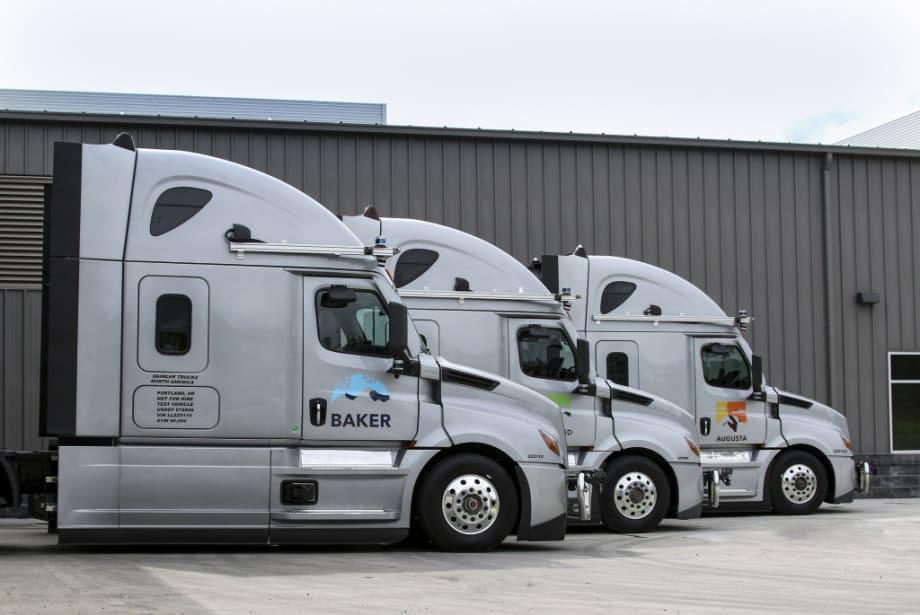
Torc Robotics and Daimler Trucks North America’s co-development of autonomous truck technology takes the next step, as the second iteration of test trucks designed to work with Torc’s SAE Level 4 autonomous self-driving technology hit the road for testing.
October 8, 2020
“To meet the redundancy and performance requirements of a self-driving truck, the traditional truck chassis must be reinvented,” explained Michael Fleming, Torc’s CEO.
Photo: Daimler Trucks North America
4 min to read
Torc Robotics and Daimler Trucks North America’s co-development of autonomous truck technology takes the next step, as the second iteration of test trucks designed to work with Torc’s SAE Level 4 autonomous self-driving technology hit the road for testing.
The two companies have been testing their technology near Torc’s Virginia headquarters, but are expanding their testing into the Southwest in early 2021, using an enhanced prototype truck. This new generation of Freightliner Cascadia test trucks, internally known as Gen 2, are the second iteration of trucks jointly developed by the two companies.
Torc and Daimler Trucks’ ultimate goal is to “reinvent the truck” by co-developing a Level 4 Freightliner Cascadia that includes safety-critical redundancy components, as well as the seamless integration of additional computers and hardware required for self-driving technology.
“To meet the redundancy and performance requirements of a self-driving truck, the traditional truck chassis must be reinvented,” explained Michael Fleming, Torc’s CEO. “Just like any major innovation, it requires a stair-step approach toward the final product. We are taking this one step at a time, with safety as our guiding principle.”
Torc has been commercializing its self-driving technology in heavy-duty applications for more than a dozen years. In 2019, Torc and Daimler Trucks teamed up to bring self-driving trucks to market within the decade.
“We knew from the outset that self-driving technology cannot be commercialized without an OEM,” Fleming said.
“Our partnership with Torc is critical to our efforts to commercialize a Level 4 highly automated truck,” said Roger Nielsen, president and CEO of DTNA. “Torc’s experience with developing self-driving technology and their focus on safety makes them the ideal partner. Our joint goal is a Level 4 integrated truck that provides true customer value.”
Level 4 Autonomous Trucks
Level 4 autonomous control, as defined by the Society of Automotive Engineers, allows for complete driver inattention to vehicle activity, with no no driver attention ever required for safety. The driver may safely go to sleep or leave the driver's seat and only need resume control of the vehicle in areas with limited telemetry or under special circumstances, such as accidents or traffic jams. Outside of these areas or circumstances, the vehicle must be able to safely abort the trip and safety park the vehicle if the driver does not retake control.
Market-ready self-driving trucks must emulate the actions of the most experienced and safe truck drivers, say Torc and Daimler. The partners are developing software and hardware that is seamlessly integrated to reliably handle failures of safety-critical vehicle components, such as braking, steering, power distribution, and messaging.
The team’s vision for a Level 4 vehicle platform is one in which component redundancies and software behaviors work together. In the case of a brake failure in a Level 4 truck, for instance, redundancies would maintain the vehicle’s ability to decelerate and stop without human intervention. Torc’s self-driving software would then be able to maneuver to a safe location so a support crew could service the brake system, according to Fleming.
Another integral behavior the team is working to replicate is the way experienced truck drivers are able to feel component failures. “Our software engineers are working with highly skilled truck drivers to understand this experience and transition this human intuition into embedded sensors and algorithms,” Fleming said.
Iterative Truck Generations for Self-Driving Tech Development
Torc and DTNA expect to develop multiple iterative test truck models before they release a self-driving truck for commercial customers. The prototypes will incorporate many lessons learned from testing and development since the partners started working together in 2019 and Daimler acquired a majority stake in the autonomous-technology company.
The upgrades included in the Gen 2 prototype truck are designed to bolster the testing effort and speed up the collection of data that is used in machine learning and algorithmic development.
Improvements in data collection and transfer will help the development team expand capabilities quickly and safely, according to the companies, supporting Torc’s effort to scale its test fleet in multiple locations. Additional sensor density and coverage will assist in overall high-fidelity perception performance and long-range sensing power, critical for highway driving.
Both companies have stated that they will only deploy self-driving trucks when they are safe and reliable – not by a set date. Fleming is convinced the team will meet its goal, because “We are two pioneers joining forces – we understand the complexities of commercializing self-driving technology. Our mission is to save lives and our vision is to become the standard in self-driving trucking.”
In a Zoom call with reporters last month, Peter Vaughan Schmidt, head of Daimler Truck’s Autonomous Technology Group, explained that the plan is to deploy small pilots with customers, “complete a few missions in selected [operations] in selected areas in the Southwest region of the U.S., and then grow it from there over time.
“It’s a marathon, it’s not a sprint. Safety will dictate our timeline."
More Equipment

How Volvo Updated Its D13 for EPA 2027 [Watch]
Volvo’s updated D13 promises lower emissions without sacrificing performance or fuel economy. Take a closer look at what changed inside the engine in this HDT Spotlight video.
Read More →
Michelin Tire Improves Efficiency and Durability for Regional Fleets
The Michelin X Multi Energy D2 is a regional haul drive tire engineered to help fleets improve fuel efficiency, durability and traction in demanding stop-and-go operations.
Read More →
ZF Expands Commercial Vehicle Push in North America
ZF is expanding its North American commercial-vehicle presence with new transmission applications, electrification, trailer technology and autonomous-driving systems.
Read More →
Tesla Wants a Self-Driving Semi. Are Cameras Enough?
Could Tesla’s camera-only autonomous driving technology work on an 80,000-pound Semi? In this commentary, HDT's Deborah Lockridge takes a look at Tesla, Cybercab, and how autonomous trucks see the road.
Read More →
Kodiak: Driverless Long-Haul Truck Launch on Track for 2026
Kodiak AI says its driverless long-haul safety case is 93% complete and it remains on track to begin commercial operations by year-end 2026.
Read More →
What DOT’s Automated Vehicle Strategy Means for Trucking
The U.S. Department of Transportation issued a new automated-vehicle strategy that outlines plans for driverless-truck regulations, cross-state freight corridors, and federal safety standards.
Read More →
East Coast Port Launches $45M Electric Truck Push
The Port Authority of New York and New Jersey announced millions in incentives for zero-emission drayage trucks, yard tractors, and new charging hubs near the port.
Read More →
PlusAI Going Public to Fund Autonomous Truck Launch
A SPAC deal could provide PlusAI with up to $300 million as it works toward a 2027 commercial launch of factory-built autonomous trucks.
Read More →
NHTSA Moves to Rewrite Truck Fuel-Economy Rules
The National Highway Traffic Safety Administration says it lacks authority to regulate medium- and heavy-duty truck engines separately from complete vehicles, but the existing standards have not yet been eliminated.
Read More →
Detroit Opens Orders for EPA 2027 Engines
Detroit isn’t starting from scratch to meet EPA 2027 diesel emissions standards. Its Gen 6 DD13 and DD15 engines keep much of today’s platform while updating the fuel and aftertreatment systems.
Read More →