





You also may like: Mass Market Roll-Out of Hydrogen Trucks in Europe Goal of H2Accelerate
Daimler to Spin off Truck Business, Cites 'Zero-Emissions Future'
Daimler plans to spin off Daimler Truck as a separate business and establish two independent pure-play companies for truck/bus and autos, “designed to unlock the full potential of its businesses in a zero-emissions, software-driven future.”
February 3, 2021
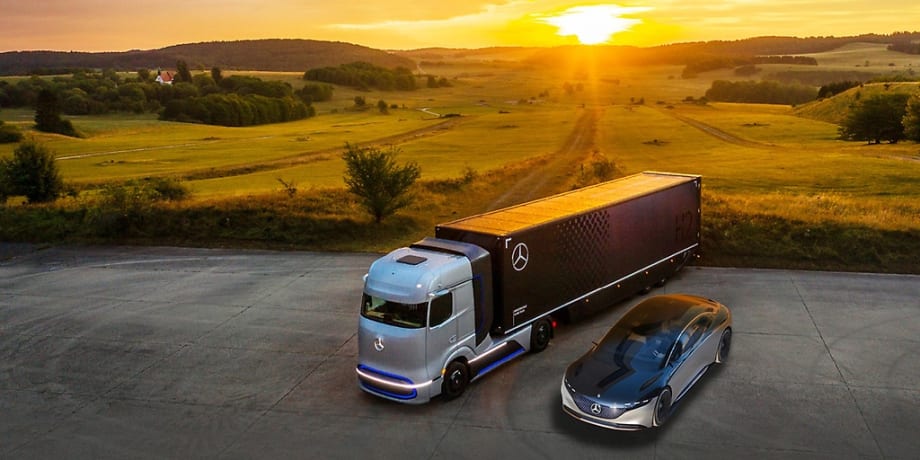
Spinning off its truck and bus business will allow acceleration of Daimler's work on zero-emission and autonomous trucks.
Photo: Daimler
3 min to read
Daimler plans to spin off Daimler Truck as a separate business and establish two independent pure-play companies, eventually renaming the car part of the business as Mercedes-Benz. The Germany-based company said this “fundamental change in its structure” is “designed to unlock the full potential of its businesses in a zero-emissions, software-driven future.”
In a Feb. 3 news release, the company said Mercedes-Benz “will be the world's pre-eminent luxury car business, committed to leading in electric drive and car software,” while “Daimler Truck will accelerate its path towards zero emissions as the world's largest truck and bus producer and technology leader.”
“Mercedes-Benz Cars & Vans and Daimler Trucks & Buses are different businesses, with specific customer groups, technology paths and capital needs,” said Ola Källenius, chairman of the board of management of Daimler and Mercedes-Benz, in the release. “Mercedes-Benz is the world's most valuable luxury car brand, offering the most desirable cars to discerning customers. Daimler Truck supplies industry leading transportation solutions and services to customers. Both companies operate in industries that are facing major technological and structural changes. Given this context, we believe they will be able to operate most effectively as independent entities, equipped with strong net liquidity and free from the constraints of a conglomerate structure.”
The Daimler Truck business will have fully independent management and stand-alone corporate governance, including an independent chairman of the supervisory board. The separate listing of Daimler Truck in Frankfurt planned for year-end 2021.
Mercedes-Benz and Daimler Truck will each be supported by dedicated captive financial and mobility service entities. The company plans to assign resources and teams from today's Daimler Mobility to both Mercedes-Benz and Daimler Truck.
The company just two years ago did a different restructuring, splitting it activities into three legally independent entities -- one new company to focus on its car and van business and a second on its truck and bus business. The third was Daimler Financial Services AG, which was renamed Daimler Mobility in that restructuring and handled both car and truck business.
Focusing on Electric, Autonomous Trucks
The new Daimler Truck will accelerate the execution of its strategic plans, according to the announcement, driving forward with its development of emissions-free technologies for trucks and buses.
"This is a pivotal moment for Daimler Truck. With independence comes greater opportunity, greater visibility and transparency,” said Martin Daum, member of the board of management of Daimler and chairman of the board of management of Daimler Truck. “We have already defined the future of our business with battery-electric and fuel-cell trucks, as well as strong positions in autonomous driving. With targeted partnerships we will accelerate the development of key technologies to bring best-in-class products to our customers rapidly.”
Daimler Truck is the world's largest truck and bus producer, with industry-leading positions in Europe, North America and Asia, according to the company, and more than 35 main locations around the globe. With more than 100,000 employees, it unites seven brands under one roof: BharatBenz, Freightliner, Fuso, Mercedes-Benz, Setra, Thomas Built Buses and Western Star. In 2019, a total of around half a million trucks and buses were delivered to customers.
Daimler will set up an innovation fund with 1.5 billion euros for Daimler Truck in addition to current financial plans.
“We are convinced that the capital markets will appreciate the opportunity to invest in more clearly focused, pure-play businesses,” said Manfred Bischoff, chairman of the supervisory board of Daimler.
Michael Brecht, chairman of Daimler's General Works Council, explained, "The transformation of our industry is moving ahead quickly. In order for us to keep pace, we need to invest in innovations boldly and more quickly.”
The final decision on the spin-off has to be made by an extra-ordinary shareholder meeting of Daimler, which is planned to take place in the third quarter.
More Equipment

How Volvo Updated Its D13 for EPA 2027 [Watch]
Volvo’s updated D13 promises lower emissions without sacrificing performance or fuel economy. Take a closer look at what changed inside the engine in this HDT Spotlight video.
Read More →
Michelin Tire Improves Efficiency and Durability for Regional Fleets
The Michelin X Multi Energy D2 is a regional haul drive tire engineered to help fleets improve fuel efficiency, durability and traction in demanding stop-and-go operations.
Read More →
ZF Expands Commercial Vehicle Push in North America
ZF is expanding its North American commercial-vehicle presence with new transmission applications, electrification, trailer technology and autonomous-driving systems.
Read More →
Tesla Wants a Self-Driving Semi. Are Cameras Enough?
Could Tesla’s camera-only autonomous driving technology work on an 80,000-pound Semi? In this commentary, HDT's Deborah Lockridge takes a look at Tesla, Cybercab, and how autonomous trucks see the road.
Read More →
Kodiak: Driverless Long-Haul Truck Launch on Track for 2026
Kodiak AI says its driverless long-haul safety case is 93% complete and it remains on track to begin commercial operations by year-end 2026.
Read More →
What DOT’s Automated Vehicle Strategy Means for Trucking
The U.S. Department of Transportation issued a new automated-vehicle strategy that outlines plans for driverless-truck regulations, cross-state freight corridors, and federal safety standards.
Read More →
East Coast Port Launches $45M Electric Truck Push
The Port Authority of New York and New Jersey announced millions in incentives for zero-emission drayage trucks, yard tractors, and new charging hubs near the port.
Read More →
PlusAI Going Public to Fund Autonomous Truck Launch
A SPAC deal could provide PlusAI with up to $300 million as it works toward a 2027 commercial launch of factory-built autonomous trucks.
Read More →
NHTSA Moves to Rewrite Truck Fuel-Economy Rules
The National Highway Traffic Safety Administration says it lacks authority to regulate medium- and heavy-duty truck engines separately from complete vehicles, but the existing standards have not yet been eliminated.
Read More →
Detroit Opens Orders for EPA 2027 Engines
Detroit isn’t starting from scratch to meet EPA 2027 diesel emissions standards. Its Gen 6 DD13 and DD15 engines keep much of today’s platform while updating the fuel and aftertreatment systems.
Read More →