




Mass Market Roll-Out of Hydrogen Trucks in Europe Goal of H2Accelerate
Daimler Truck, Iveco, Shell, the Volvo Group and energy company OMV announced a collaboration to ramp up the mass-market roll-out of hydrogen trucks in Europe.


The Mercedes-Benz GenH2 Truck is a concept for a fuel cell powered long-haul vehicle.
Photo: Daimler Trucks
Daimler Truck, Iveco, Shell, the Volvo Group and energy company OMV are teaming up to ramp up the mass-market roll-out of hydrogen trucks in Europe.
Participants in the new collaboration, called H2Accelerate, believe hydrogen is an essential fuel for the complete decarbonization of the truck sector.
Achieving a large-scale roll-out of hydrogen-fueled trucks is expected to create new industries, such as zero-carbon hydrogen production facilities, large-scale hydrogen distribution systems, a network of high-capacity refueling stations for liquid and gaseous hydrogen, and the production of the hydrogen-fueled trucks themselves.
H2A participants believe that synchronized investments across the sector during the 2020s will create the conditions for the mass market roll-out of hydrogen-fueled heavy-duty transportation, which is required to meet the European ambition of net zero emissions by 2050.
The decade-long scale-up is expected to begin with groups of customers willing to make an early commitment to hydrogen-based trucking. These fleets are expected to operate in regional clusters and along European high-capacity corridors with good refueling station coverage. These clusters can then be interconnected to build a pan-European network.
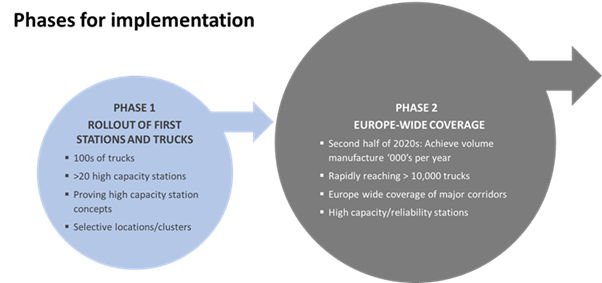
H2Accelerate plans to implement the mass-market roll-out of hydrogen fuel cell trucks over the next decade.
Graphic: Shell
Although this effort is focused on Europe, global companies like these can use what they learn to help them in efforts to develop hydrogen fuel trucking in other parts of the world, including North America. Iveco has a partnership with U.S.-based electric-truck startup Nikola, which plans to offer both battery-electric and hydrogen-electric trucks.
Throughout the scale up, support from the public sector will be required. Under H2Accelerate, the participants expect to work together to seek funding for early pre-commercial projects during the first phase of the roll-out. In parallel, the participants will engage with policy makers and regulators to encourage a policy environment which will help support the subsequent scale up into volume manufacturing for hydrogen trucks and a Europe-wide refueling network for zero-carbon hydrogen fuel.
H2Accelerate is a collaboration agreement signed between the participants under which the participants will work together to:
seek public support to fund early pre-commercial projects to activate the market on the path towards a mass market roll-out;
communicate around the technical and commercial viability of hydrogen-fueled trucking at scale; and
hold discussions with policy makers and regulators to encourage policies to support a sustainable and speedy activation of the zero-emissions long-haul trucking market.
“Climate change is the challenge of our generation, and we are fully committed to the Paris Climate Agreement for decarbonizing road transport,” said Martin Lundstedt, president and CEO of the Volvo Group. “In the future, the world will be powered by a combination of battery-electric and fuel-cell electric vehicles, along with other renewable fuels to some extent. The formation of the H2Accelerate collaboration is an important step in shaping a world we want to live in.”
Martin Daum, who heads up Daimler Truck, called the collaboration unprecedented and “an important milestone for driving forward the right framework conditions for establishing a mass market for hydrogen-based trucking. It is also a call to action for policymakers, further players involved and society as a whole.”
Alastair Hayfield, senior research director at market research firm Interact Analysis, said the effort will be a massive undertaking.
Currently, the medium- and heavy-duty battery electric truck market is very small, he pointed out. In Europe it amounted to 124 units in 2019 (44 medium-duty trucks and 80 heavy-duty trucks), while the European market for hydrogen fuel cell medium- and heavy-duty trucks was negligible.
“By 2030 (which is as far out as our projections reach) our research shows that the total medium-duty truck market for Europe will be 43,168 units. While for heavy-duty trucks the total 2030 market will be 292,569 units.
“To achieve the highly ambitious target of weaning themselves off fossil-fuel-powered models by 2040, these truck manufacturers will need to implement an absolutely massive ramp-up of their capabilities to manufacture battery and fuel cell electric trucks in a very short space of time.”
However, he said, these ambitions “may be very much in step with reality,” because its research also shows that Europe will hit peak internal combustion engine commercial vehicle registrations in 2024.
More Fuel Smarts

How Volvo Updated Its D13 for EPA 2027 [Watch]
Volvo’s updated D13 promises lower emissions without sacrificing performance or fuel economy. Take a closer look at what changed inside the engine in this HDT Spotlight video.
Read More →
Diesel Price Spike Shortens Payback for Natural Gas Trucks, Report Says
Energy Vision estimates fleets could recover the higher purchase price of an RNG-fueled Class 8 tractor in 1.3 to 2.8 years under current fuel-price scenarios.
Read More →
Calstart Becomes Catalyst Mobility, Reflecting Broader Focus
Calstart is now Catalyst Mobility, reflecting the nonprofit’s growing national role in clean transportation, including zero-emission trucks, infrastructure and incentive programs.
Read More →

Record Diesel Prices Squeeze Trucking Fleets
Average U.S. diesel prices have climbed to nearly $6 a gallon, surpassing the 2022 record as tight refinery capacity and Middle East disruptions keep fuel costs elevated.
Read More →
How Fuel Delivery Shapes Engine Performance
Fuel delivery depends on more than what happens at the injector. For fleet, maintenance and technical professionals, looking at the full path from pump to injector can provide useful context for understanding engine performance.
Read More →
East Coast Port Launches $45M Electric Truck Push
The Port Authority of New York and New Jersey announced millions in incentives for zero-emission drayage trucks, yard tractors, and new charging hubs near the port.
Read More →
California Bill Could Shed Light on Electric Truck Prices
Why do battery-electric Class 8 trucks remain so expensive? A California bill headed to Gov. Gavin Newsom would give fleets and state agencies more visibility into what manufacturers charge.
Read More →
Detroit Opens Orders for EPA 2027 Engines
Detroit isn’t starting from scratch to meet EPA 2027 diesel emissions standards. Its Gen 6 DD13 and DD15 engines keep much of today’s platform while updating the fuel and aftertreatment systems.
Read More →
Zero-Emission Truck Corridor Planned for West Coast
California, Oregon, Washington, British Columbia and Baja California are coordinating plans for truck charging and hydrogen fueling from Canada to Mexico.
Read More →
A Closer Look at Kenworth’s Electric T880E Vocational Truck [Video]
Learn more about Kenworth's T880E battery-electric vocational truck at the Paccar Technical Center, including its range, applications, upfitting considerations, and PTO options, in this HDT Spotlight video.
Read More →