





Related: Smart Trucks Have Already Arrived
Daimler Announces Public Highway Platooning Tests
DTNA president Roger Nielsen revealed at the NACV Show in Atlanta that the company is conducting platooning tests on public highways in Oregon and Nevada.
September 25, 2017
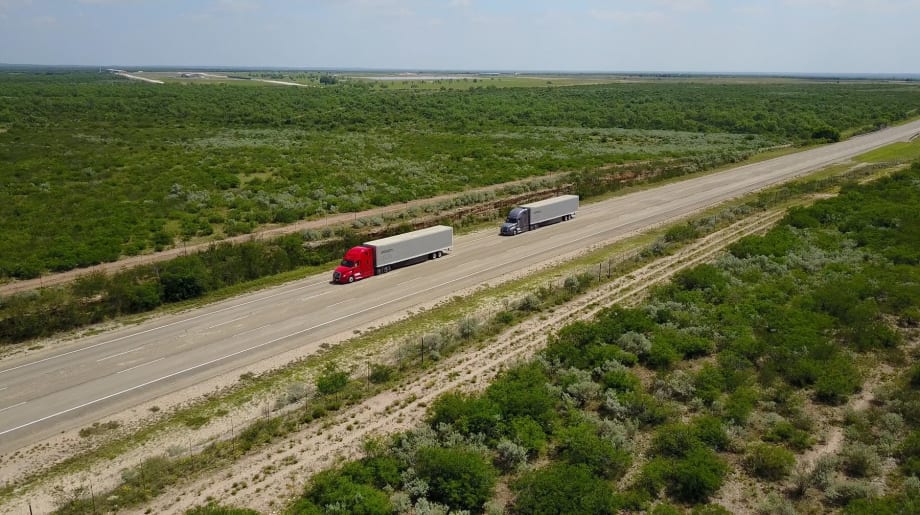
Roger Nielsen said at the NACV Show that Detroit Assurance Safety Systems are the enabling platform for the company’s current platooning tests in Oregon and Nevada. Photo: Daimler Trucks North America
2 min to read
Roger Nielsen said at the NACV Show that Detroit Assurance Safety Systems are the enabling platform for the company’s current platooning tests in Oregon and Nevada. Photo: Daimler Trucks North America
ATLANTA — For the first time in North America, Daimler Trucks showcased its entire lineup of commercial vehicles, from mid-sized vans to school buses to Class 8 long-haul tractors at a press event kicking off the opening day of the North American Commercial Vehicle Show (NACV) in Atlanta today.
The collection of vehicles, highlighted with a concept model of a next-generation Sprinter van, was a clear indication that Daimler views the future of logistics as coordinated, data-driven chain dependent on the efficient deployment of all sorts of vehicles with different sizes, shapes, and capabilities.
During the press briefing, Roger Nielsen, president and chief executive officer of Daimler’s North American Truck business division also noted that the company has been testing advanced platooning systems on public roads in both Oregon (near Portland, where the company’s North American headquarters is located) and in Nevada, which was an early adopter of autonomous vehicle regulations in 2014. The tests are based largely on the Detroit Assurance suite of active vehicle safety systems, Nielsen said, which enable coordinated vehicle movement at close following distances in platooning applications to take advantage of increased fuel efficiency brought enabled by shared aerodynamic efficiencies.
Nielsen noted that Daimler engineers have been testing platooning systems on test tracks and select U.S. highways, demonstrating how the new technology can improve fuel efficiency, driver productivity, convenience, and safety.
The first step of platooning is called “pairing,” where two trucks travel in tandem at distances closer than what is possible under manual operation. A team of engineers is testing the system in trucks under controlled circumstances in both Oregon and Nevada highways, driving in cooperation with officials in those states.
In addition to road testing, Nielsen revealed that DTNA is conducting coordinated braking tests on a closed track at the company’s High Desert Proving Grounds in Madras, Ore. in preparation for a fleet trial early next year.
“Platooning holds the potential to offer significant fuel economy advantages, while assisting drivers,” said Roger Nielsen, president and CEO, DTNA, who has driven the new Cascadia under platooning conditions using this technology. “To be sure, the platooning technology is not meant to replace drivers – it’s designed to help drivers.”
“If we can help relieve drivers while they are on highways, they will likely become less fatigued,” continued Nielsen. “That can reduce the risk of crashes and make the driving experience more comfortable. Commercial development of platooning will depend on several factors, including government regulations,” Nielsen said. “The bottom line: we see a growing number of customers interested in platooning. When America is ready for platooning, we will have a proven solution.”
More Equipment

Used-Truck Remarketing Math Is Changing
Used-truck value is no longer just a concern at trade-in. Decisions made throughout a truck’s first life can influence what it’s worth years later.
Read More →
How Volvo Updated Its D13 for EPA 2027 [Watch]
Volvo’s updated D13 promises lower emissions without sacrificing performance or fuel economy. Take a closer look at what changed inside the engine in this HDT Spotlight video.
Read More →
Michelin Tire Improves Efficiency and Durability for Regional Fleets
The Michelin X Multi Energy D2 is a regional haul drive tire engineered to help fleets improve fuel efficiency, durability and traction in demanding stop-and-go operations.
Read More →
ZF Expands Commercial Vehicle Push in North America
ZF is expanding its North American commercial-vehicle presence with new transmission applications, electrification, trailer technology and autonomous-driving systems.
Read More →
Tesla Wants a Self-Driving Semi. Are Cameras Enough?
Could Tesla’s camera-only autonomous driving technology work on an 80,000-pound Semi? In this commentary, HDT's Deborah Lockridge takes a look at Tesla, Cybercab, and how autonomous trucks see the road.
Read More →
Kodiak: Driverless Long-Haul Truck Launch on Track for 2026
Kodiak AI says its driverless long-haul safety case is 93% complete and it remains on track to begin commercial operations by year-end 2026.
Read More →
What DOT’s Automated Vehicle Strategy Means for Trucking
The U.S. Department of Transportation issued a new automated-vehicle strategy that outlines plans for driverless-truck regulations, cross-state freight corridors, and federal safety standards.
Read More →
East Coast Port Launches $45M Electric Truck Push
The Port Authority of New York and New Jersey announced millions in incentives for zero-emission drayage trucks, yard tractors, and new charging hubs near the port.
Read More →
PlusAI Going Public to Fund Autonomous Truck Launch
A SPAC deal could provide PlusAI with up to $300 million as it works toward a 2027 commercial launch of factory-built autonomous trucks.
Read More →
NHTSA Moves to Rewrite Truck Fuel-Economy Rules
The National Highway Traffic Safety Administration says it lacks authority to regulate medium- and heavy-duty truck engines separately from complete vehicles, but the existing standards have not yet been eliminated.
Read More →