





Related: Daimler - Electric Delivery Trucks, Vans on the Way for U.S.
Daimler and Trailer Maker Partner on European Fuel-Efficient Rig
Daimler’s Mercedes-Benz Truck unit along with Germany-based trailer maker Krone have teamed up to put together a linehaul tractor-trailer they say delivers up to a 20% cut in fuel consumption compared to existing combinations.
September 30, 2016
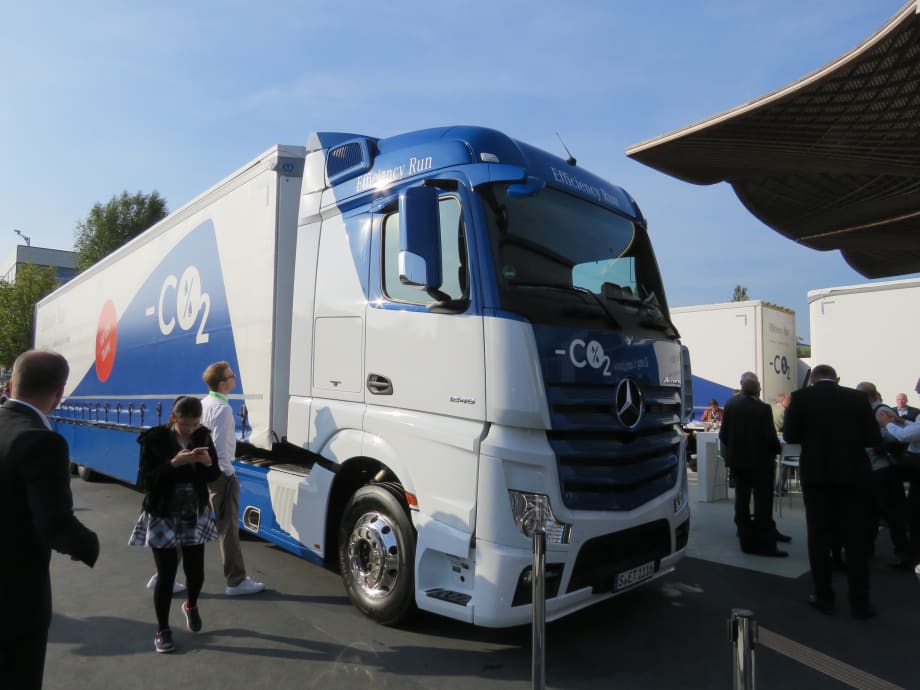
New European tractor-trailer setup promises real-world fuel savings of up to 20%. Photo: David Cullen
3 min to read
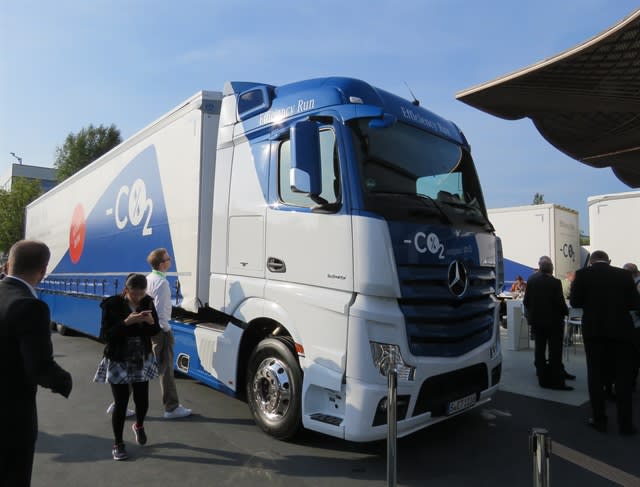
New European tractor-trailer setup promises real-world fuel savings of up to 20%. Photo: David Cullen
Daimler’s Mercedes-Benz Truck unit along with Germany-based trailer maker Krone have teamed up to put together a linehaul tractor-trailer they say delivers up to a 20% cut in fuel consumption compared to existing combinations.
The rig, rolled out at the IAA Truck Show in Frankfurt, Germany, consists of the latest generation Mercedes-Benz Actros over-the-roadcabover mated to Krone’s new Profi Liner Efficiency, an aerodynamically enhanced curtain-side trailer fitted with low-rolling-resistance tires.
According to Daimler, the specific Mercedes-Benz Actros unveiled at IAA features an efficiency package that includes the latest generation OM 471 six-cylinder in-line diesel engine as well as the OEM’s Predictive Powertrain Control (described as an “anticipatory cruise control system”) and “A-label” low-rolling-resistance tires.
When combined with the new Krone Profi Liner Efficiency trailer, Daimler said, “it promises a reduction in fuel consumption, and therefore CO2 emissions, of up to 20% compared to existing combinations.” A standard semitrailer-tractor combination from 2014 is the basis of the comparison. The manufacturers said that their second yearly “Efficiency Run” involved five fleet customers that tested the fuel efficiency of the rigs and verified the results.
Daimler and Krone laid out the various contributions that added up to the 20% efficiency gain:
Krone Profi Liner Efficiency: over 5%
Mercedes-Benz Actros tractor unit: up to 6%
Daimler Predictive Powertrain Control: up to 5%
“A-label” low-rolling-resistance tires on tractor: 2 to 4%
The trailer’s aerodynamics were improved with new self-engineered Krone side panels made of impact-resistant plastic that cover all the sides, including those of the three trailer axles and a four-part folding “rear wing,” also made of robust plastic.
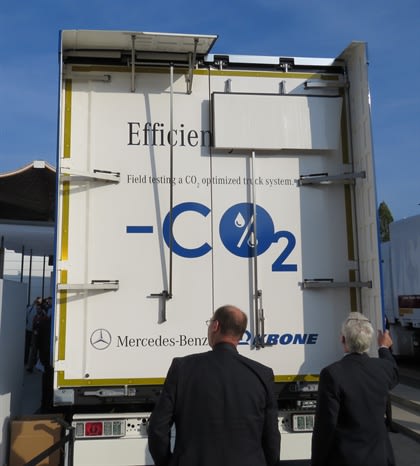
Krone trailer's aero treatment includes four-part folding “rear wing,” made of robust plastic. Photo: David Cullen
"In 2015, the first Efficiency Run proved that the integrated approach works,” said Wolfgang Bernhard, head of Daimler Truck and Buses, speaking at an IAA press briefing. “Now, just one year later, we are putting products that are fit for series production onto the roads.
"Our optimized semitrailer-tractor combination pays off for the environment and our customers," he continued. "It lowers CO2 emissions and fuel consumption by up to 20%– and the cost can be amortized in about 18 months."
Gero Schulze Isfort, managing director of Krone Commercial Vehicle Group, pointed out that since the inaugural Efficiency Run in 2015, the company further optimized its trailer “particularly with regard to everyday practicality. Thus, this year we were able to launch another field trial, now ended, which has resulted in a semitrailer that is fit for series production and is now going on the market-- the Profi Liner Efficiency."
The manufacturers noted that the Efficiency Run test did not look solely at fuel savings but also assessed the new trailer's everyday usability. That involved reviewing handling, noise emission, robustness, loading options, and access.
During the three months of testing, the five combinations covered more than 150,000 km (93,200 miles) on German roads. They transported car engines, steel, paper, timber products and building materials over short and long distances.
According to the drivers on the run, the new trailer proved its worth in day-to-day operation. Loading is possible from all sides and from the top and it was reported that using a forklift to load from the side works as smoothly as with a conventional trailer, despite the side panels. No damage to the side panels was noticed during the testing. Reverse docking to a loading ramp was also completed without difficulty as long as the four-part rear wing is folded before opening the rear-doors. Based on feedback from drivers, this takes just a few seconds.
The manufacturers also said the structural system for the side panels was “singled out for high praise.” It comprises five individual elements that can be removed easily by hand at the height of the trailer axles, “an important consideration when a wheel needs to be changed.” It was also noted that the lightweight plastic side panels (a proprietary Krone design) are “so stable that they do not cause any wind noise.”
More Fuel Smarts

How Volvo Updated Its D13 for EPA 2027 [Watch]
Volvo’s updated D13 promises lower emissions without sacrificing performance or fuel economy. Take a closer look at what changed inside the engine in this HDT Spotlight video.
Read More →
Diesel Price Spike Shortens Payback for Natural Gas Trucks, Report Says
Energy Vision estimates fleets could recover the higher purchase price of an RNG-fueled Class 8 tractor in 1.3 to 2.8 years under current fuel-price scenarios.
Read More →
Calstart Becomes Catalyst Mobility, Reflecting Broader Focus
Calstart is now Catalyst Mobility, reflecting the nonprofit’s growing national role in clean transportation, including zero-emission trucks, infrastructure and incentive programs.
Read More →

Record Diesel Prices Squeeze Trucking Fleets
Average U.S. diesel prices have climbed to nearly $6 a gallon, surpassing the 2022 record as tight refinery capacity and Middle East disruptions keep fuel costs elevated.
Read More →
Sponsored•September 9, 2026
How Fuel Delivery Shapes Engine Performance
Fuel delivery depends on more than what happens at the injector. For fleet, maintenance and technical professionals, looking at the full path from pump to injector can provide useful context for understanding engine performance.
Read More →
East Coast Port Launches $45M Electric Truck Push
The Port Authority of New York and New Jersey announced millions in incentives for zero-emission drayage trucks, yard tractors, and new charging hubs near the port.
Read More →
California Bill Could Shed Light on Electric Truck Prices
Why do battery-electric Class 8 trucks remain so expensive? A California bill headed to Gov. Gavin Newsom would give fleets and state agencies more visibility into what manufacturers charge.
Read More →
Detroit Opens Orders for EPA 2027 Engines
Detroit isn’t starting from scratch to meet EPA 2027 diesel emissions standards. Its Gen 6 DD13 and DD15 engines keep much of today’s platform while updating the fuel and aftertreatment systems.
Read More →
Zero-Emission Truck Corridor Planned for West Coast
California, Oregon, Washington, British Columbia and Baja California are coordinating plans for truck charging and hydrogen fueling from Canada to Mexico.
Read More →
A Closer Look at Kenworth’s Electric T880E Vocational Truck [Video]
Learn more about Kenworth's T880E battery-electric vocational truck at the Paccar Technical Center, including its range, applications, upfitting considerations, and PTO options, in this HDT Spotlight video.
Read More →