




Daimler to Offer Carbon Neutral Trucks by 2039
Within just 20 years, the world's biggest truck maker wants to offer only CO2-neutral trucks in the U.S. and elsewhere.

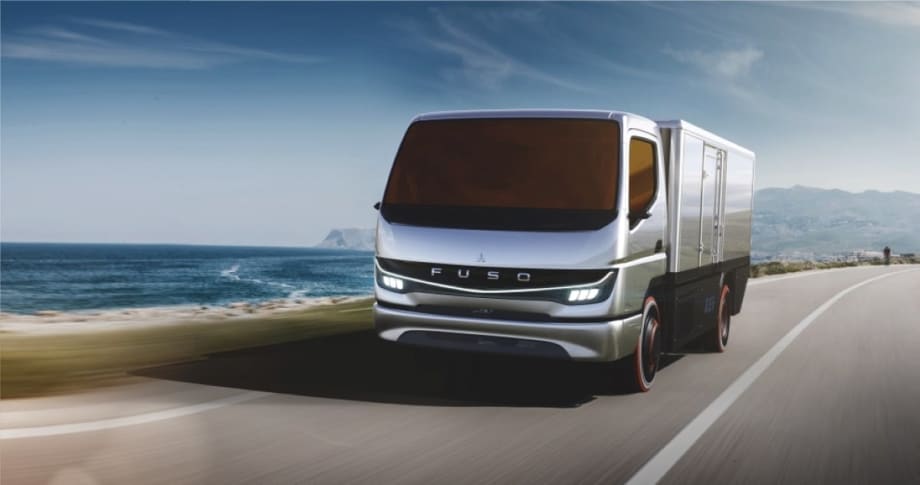
The Fuso Vision F-Cell is a just-rolled-out “fully drivable concept model” intended to help “explore the benefits of fuel cell technology” for use in commercial vehicles, according to Daimler.
Artist's Rendering: Daimler
Daimler Trucks & Buses has set for itself the lofty strategic goal of offering only new commercial vehicles that are carbon-dioxide (CO2) neutral while being driven (in what the company calls “tank-to-wheel” operation) in the so-called triad markets of North America, Europe, and Japan by 2039.
The Germany-based OEM laid out in an Oct. 25 press release the roadmap it will follow to get there. First off, its plans call for full production of battery-electric drive vehicles for those three key markets by 2022.
From there, Daimler Trucks & Buses said that by the end of that next decade, it will extend its range of CO2-neutral vehicles by putting hydrogen-powered commercial vehicles into full production.
The truck maker emphasized its confidence in reaching its production goal by pointing out that it celebrated the world premiere of its Fuso brand fuel-cell prototype, the Vision F-Cell, at the Tokyo Motor Show on Oct. 25, “thus further strengthening its activity in the hydrogen field.” In addition, all European Daimler Trucks & Buses plants will be CO2-neutral by the year 2022 with all other plants to follow.
“At Daimler Trucks & Buses we are clearly committed to the goals of the Paris Climate Protection Agreement and thus to the decarbonization of our industry,” said Martin Daum, head of Daimler Trucks & Buses.
“Having CO2-neutral transport on the road by 2050 is our ultimate goal,” Daum continued. “This can only be achieved if competitive conditions for CO2-neutral transport are created for our customers in terms of costs and infrastructure. As it takes about ten years to completely renew a fleet until 2050, our ambition is to offer ‘tank-to-wheel’ locally CO2-neutral new vehicles in the ‘triad’ by the year 2039.”
He stated that “truly CO2-neutral transport only works with battery-electric or hydrogen-based drive. We were the first manufacturer to seriously commit to electromobility in heavy trucks and, today, are pioneers and in all segments with electric vehicles in customer use.”
However, Daum also emphasized the reality on the ground. “Locally CO2-neutral trucks and buses won’t sell themselves, because even in 2040 -- despite all efforts by manufacturers -- the acquisition and total cost of ownership of trucks and buses with electric drives will be still higher than for diesel vehicles.”
To make up that diesel differential, he said government incentives are needed to make locally CO2-neutral vehicles competitive. “Particularly necessary,” said Daum, “[is] converting and staggering tolls Europe-wide based on CO2 values whereby CO2-neutral vehicles would get significant relief, a targeted subsidy program for buses and for a nationwide charging and hydrogen infrastructure as, well as uniform standards for the transport and refueling of hydrogen.”
The OEM noted that it rolled out its first limited production all-electric truck in 2017, the Fuso eCanter light-duty truck. More than 140 eCanters are now in customer service in cities around the world, including New York, Tokyo, Berlin, London, Amsterdam, Paris and Lisbon. The Mercedes-Benz eActros electric heavy-duty longhauler is in “intensive use by customers in Germany and Switzerland” as part of the eActros Innovation Fleet. And the U.S, the medium-duty Freightliner eM2 and the heavy-duty Freightliner eCascadia are “undergoing intensive field tests with customers.”
More Fuel Smarts

How Volvo Updated Its D13 for EPA 2027 [Watch]
Volvo’s updated D13 promises lower emissions without sacrificing performance or fuel economy. Take a closer look at what changed inside the engine in this HDT Spotlight video.
Read More →
Diesel Price Spike Shortens Payback for Natural Gas Trucks, Report Says
Energy Vision estimates fleets could recover the higher purchase price of an RNG-fueled Class 8 tractor in 1.3 to 2.8 years under current fuel-price scenarios.
Read More →
Calstart Becomes Catalyst Mobility, Reflecting Broader Focus
Calstart is now Catalyst Mobility, reflecting the nonprofit’s growing national role in clean transportation, including zero-emission trucks, infrastructure and incentive programs.
Read More →

Record Diesel Prices Squeeze Trucking Fleets
Average U.S. diesel prices have climbed to nearly $6 a gallon, surpassing the 2022 record as tight refinery capacity and Middle East disruptions keep fuel costs elevated.
Read More →
How Fuel Delivery Shapes Engine Performance
Fuel delivery depends on more than what happens at the injector. For fleet, maintenance and technical professionals, looking at the full path from pump to injector can provide useful context for understanding engine performance.
Read More →
East Coast Port Launches $45M Electric Truck Push
The Port Authority of New York and New Jersey announced millions in incentives for zero-emission drayage trucks, yard tractors, and new charging hubs near the port.
Read More →
California Bill Could Shed Light on Electric Truck Prices
Why do battery-electric Class 8 trucks remain so expensive? A California bill headed to Gov. Gavin Newsom would give fleets and state agencies more visibility into what manufacturers charge.
Read More →
Detroit Opens Orders for EPA 2027 Engines
Detroit isn’t starting from scratch to meet EPA 2027 diesel emissions standards. Its Gen 6 DD13 and DD15 engines keep much of today’s platform while updating the fuel and aftertreatment systems.
Read More →
Zero-Emission Truck Corridor Planned for West Coast
California, Oregon, Washington, British Columbia and Baja California are coordinating plans for truck charging and hydrogen fueling from Canada to Mexico.
Read More →
A Closer Look at Kenworth’s Electric T880E Vocational Truck [Video]
Learn more about Kenworth's T880E battery-electric vocational truck at the Paccar Technical Center, including its range, applications, upfitting considerations, and PTO options, in this HDT Spotlight video.
Read More →