




CVSA Weighs in on New HOS Rules
The Commercial Vehicle Safety Alliance (CVSA) says that "on balance," the revised hours-of-service rules published last week by the Federal Motor Carrier Safety Administration should prove to be palatable for its members.
The Commercial Vehicle Safety Alliance (CVSA) says that "on balance," the revised hours-of-service rules published last week by the Federal Motor Carrier Safety Administration should prove to be palatable for its members.
The FMCSA has published the first substantial changes to the hours-of-service rules in the United States since 1939. The science-based rules are intended to improve highway safety and help reduce the number of truck crashes and related fatalities and injuries by addressing commercial motor vehicle driver fatigue.
"While we anticipate there will be some bumps to deal with, on balance it looks like enforcement of the rule itself it will not create a huge burden on the membership," the CVSA said.
"While there are some changes to the existing rules, it in no way resembles the proposed rules that FMCSA issued back in 2000. At first glance, the administration seems to have listened to many of the comments CVSA submitted to the docket. "
Those comments were based on four principles:
-- Correlation of research findings and crash analysis with the proposed rule;
-- Ease of understanding;
-- Uniformity in application and enforcement; and
-- Ease of enforceability
Major pieces of the new rules published by FMCSA last week include:
-- Driving time increased from 10 to 11 hours
-- On duty time decreased from 15 to 14 hours
-- Off duty time increased from 8 to 10 hours
-- Sleeper berth requirements basically unchanged (except that it's over 10 hours rather than 8), a minimum of 2 hours is required.
-- 60/7 and 70/8 hour rules left unchanged, except for a 34 hour restart provision
-- 16 hour on duty time permitted for short haul property carriers (under certain circumstances)
-- Motorcoach operators subject to existing rules
-- No on-board recorder requirement, although they are initiating a research initiative
FMCSA and the states will begin enforcing the revised rules beginning Jan. 4, 2004 – voluntary compliance before that date is not permitted. The lead time will provide the FMCSA and the states with time to modify computer systems to reflect the regulatory changes and train more than 8,000 personnel in the U.S. who will be enforcing the rules.
The implementation plan will also provide carriers and drivers time to become familiar with the new regulations and make any procedural and operational changes necessary for compliance.
The CVSA said that, equally as important for the alliance is that the changes be coordinated with Canada and Mexico.
"In January of this year, Canada issued its own proposal for changes to their hours of service requirements. The comment period just ended, and they expect to issue new rules in the early part of 2004.
CVSA also announced that its driver and training committees will be working in the coming months to "help the alliance ramp up for a smooth transition to implementation."
More Drivers
How Top Trucking Fleets Improve Driver Retention [Video]
What do healthy snacks, optimized routing, and just picking up the phone have in common? They're all strategies the Best Fleets to Drive For are using to retain truck drivers.
Read More →
Trucker Path Adds Verisk CargoNet Theft Data to Navigation Platform
Trucker Path’s new cargo theft risk overlays give drivers and fleets visibility into high-risk areas, stolen commodity trends, and theft hotspots.
Read More →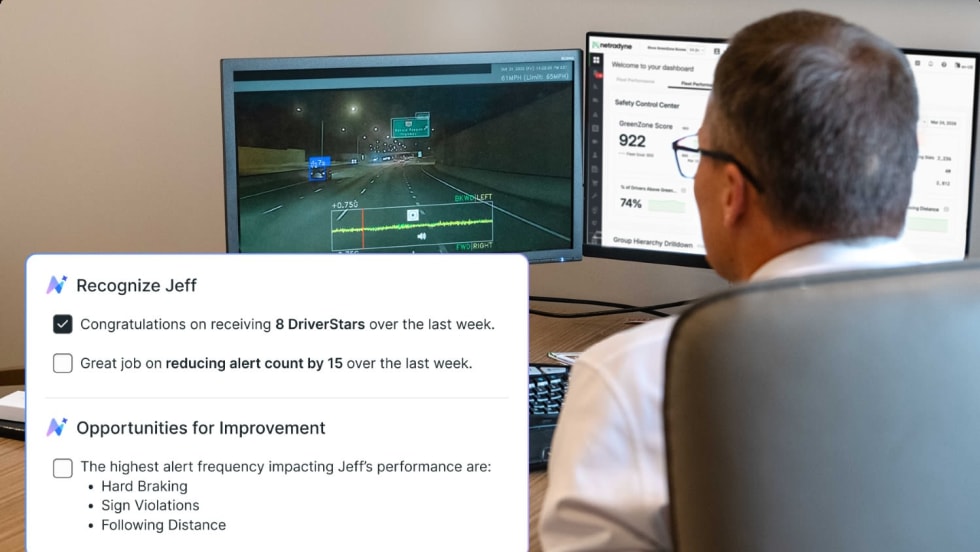
Netradyne Intelligence Uses New AI Agents to Automate Response to In-Cab Camera Data
The company called the next-generation in-cab camera safety platform "a fundamental shift from systems that report on what happened to systems that actively drive what should happen next."
Read More →
Why Truck Detention Keeps Costing Fleets Time and Money
A 2024 ATRI study found detention affects nearly 40% of truckload stops and costs the industry more than $15 billion annually. Despite the toll on drivers, fleets, and supply chains, the problem remains stubbornly persistent.
Read More →
Prime Inc. to Open $7.9M Flagship Used-Truck Dealership
A new driver-focused facility to sell Prime Inc's used trucks and trailers will be the first purpose-built location in the company's history.
Read More →
Short Takes: Inside K&B’s Truck Safety Tech
Listen to learn how K&B Transportation uses cellphone-blocking technology, speed management systems, weather geofencing, bridge avoidance tools, and more to improve driver safety.
Read More →
Nussbaum Expands Driver Compensation with Pay Raises, Profit Sharing
Nussbaum Transportation said its latest compensation package could push first-year driver earnings above $90,000 in key hiring markets.
Read More →
Listen: Inside Modern Fleet Safety: AI, Cameras & Speed Control at K&B Transportation
Fleet safety is evolving fast—and technology is at the center of it. Learn how a former commercial vehicle enforcement officer turned director of safety at K&B Transportation is embracing real-world safety technology.
Read More →
Maverick Announces 2026 Driver Pay Raises
New raises for Maverick Transportation drivers will take effect on May 31, 2026.
Read More →
Illinois Trucker Indicted for Nearly $22,000 in Ohio Turnpike Toll Evasion
Authorities say an Illinois trucker avoided paying tolls for two years, and now faces felony charges, possible prison time, and forfeiture of his Freightliner tractor.
Read More →