





Related: Cummins Sees a Future with Many Truck Power Options
Cummins Introduced as Cummins Integrated Power
Cummins is repositioning itself as Cummins Integrated Power. The new name denotes both the company’s expertise in technology integration and its reach into different alternative fuel segments, including diesel, natural gas, hybrid and battery-electric.
March 20, 2018
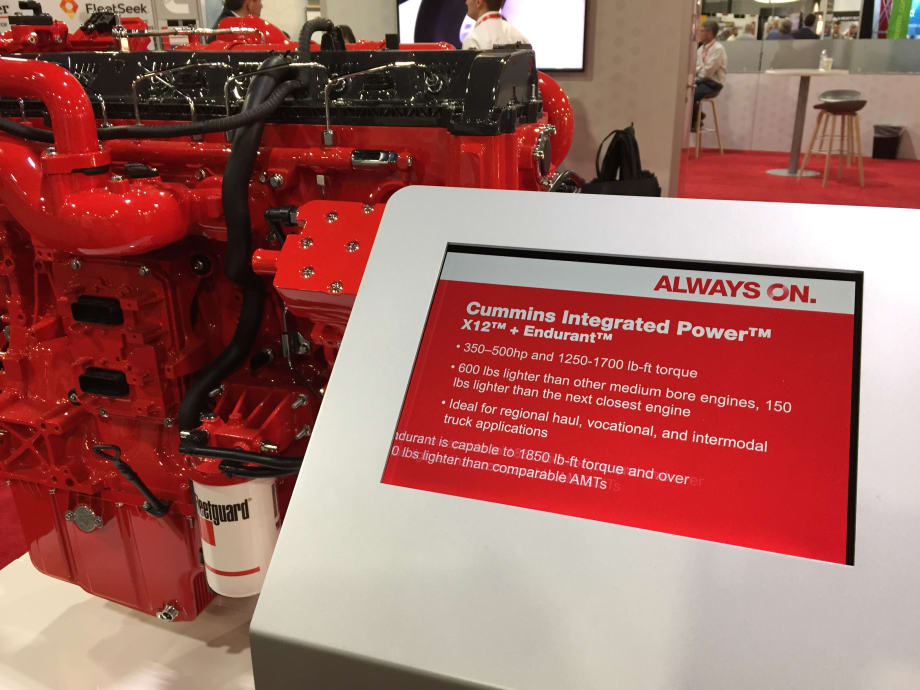
Cummins highlighted the new name at its booth at the Technology & Maintenance Council annual meeting. Photo: Deborah Lockridge
3 min to read
Cummins highlighted the new name at its booth at the Technology & Maintenance Council annual meeting.Photo: Deborah Lockridge
Cummins is repositioning itself in the heavy-duty marketplace with a new name for its expanding portfolio of motive technologies. The new name, Cummins Integrated Power, denotes both the company’s expertise in technology integration and its reach into different alternative fuel segments, including diesel, natural gas, hybrid and battery-electric.
Cummins Integrated Power made its debut at ATA’s Technology & Maintenance Council Annual Meeting in Atlanta earlier this month.
“As a global, independent supplier, Cummins is uniquely positioned to work with a variety of partners and suppliers to provide the broadest portfolio of integrated power to our customers,” said Srikanth Padmanabhan, president of Cummins Engine Business. “Our expanding portfolio of diesel, natural gas, hybrid and electrified power is a testament to our dedication to delivering the right technology at the right time.”
CPI’s diesel engine side will feature the X12 and X15 engine platforms, both of which can be paired with Eaton Cummins Automated Transmission Technologies’ Endurant transmissions for optimum efficiency. Each of these integrated diesel powertrains harnesses the power of Cummins’ Adept suite of fuel-saving features, capitalizing on the electronic capabilities of the engine and transmission to make powertrain control decisions in real time.
“The joint venture with Eaton has provided complete transparency between the two components and we are working more closely together now which brings additional efficiency to the powertrain,” said Teresa Voors, Cummins’ global powertrain sales and marketing director.
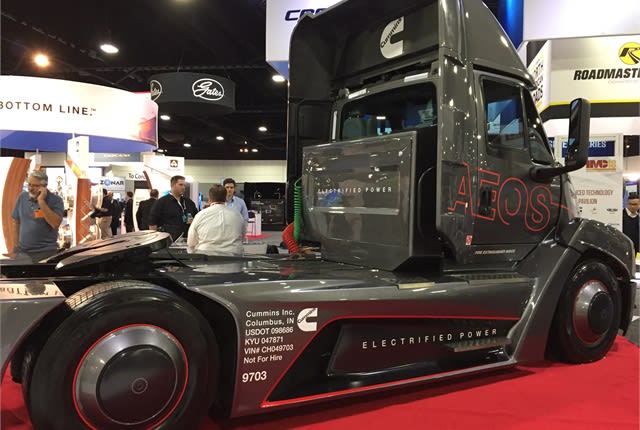
Rounding out the Cummins Integrated Power portfolio, for now, are hybrid and battery-electric vehicles. In 2017, Cummins unveiled the AEOS electric concept vehicle, on display at TMC.Photo: Deborah Lockridge
On the alternative fuel side, CIP natural gas power portfolio offer several engines from its joint venture with Westport (Cummins Westport), including the B6.7N, L9N, ISX12 G and the Ultra-Low NOx ISX12N. Voors said production volumes for these engines have remained very consistent even though natural gas is not talked about as widely as it once was.
“The natural gas engines do quite well for customers with certain sustainability goals,” she said. “It's still an important product line, and we have the economies of scale to keep up a platform like natural gas, offering it across a broad range of OEM trucks.”
Rounding out the Cummins Integrated Power portfolio, for now, are hybrid and battery-electric vehicles. In 2017, Cummins unveiled the AEOS electric concept vehicle. It’s still early in the game, but Voors said CIP is looking at a 2019 launch for a battery-electric transit bus powertrain.
“That's the market that makes the most sense right now, so that’s where you will see us first,” she said.
By offering more than one solution and more than one type of fuel, CIP is well positioned to offer customers the best choice of powertrain options that fit with their individual sustainability goals, according to the company.
“Cummins has a long history of delivering reliable power and service to our customers, and our commitment to a growing Cummins Integrated Power portfolio will only enhance our offerings,” said Mike Taylor, general manager, global powertrain integration.
More Fuel Smarts

How Volvo Updated Its D13 for EPA 2027 [Watch]
Volvo’s updated D13 promises lower emissions without sacrificing performance or fuel economy. Take a closer look at what changed inside the engine in this HDT Spotlight video.
Read More →
Diesel Price Spike Shortens Payback for Natural Gas Trucks, Report Says
Energy Vision estimates fleets could recover the higher purchase price of an RNG-fueled Class 8 tractor in 1.3 to 2.8 years under current fuel-price scenarios.
Read More →
Calstart Becomes Catalyst Mobility, Reflecting Broader Focus
Calstart is now Catalyst Mobility, reflecting the nonprofit’s growing national role in clean transportation, including zero-emission trucks, infrastructure and incentive programs.
Read More →

Record Diesel Prices Squeeze Trucking Fleets
Average U.S. diesel prices have climbed to nearly $6 a gallon, surpassing the 2022 record as tight refinery capacity and Middle East disruptions keep fuel costs elevated.
Read More →
Sponsored•September 9, 2026
How Fuel Delivery Shapes Engine Performance
Fuel delivery depends on more than what happens at the injector. For fleet, maintenance and technical professionals, looking at the full path from pump to injector can provide useful context for understanding engine performance.
Read More →
East Coast Port Launches $45M Electric Truck Push
The Port Authority of New York and New Jersey announced millions in incentives for zero-emission drayage trucks, yard tractors, and new charging hubs near the port.
Read More →
California Bill Could Shed Light on Electric Truck Prices
Why do battery-electric Class 8 trucks remain so expensive? A California bill headed to Gov. Gavin Newsom would give fleets and state agencies more visibility into what manufacturers charge.
Read More →
Detroit Opens Orders for EPA 2027 Engines
Detroit isn’t starting from scratch to meet EPA 2027 diesel emissions standards. Its Gen 6 DD13 and DD15 engines keep much of today’s platform while updating the fuel and aftertreatment systems.
Read More →
Zero-Emission Truck Corridor Planned for West Coast
California, Oregon, Washington, British Columbia and Baja California are coordinating plans for truck charging and hydrogen fueling from Canada to Mexico.
Read More →
A Closer Look at Kenworth’s Electric T880E Vocational Truck [Video]
Learn more about Kenworth's T880E battery-electric vocational truck at the Paccar Technical Center, including its range, applications, upfitting considerations, and PTO options, in this HDT Spotlight video.
Read More →