




CSA Issues to be Aired on Hill Today
The Federal Motor Carrier Safety Administration's flagship CSA safety enforcement program will face congressional scrutiny today as a House subcommittee airs questions about the program's effectiveness
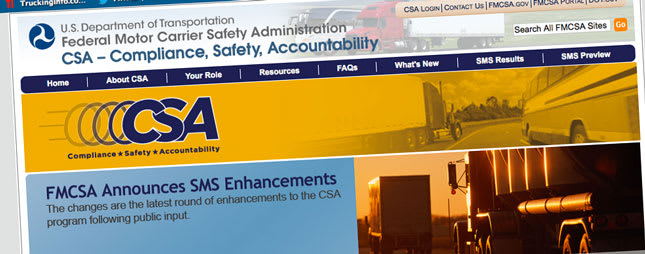
The Federal Motor Carrier Safety Administration's flagship CSA safety enforcement program will face congressional scrutiny today as a House subcommittee airs questions about the program's effectiveness.
Rep. John Duncan, R-Tenn., has assembled a panel of witnesses to discuss a range of contentious CSA issues, including the quality and quantity of the data upon which the program is built, the lack of a method to determine fault in crashes, shortcomings in the DataQs correction system, and risks of legal liability shippers face when they use CSA data to select carriers.
FMCSA Administrator Anne Ferro will be the lead witness. She will be followed by Steve Owings, co-founder of the safety advocacy group Road Safe America; David Palmer, assistant chief of the Texas Department of Public Safety; Scott Mugno, vice president of FedEx Ground; Ruby McBride, vice president of Colonial Freight Systems; Bruce Johnson, director of carrier services at C.H. Robinson; and Bill Gentry, president of Gentry Trailways.
This is a catch-up hearing by the House Subcommittee on Highways and Transit. As a unit of the House Transportation and Infrastructure Committee, the subcommittee has direct jurisdiction over FMCSA, but the first congressional action on CSA came from the House Small Business Committee last July.
At that hearing, chaired by Rep. Sam Graves, R-Mo., shipper and owner-operator interests held forth on the same CSA issues that are on the table today.
Among the top items was the matter of crash accountability, which no doubt will be at the center of attention today, as well.
"Accidents that are not the fault of a commercial motor vehicle operator should not be included in a carrier's (CSA) score," said committee chairman Sam Graves, R-Mo., in a follow-up letter to Ferro after the hearing.
He said he was troubled to learn that the agency is only now beginning to study the appropriateness of using police reports in a crash accountability system.
"We understand from stakeholders that FMCSA may have conducted prior research in this area in 2010. What was the outcome of that research, and why is additional research on police reports necessary?"
Ferro has said that there are concerns, particularly in the safety advocacy community, about the accuracy of the police reports that will be used to determine fault in crashes. The reliability of the reports is one of several issues the agency will address in a study now underway. The study is due to be finished next summer.
Graves also noted concerns about how shippers use CSA data. "The FMCSA is sending a mixed and confusing message to shippers, brokers, carriers and the public," he said.
The agency has a disclaimer on the CSA website saying that the data does not constitute an official safety fitness rating, but at the same time it encourages the use of this data to make business decisions, Graves said.
Robert Voltmann, president of the Transportation Intermediaries Association, is among those who say that is exactly what is happening.
He said it is the pressure of legal liability that pushes shippers toward using the data the wrong way.
"It's not as simple as explaining to shippers that they have to use the data carefully," Voltmann said. "The problem is that the lawsuits are so egregious and so expensive. Everyone's afraid. The real answer is liability reform."
Ferro is likely to mention in her testimony a recent initiative to give trucking and other transportation interests more say in the shaping of CSA policy.
Last month the agency launched a new CSA advisory panel, a subcommittee of the Motor Carrier Safety Advisory Committee, and asked for recommendations on a long list of CSA questions, including those that will be aired today.
On the CSA Subcommittee's list:
* How to handle public display of CSA data and messaging.
* What thresholds should be used to trigger intervention by enforcement officials?
* Should the safety data take a carrier's area of operation into account?
* How to fix the shortcomings in the DataQs system, particularly with respect to handling violations that have been dismissed by a court?
* How to account for roadside screening versus a full inspection in the database.
* Should carriers get credit for using safety technologies such as lane departure warning?
* Should Safety Measurement System data be segmented by the type of operation, such as truckload, less-than-truckload, private carriage, flatbed, rural or urban?
* Is CSA is working as it is supposed to? The subcommittee wants to hire a third party to do an analysis.
* Should the CSA system focus on reducing the number of crashes, or on the severity of crashes?
* How to lessen disparities in CSA enforcement by the states.
* How to find data that ties specific safety violations to crash risk.
In addition, the agency is planning more changes in CSA over the coming months.
It will consider modifying roadside violation severity weights, and changing the way it uses vehicle miles in determining scores for the Crash and Unsafe Driving categories of CSA. And it will consider adjusting safety event groupings in all of the categories.
More Drivers

Driver Trust Can Make or Break the Success of Fleet Safety Technology
New Teletrac Navman research suggests that onboarding, transparency about driver data, and positive feedback can play a significant role in how commercial drivers respond to safety and coaching technology.
Read More →
EEOC Sues KLLM Over Alleged Sex Discrimination in Driver Training
KLLM is facing a federal sex-discrimination lawsuit over policies the EEOC alleges put female truck driver trainees at a disadvantage.
Read More →
FMCSA Moves to Codify English Language Requirements for Commercial Drivers
By changing regulations on English-language proficiency requirements for commercial drivers, rather than relying on a guidance memo, the FMCSA said future administrations won't be able to walk back the Trump administration's stricter enforcement with just a memo.
Read More →
Drivers Put Western Star Trucks to the Test at Star Nation Experience
Watch to get an inside look at the Western Star trucks, technology, and community behind the Star Nation Experience 2026!
Read More →
Trump Administration Looks to Put More Veterans Behind the Wheel
The Freedom Haulers program pulls together existing and expanded programs at several federal agencies to recruit veterans to drive commercial heavy-duty trucks and cut the red tape for them to get a CDL, training, and employment.
Read More →
Putting Mack’s Command Steer to the Test
A test drive of Mack’s Command Steer active steering system evaluates how it can make truck driving easier and less tiring.
Read More →
Competition Heating Up for Truck Drivers
New report reveals rising driver hiring costs, the return of sign-on bonuses, growing AI advantages, and the operational factors shaping driver retention.
Read More →
How Fraley & Schilling Improved Logbook Compliance by Over 50%
Fraley & Schilling needed a way to close a compliance workflow gap in its ELD system without adding more work from driver training, reminders, and back-office follow-ups. It found the answer in a custom driver app.
Read More →
Volvo Goes Gaming
Volvo has roared into American Truck Simulator with two new flagship trucks.
Read More →
What the Best Fleets to Drive For Teach About Driver Retention
Survey fatigue, AI-powered routing, owner-operator expectations, and the decline of social media all emerged as themes from this year's Best Fleets to Drive For program.
Read More →