




Cross-Border Truck Freight Value Falls Again
Trucking and two other freight transportation modes carried less U.S. freight by value with North American Free Trade Agreement (NAFTA) partners Canada and Mexico in October 2016 compared to the same time a year earlier, according to a new Transportation Department report.


U.S.-NAFTA freight value percent change from previous year over the last 24 months. Graphic: U.S. DOT
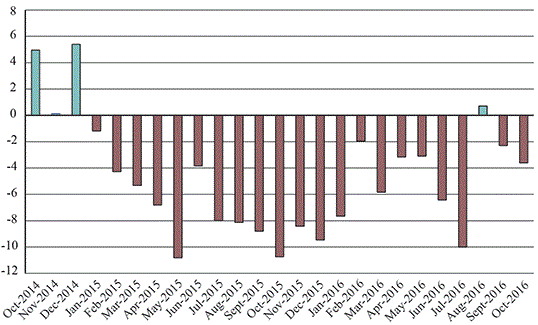
U.S.-NAFTA freight value percent change from previous year over the last 24 months.Graphic: U.S. DOT
Trucking and two other freight transportation modes carried less U.S. freight by value with North American Free Trade Agreement (NAFTA) partners Canada and Mexico in October 2016 compared to the same time a year earlier, according to a new Transportation Department report.
This happened as total cross-border freight moved by all modes fell by 3.6% to $93.2 billion, marking the 21st monthly drop out of the past 22 months beginning in January 2015. The only increase since was a hike of 0.7% this past August.
The value of commodities moved by truck decreased 6.1%, vessel by 7% and air by 12.7%. The value of freight carried on pipeline and rail increased 21.8% and 6.2%, respectively
Trucks carried 65.3% of U.S.-NAFTA freight and continued to be the most heavily used mode for moving goods to and from both U.S.-NAFTA partners. Trucks accounted for $31.9 billion of the $50.3 billion of imports, or 63.4%, and $29 billion of the $42.9 billion of exports, or 67.6%. Rail remained the second largest mode by value, moving 15.8% of all U.S.-NAFTA freight.
U.S.-Canada Freight Falls 2.5 Percent
From October 2015 to October 2016, the value of U.S.-Canada freight flows fell 2.5% to $46.5 billion due to decreases in the value of goods moved by vessel, down 31.1%, air 8.8% lower and truck down 3.1%. The value of freight carried on pipeline and rail increased 21.7% and 2.5%, respectively.
During this 12-month period, much of the mineral fuel freight between Texas and Canada shifted from vessel to pipeline as the value of mineral fuel shipments carried by vessel between Texas and Canada decreased while the value of pipeline shipments rose, according to the report. Texas-Canada mineral fuel trade made up about 25.5% of all U.S.-Canada mineral fuel shipments in October 2016.
The top commodity category transported between the U.S. and Canada by all modes was vehicles and parts, of which $5.2 billion, or 56.9%, moved by truck and $3.8 billion, or 40.8%, moved by rail.
Trucks carried 60.8% of the value of the freight to and from Canada. Rail carried 16.1% followed by pipeline, 9.2%; air, 4.6%; and vessel, 2.9%. The surface transportation modes of truck, rail and pipeline carried 86% of the value of total U.S.-Canada freight flows.
U.S.-Mexico Freight Falls Nearly 5 Percent
The value of U.S.-Mexico freight flows fell 4.7% to $46.6 billion in October compared to a year earlier due to decreases in the value of goods moved by air, down 18%, and truck 8.5% lower. The value of freight carried on three modes increased: pipeline, by 23.6%; rail by 10.4%; and vessel by 6.9%.
Trucks carried 69.9% of the value of the freight to and from Mexico. Rail carried 15.4% of the value of freight to and from Mexico followed by vessel, 7.9%; air, 3.1%; and pipeline, 0.8%. The surface transportation modes of truck, rail and pipeline carried 86% of the value of total U.S.-Mexico freight flows.
The top commodity category transported between the U.S. and Mexico by all modes in October 2016 was electrical machinery, of which $8.7 billion, or 92.1%, moved by truck.
Cross-border freight movements between the U.S. and Canada, as well as with Mexico, have both been hurt by a strong U.S. dollar for more than the past year, which makes U.S. produced goods more expensive outside the country. Also, the sharp drop in the price of oil that began nearly two years ago has pushed the value of freight movements between the three NAFTA countries lower.
More Fleet Management

Can You Beat Our Trucking Trivia Challenge?
Test your truck knowledge with 19 trivia questions from Heavy Duty Trucking Exchange. Can you keep up with the fleet pros?
Read More →
BeyondTrucks Adds Rules Checks to Dispatch
New Compatibility Engine checks driver qualifications, equipment requirements and fleet policies before loads are dispatched.
Read More →
Diesel Prices Hijack Trucking’s Worry List
ATRI’s annual survey finds cautious optimism about freight, but diesel costs, litigation, and insurance continue to squeeze fleets. Drivers have different priorities on several issues.
Read More →
Nomination Deadline Extended for HDT Emerging Leaders
Just a few more days to nominate accomplished trucking fleet professionals under 40 who are making an impact and helping lead the industry forward for the HDT Emerging Leaders award. Deadline extended to October 20!
Read More →
What Will ATA’s New Leader Bring to Trucking's Table?
Incoming President and CEO Mark Colson’s record in Alabama offers clues about his priorities and approach following Chris Spear’s abrupt departure as the head of the American Trucking Associations.
Read More →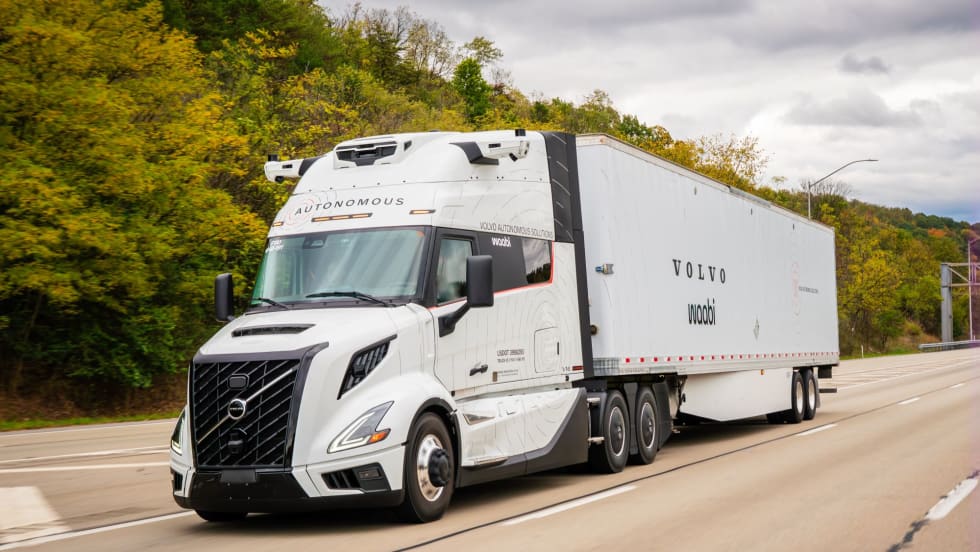
Volvo, Waabi Start Commercial Autonomous Operations in Texas
Volvo VNL Autonomous trucks, powered by the Waabi Driver, are hauling freight directly to third-party facilities for a customer in Texas.
Read More →
Samsara Launches Custom AI Agent Builder
Agent Studio lets fleets create AI tools for hours-of-service monitoring, reporting and driver support, including agents that communicate by phone.
Read More →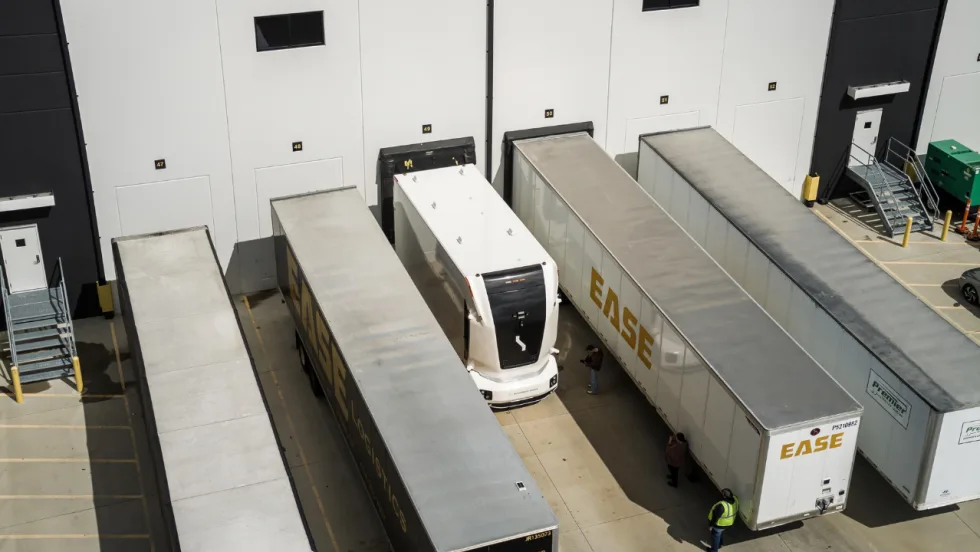
Einride Driverless Electric Trucks Begin Daily Freight Operations in Ohio
Two cabless electric trucks are hauling freight between EASE Logistics facilities in Marysville, Ohio, as part of a multi-state truck automation project.
Read More →
Geotab Links Fleet Card to Vehicle Data
The new card combines fuel discounts with telematics-based purchase controls. Geotab’s analysis also points to potential savings from choosing lower-priced fuel stops.
Read More →
How MFA Helps Protect Trucking Fleets
Multi-factor authentication adds protection when passwords are stolen. Here’s how it works and where fleets should start.
Read More →