




Cross Border Freight Value Jumps Nearly 11%
The value of freight moved between the U.S. and its next door neighbor countries has spiked as all five major transportation modes carried more cargo in March compared to the year before, according to new Transportation Department figures.

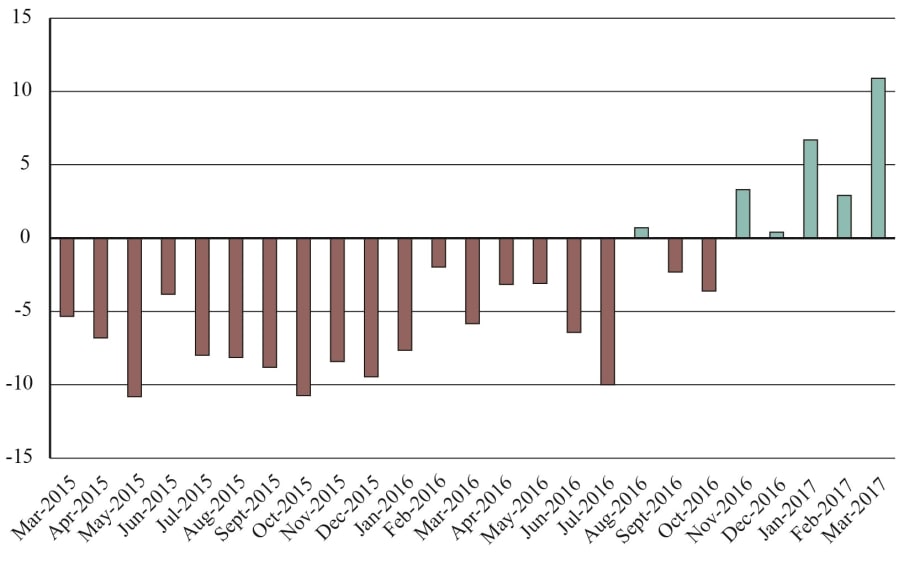
U.S.-NAFTA freight value percent change from the previous year. Graphic: U.S. DOT
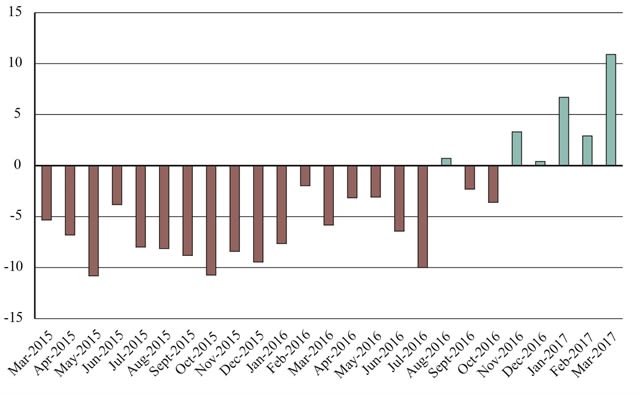
U.S.-NAFTA freight value percent change from the previous year.Graphic: U.S. DOT
The value of freight moved between the U.S. and its next door neighbor countries has spiked as all five major transportation modes carried more cargo in March compared to the year before, according to new Transportation Department figures.
U.S.-North American Free Trade Agreement freight totaled $100.3 billion, the first time since October 2014 it has exceeded the $100 billion level.
The 10.9% rise from March 2016 is the fifth consecutive month in which the year-over-year value of U.S.-NAFTA freight increased from the same month of the previous year. It is also the first double digit year-over-year percentage increase in 33 months.
Despite this increase, trucking reported the smallest gain, up 5%, compared to increases of 81.3% for pipeline, vessel by 38.2%, air by 13.5% and rail by 12.6%.
The large percentage increase in the value of goods moving by pipeline and vessel is due in part to a 31% increase in the year-over-year price of crude oil between March 2016 and March 2017, according to the department.
Trucks carried 63.7% of U.S.-NAFTA freight and continued to be the most heavily utilized mode for moving goods to and from both U.S.-NAFTA partners. Trucks accounted for $32.6 billion of the $54.3 billion of imports, or 60%, and $31.3 billion of the $45.9 billion of exports, or 68.1%.
Rail remained the second largest mode by value, moving 15.8% of all U.S.-NAFTA freight, followed by pipeline, 5.9%; vessel, 5.6%; and air, 4.1%. The surface transportation modes of truck, rail and pipeline carried 85.4% of the total value of U.S.-NAFTA freight flows
U.S.-Canada Freight Value Surges More Than 10%
From March 2016 to March 2017, the value of U.S.-Canada freight flows increased by 10.4% to $51.2 billion as the value of freight on all five major modes increased from a year earlier.
The value of freight carried on pipeline increased by 87.3%, vessel by 42.9%, air by 8.4%, rail by 5.1%, and truck by 3.9%.
The top commodity category transported between the U.S. and Canada was vehicles and parts, of which $5.6 billion, or 58%, moved by truck and $3.8 billion, or 39.5%, moved by rail.
Trucks carried 58.5% of the value of the freight to and from Canada. Rail carried 16.2% followed by pipeline, 11.0%; air, 4.8%; and vessel, 2.9%. The surface transportation modes of truck, rail and pipeline carried 85.6% of the value of total U.S.-Canada freight flows.
U.S.-Mexico Freight Posts More Modest Increase
To the south, the value of U.S.-Mexico freight flows increased by 11.3% to $49.1 billion during March compared to a year earlier as the value of freight on all five major modes increased from a year earlier.
The value of commodities moved by vessel increased by 36.5%, air by 22.2%, rail by 22%, pipeline by 8.9%, and truck by 6%.
Trucks carried 69.2% of the value of freight to and from Mexico. Rail carried 15.4% followed by vessel, 8.3%; air, 3.3%; and pipeline, 0.6%. The surface transportation modes of truck, rail and pipeline carried 85.1% of the value of total U.S.-Mexico freight flows
The top commodity category transported between the U.S. and Mexico in March 2017 was also vehicles and parts, of which $4.4 billion or 45.7% moved by rail.
More Fleet Management

Nominations Open for HDT Emerging Leaders
Heavy Duty Trucking is looking for accomplished trucking fleet professionals under 40 who are making an impact and helping lead the industry forward.
Read More →
Why Private Fleets Are Taking More Freight
Private fleets are putting their own trucks on demanding customers and high-cost lanes as companies seek greater control over service, costs, and capacity.
Read More →
Color Match Smarter: Tools That Restore & Perform
For fleet managers and collision repair professionals keeping heavy-duty trucks on the road, getting the color right the first time isn't just about appearance — it's about efficiency, turnaround time, and bottom-line results. Discover how today's digital color tools are transforming the repair process from guesswork to precision.
Read More →


FMCSA Pauses Biennial-Update Enforcement Amid Motus Transition
Carriers whose updates were due on or after June 1 have more time, while FMCSA works to stabilize its new registration system and warns of phishing sites impersonating its new carrier registration system, Motus.
Read More →
2026 Blueprint for Countering Smarter Supply Chain Theft
Cargo theft is no longer just the cost of doing business. It's a multi-billion-dollar criminal enterprise exploiting vulnerabilities across your fleet, drivers, and supply chain.
Read More →
How Telematics Improves Visibility, Control, and Performance in Refrigerated Fleets
Explore how telematics help refrigerated fleets improve visibility, uptime, efficiency, compliance, and cargo protection across connected cold chain operations.
Read More →
What the U.S.-Canada Trade War Means for Trucking
Escalating U.S.-Canada tariffs could disrupt cross-border freight, reduce truck volumes, raise costs, and create new uncertainty for carriers on both sides of the border.
Read More →
What Are Trucking’s Top Concerns for 2026?
The American Transportation Research Institute wants to know what's worrying trucking fleet managers, drivers, and other stakeholders in its annual Industry Issues survey.
Read More →
American Trucking Associations Looks for a New Leader
ATA President and CEO Chris Spear abruptly left his job at the association on August 21, at a pivotal time for the trucking industry.
Read More →
Public Wi-Fi Cybersecurity Risks: How Truck Drivers and Fleets Can Protect Their Data
Public Wi-Fi can expose truck drivers and fleets to credential theft, malware, and other cyber threats. Here’s how to reduce the risk on the road.
Read More →