




COVID-19 Affecting Cargo Theft Trends
North American cargo theft is on the rise this year, and the Covid-19 pandemic caused a spike in cargo crime in April.
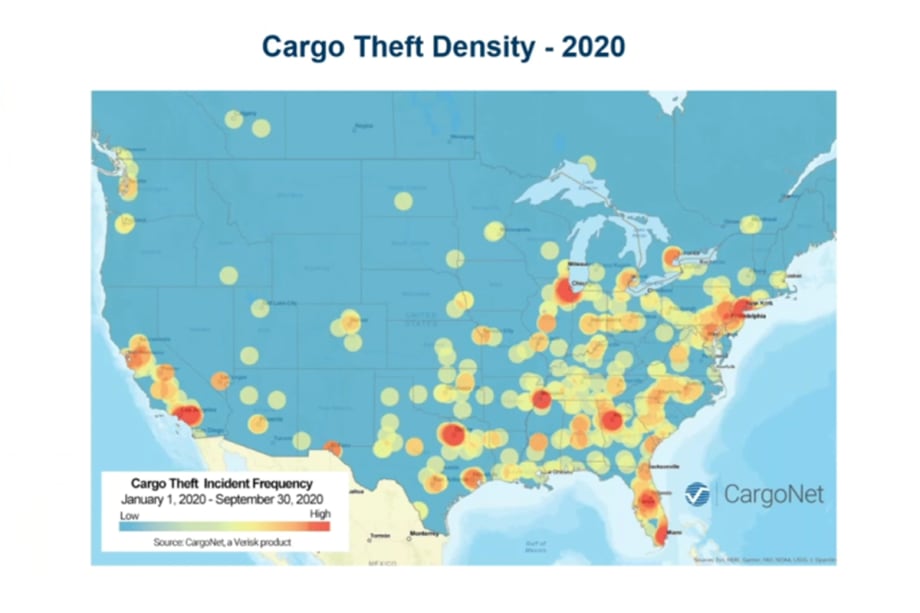
Source: CargoNet
North American cargo theft is on the rise this year, and the Covid-19 pandemic caused a spike in cargo crime in April.
April 2020 saw a 107% jump in cargo thefts compared to April 2019, according to CargoNet, which gave an update during its Cargo Theft and Transportation Summit Nov. 10.
There have been 1,080 reported thefts in the U.S. and Canada so far this year, up to Sept. 30.
“Most occurred within a five-month period,” said Keith Lewis, CargoNet’s vice-president of operations, referring to the height of the initial Covid outbreak in the Spring. Cargo thefts decreased in September, but Lewis anticipates another increase will come in November as holiday shipments ramp up.
Shannon Elliott, crime intelligence analyst with CargoNet, said weekends continue to see a higher rate of theft, as more shipments are left unattended. Most of those weekend thefts aren’t reported for several days, giving thieves a head start to move the stolen cargo and conceal their actions.
“There are a lot of fictitious pickups on Friday afternoons, when people are in a crunch to get their loads moved,” added Lewis.
Victims are getting better at reporting thefts more quickly, with 26% reporting them the same day and 60% within three days. After seven days, however, “the chances of getting the freight back or your trailer back in tact is very slim,” Lewis warned.
Cargo theft dominated reports, with 613 filed so far this year. Trailer theft rose 49% from 2019 and tractor theft also spiked 18%. Lewis advised fleets to have GPS installed not only on their power units, but also embedded within the cargo. Commodities targeted this year include food and beverage loads, which is typical, with household products on the rise. Elliott attributed this to the shortage of essential items such as toilet paper and paper towels earlier this year.
The average value per theft is $230,000 this year, up from $151,000 in 2019. Lewis attributed this to the increase in medical supplies being targeted.
Thieves have been targeting truck stops, especially for pilfering (stealing partial loads), where they can hit multiple trailers at a time. In one instance, Elliott said, six trailers were broken into in a single location. Thefts in parking lots are up 23% so far in 2020, often occurring while drivers wait to be unloaded.
California leads with 143 reported thefts so far this year, down from 194 in 2019 and 223 in 2020.
Fictitious pickups – where thieves use deception, sometimes including identify theft, to pick up loads – are on the rise. These thieves are focusing on metals such as copper, Elliott said. Law enforcement is unlikely to get involved in these thefts, viewing it as a civil matter since the load was handed over willingly.
The same is true for hostage loads, where a driver holds a load while demanding payment, sometimes stemming from a business dispute. Lewis recommended getting an unemotional third party to negotiate with the driver for the load’s return. When reporting a hostage load to law enforcement, “articulation is key,” warned Lewis, noting they won’t intervene if it’s viewed as a business dispute. “That first phone call to law enforcement is the most important phone call in getting a report filed.”
Another emerging trend carriers and drivers should be aware of, are violent thefts along the Illinois Tollway. A lack of safe parking has resulted in truckers parking wherever they can along this route, where they’re susceptible to thefts by criminals traveling in cargo vans looking for such opportunities. Lewis said there have been eight reported cases along this highway, typically trailer burglaries.
“Avoid parking at these tollways whenever possible,” Lewis warned. “If you see a crime in progress, stay in your vehicle, lock your doors and call 911. Assume they are heavily armed and prone to violence.”
The tollway is seen by thieves as a good place to perpetrate their crimes because of the abundance of parked trucks and easily accessed getaway routes.
Covid Increasing Theft, Violence
James McDonald, director of corporate security for Saia, acknowledged his company and others in trucking are dealing with increased risks due to the COVID-19 pandemic.
“During these trying times, we’ve seen folks have gotten more motivated and have definitely made more attempts not just in our normal challenging markets like Chicago, Memphis and Atlanta, but at smaller locations where we haven’t seen any risk factors in 20-plus years,” McDonald said.
Inside jobs are also occurring more frequently, as employees have struggled with reduced hours or time away from work due to COVID-19 exposure. Thieves have become more brazen, McDonald noted, stealing cargo off the dock. Saia uses live monitoring with video analytics and artificial intelligence to geofence its facilities.
“Trends have changed,” he said. “Employees are being more brazen just because of either their hours being cut or being out of work for a while. These are desperate times but the way our security department looks at it, theft is theft.”
He emphasized the need to educate staff, especially terminal managers, and reward them for reporting suspicious activity. He also encouraged networking with other carriers who are undoubtedly facing similar challenges. And the stress of the pandemic has created other security challenges as well.
“Employees are becoming more hostile,” McDonald added. “We are seeing more cases of workplace violence, internal thefts, and more potential for risk. What we tell employees is, if you see something, say something. If folks are becoming hostile you need to report it. We want to start down that path of quashing anything before the red flags start.”
In addition to the COVID-19 pandemic, natural disasters, civil unrest, and the election have all contributed to the unease of employees. But McDonald closed with this upbeat outlook: “Remember, out employees are resilient, America is resilient, we will come out stronger after this pandemic and craziness of 2020.
James Menzies is the editor of Today's Trucking, where this article originally appeared. This content was used with permission from Newcom Media as part of a cooperative editorial agreement.
More Fleet Management

Color Match Smarter: Tools That Restore & Perform
For fleet managers and collision repair professionals keeping heavy-duty trucks on the road, getting the color right the first time isn't just about appearance — it's about efficiency, turnaround time, and bottom-line results. Discover how today's digital color tools are transforming the repair process from guesswork to precision.
Read More →
FMCSA Pauses Biennial-Update Enforcement Amid Motus Transition
Carriers whose updates were due on or after June 1 have more time, while FMCSA works to stabilize its new registration system and warns of phishing sites impersonating its new carrier registration system, Motus.
Read More →
2026 Blueprint for Countering Smarter Supply Chain Theft
Cargo theft is no longer just the cost of doing business. It's a multi-billion-dollar criminal enterprise exploiting vulnerabilities across your fleet, drivers, and supply chain.
Read More →


How Telematics Improves Visibility, Control, and Performance in Refrigerated Fleets
Explore how telematics help refrigerated fleets improve visibility, uptime, efficiency, compliance, and cargo protection across connected cold chain operations.
Read More →
What the U.S.-Canada Trade War Means for Trucking
Escalating U.S.-Canada tariffs could disrupt cross-border freight, reduce truck volumes, raise costs, and create new uncertainty for carriers on both sides of the border.
Read More →
What Are Trucking’s Top Concerns for 2026?
The American Transportation Research Institute wants to know what's worrying trucking fleet managers, drivers, and other stakeholders in its annual Industry Issues survey.
Read More →
American Trucking Associations Looks for a New Leader
ATA President and CEO Chris Spear abruptly left his job at the association on August 21, at a pivotal time for the trucking industry.
Read More →
Public Wi-Fi Cybersecurity Risks: How Truck Drivers and Fleets Can Protect Their Data
Public Wi-Fi can expose truck drivers and fleets to credential theft, malware, and other cyber threats. Here’s how to reduce the risk on the road.
Read More →
For Nicky Cupp, Fleet Innovation Starts With Frustration
HDT Truck Fleet Innovator Nicky Cupp turns everyday pain points at Fraley & Schilling into opportunities for better technology and smarter processes.
Read More →
Adam Buttgenbach’s Approach to Electric Trucks: Start With Where They Fit
HDT Truck Fleet Innovator Adam Buttgenbach helped PepsiCo build one of North America’s largest EV fleets by focusing on where electric trucks make operational sense.
Read More →